
Population
About 262,000 on the city's own register at the end of 2025 and roughly 250,000 on the census-based official count — Germany publishes both and they do not agree; the surrounding StädteRegion holds about 563,000
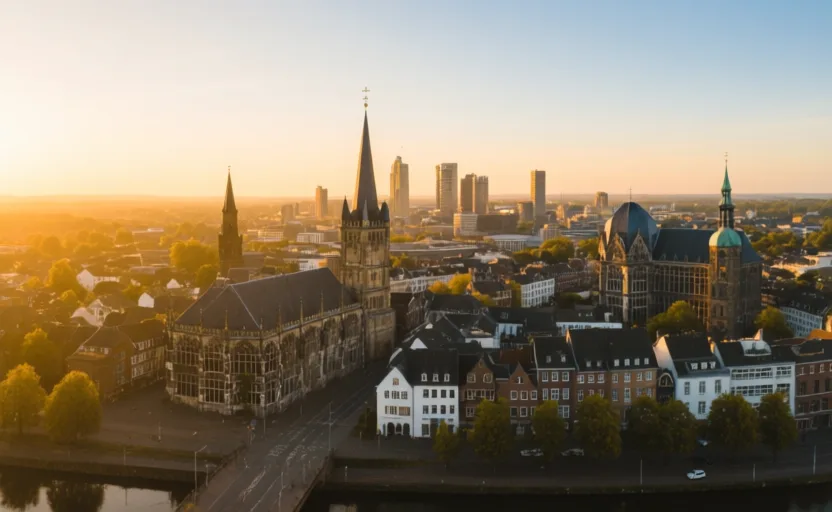 AI city illustration · Artistic impression
What people learn after moving
About 262,000 on the city's own register at the end of 2025 and roughly 250,000 on the census-based official count — Germany publishes both and they do not agree; the surrounding StädteRegion holds about 563,000
German, with Öcher Platt underneath it; English is the working language across much of RWTH, and Dutch and French are heard daily because the borders are minutes away
Euro (EUR) — and the same on both sides of both borders
CET (GMT+1); CEST (GMT+2) from late March to late October
AI city illustration · Artistic impressionCost of living in Aachen
Check your eligibility
Pick your passport to see entry rules and the long-stay routes we have researched.
Pick your passport to see whether you can enter Germany — and what it takes to stay.
Germany's sequence is rigid and identical everywhere: register your address within two weeks of moving in, which produces the confirmation needed for a tax ID, bank account, health insurance and residence permit. Aachen's local complication is that the second half of that sentence belongs to a different government. The StädteRegion Aachen — the city plus nine surrounding municipalities — runs the Ausländeramt, so the residence permit is a separate authority with a separate appointment. Newcomers routinely complete the Anmeldung, assume the process is running, and discover weeks later that nothing has been filed.
EU and EEA licences remain valid without action. Non-EU licences are valid for six months from taking up residence, after which you need a German licence — and whether tests are required depends on the issuing country and, for federal countries, the specific state or province. Aachen's twist is administrative rather than legal: the office is a tier of government up, at the StädteRegion. The geography adds its own layer, because a twenty-minute drive puts you under Dutch or Belgian traffic rules, with different speed limits, different rules on winter equipment and much heavier enforcement of low-emission zones in Belgian cities.
You need a German account for rent, insurance and the direct debits German life runs on. Traditional banks require an Anmeldung first, creating a sequencing problem; digital banks generally do not. Aachen adds a cross-border wrinkle: SEPA means a Dutch or Belgian employer must accept a German IBAN, but payroll systems and some smaller employers still push back, and knowing that refusal is unlawful under the SEPA Regulation saves an argument. The Schufa problem is federal, and here it competes with 44,000 students every September.
Germany requires everyone to hold health insurance. Employees below an annually-set income threshold must join the statutory system, where contributions are a percentage of income shared with the employer and dependants are covered free. Above the threshold, and for the self-employed, private cover becomes available — cheaper when young and healthy, considerably more expensive later, and very difficult to leave. Aachen's genuine complication is that a large share of residents work across a border, in which case EU Regulation 883/2004 assigns them to the work state's system and they access German care through an S1 registration with a German fund rather than as ordinary members. Getting this wrong means paying twice or being covered by neither.
Germany requires identity verification for every SIM including prepaid — passport or ID, verified in a shop, by video call or at a post office. Prepaid needs no Anmeldung or Schufa. Postpaid contracts run a Schufa check a newcomer will fail or pass marginally, so start prepaid and switch once you have a record. Aachen's own quirk is geographic: the western districts sit close enough to the Dutch and Belgian networks that phones roam across without being asked, and while EU roaming rules mean that is usually free, it is not always, and it confuses call routing and emergency location.
German income tax is progressive and deducted at source, with your tax class determining monthly withholding. Church tax adds 9% of your income tax liability in NRW if you declared a religious affiliation at Anmeldung. A solidarity surcharge applies to higher incomes. Aachen's genuine complexity is the border. Germany's treaties with Belgium and the Netherlands no longer contain a general frontier-worker rule — Belgium's was abolished from 1 January 2004 — so employment income is taxed where the work is physically done, and Germany exempts it while still counting it when setting your rate. Home-working days shift income back into German taxation one day at a time.
Each guide has verified costs, timelines, required documents, and the non-obvious gotchas — sourced from official government pages. Last verified August 2026.
Reading a list isn’t learning it. Globe Quest turns these into a trainer — hear each phrase spoken, drill them with spaced repetition, and get scored as you say them out loud.
This is the Aachen-specific process fact and it costs people weeks. The Anmeldung is done at the city's Bürgerservice within two weeks of moving in. The residence permit is not: the Ausländeramt is run by the StädteRegion Aachen, a separate authority covering the city and nine surrounding municipalities, with its own building, its own appointment system and its own backlog. The Führerscheinstelle sits with the StädteRegion's Straßenverkehrsamt too — the city's Bürgerservice can forward a replacement-licence application but cannot decide it. Book both separately and do not assume the first appointment starts the second.
Declaring membership of a recognised church at your Anmeldung triggers automatic deduction of church tax at 9% of your income tax liability in NRW — the standard rate in most German states, against 8% in Bavaria and Baden-Württemberg. Declaring no affiliation means no church tax. It is decided in a five-minute appointment most newcomers do not realise carries an annual cost, and leaving later needs a formal appointment and a fee.
Aachen has an official, free cross-border advice service — the GrenzInfoPunkt Aachen–Eurode, run through the Region Aachen Zweckverband and the StädteRegion, with offices in Aachen and at the Eurode Business Center on the Herzogenrath–Kerkrade line. It advises on German, Dutch and Belgian tax and social insurance, health and pension cover, child benefit and job search, by phone, online or in person, at no cost. Almost nobody arriving in Aachen knows it exists, and the questions it answers — where your income is taxed, which country insures you, what happens to your pension — are precisely the ones an employer's HR department will get wrong.
Live in Aachen and work in the Netherlands or Belgium and your employment income is generally taxed where you work, with Germany exempting it but counting it when setting the rate on everything else. Social insurance is decided separately, under EU coordination rules: you are normally insured where you work, unless you carry out a substantial part of your activity — the usual threshold is 25% — in your country of residence, which flips your entire social security to Germany. Since 1 July 2023 a Framework Agreement, which Germany, Belgium and the Netherlands have all signed, lets habitual cross-border teleworkers stay insured in the employer's state while working up to 50% from home. Two thresholds, two authorities, and days worked at your kitchen table count towards both.
The Mieterschutzverordnung that took effect on 1 March 2025 widened NRW's tenant protections from 18 municipalities to 57, and Aachen is the first name on the list. Inside those areas a new letting may not exceed the local comparative rent by more than 10%, increases during a tenancy are held to 15% over three years rather than 20%, and conversion to condominiums carries an eight-year rather than three-year block on own-use eviction. The rent cap runs to 31 December 2029 and the other two protections to 28 February 2030. What the ordinance cannot fix is the timing: RWTH had 44,382 students in winter semester 2025/26, 36% of them international, and the market is emptied every September.
Everyone resident in Germany must hold health insurance. Employees below an annually-set income threshold join the statutory system, where contributions are shared with the employer and dependants are covered free; above it private cover becomes available and is very hard to leave. For urgent but non-emergency problems, 116117 is the national medical on-call number. The poison information centre serving North Rhine-Westphalia is at the university hospital in Bonn on 0228 19240 — not in Aachen, despite Aachen having one of Europe's largest hospitals of its own.
RWTH Aachen University, FH Aachen, RWTH Aachen Campus, Fraunhofer ILT and IPT, DWI Leibniz Institute, Forschungszentrum Jülich nearby
RWTH is the largest employer in the city with around 13,000 staff and 44,382 students in winter semester 2025/26 — 36% of them international, from 141 countries, with China, India and Türkiye the largest groups. Mechanical engineering alone has more students than many German universities have in total.
Uniklinik RWTH Aachen, Luisenhospital, Marienhospital
The Uniklinik employs more than 9,000 people across some 300 job families, which makes it one of the largest single employers in the region and the reason a mid-sized city has tertiary care for a catchment reaching into Belgium and the Netherlands.
Grünenthal, Chemische Fabrik Budenheim's regional operations, the RWTH biotech spin-out sector
Grünenthal, headquartered in Aachen with around 5,500 staff worldwide, is the largest private company in the city and the anchor of a life-sciences cluster feeding off the university hospital and the chemistry faculties.
FEV Group, the RWTH Institute for Combustion Engines and its successors, the e-mobility spin-out scene
FEV runs its global headquarters here with roughly 4,700 staff worldwide, and the city's engineering-services sector exists because RWTH's powertrain institutes have spent decades spinning out consultancies. It is the reason Aachen absorbs mechanical engineers rather than exporting them.
Lambertz, Zentis, Lindt & Sprüngli's German operation
Henry Lambertz has made Printen in Aachen since 1688; Zentis employs around 1,150 people in the city; and Aachen is Lindt's largest German site. A surprisingly large slice of the local blue-collar labour market is in chocolate, jam and biscuits.
Freight and customs operators along the Rotterdam–Genoa corridor, cross-border healthcare and retail, the euregio labour market
Aachen sits on the busiest freight corridor in Europe and inside a labour market that straddles three national systems. The practical result is a steady demand for people who can work across German, Dutch and Belgian tax, customs and employment rules — a niche that barely exists anywhere else in Germany.
Landmark · Altstadt
Charlemagne's Palatine Chapel, consecrated around 800, later encased in a Gothic choir — and in 1978 one of the first twelve sites anywhere on the UNESCO World Heritage list, the first in Germany.
Local tip: The octagon is free to enter but the Kaiserthron and the treasury need a ticket and a timed slot — book the guided tour rather than wandering in, because the throne is upstairs and closed to unguided visitors. The Domschatzkammer next door is one of the most important church treasuries in Europe and takes twenty minutes.
Culture · Friedrich-Wilhelm-Platz
A neoclassical colonnade over two drinking fountains fed by Aachen's sulphurous thermal springs — the reason the Romans built here and the reason Charlemagne stayed.
Local tip: The water smells of rotten eggs and you are supposed to drink it anyway; it is free and locals do. The Carolus Thermen on the other side of the Stadtgarten is where the springs are actually enjoyable, and Burtscheid — a second, separate spring field a short walk south — is the quieter, older half of Aachen's spa story.
Nightlife · Between the Markt and the Ponttor
The student street: 500 metres of bars, kebab shops, cafés and cheap kitchens running from the town hall to a surviving 14th-century city gate.
Local tip: It is loud, cheap and reliably busy on a Tuesday, which is what having 44,000 students in a small city does. Walk to the Ponttor end for the medieval gate and the quieter bars; the stretch nearest the Markt is where every first-semester group starts and it shows.
Food · Büchel, Altstadt
A café in a 17th-century house that has been serving Aachen's Printen, Reisfladen and coffee for generations, in a warren of small wood-panelled rooms.
Local tip: Order the Reisfladen rather than the Printen — the rice tart is the genuinely local thing and nobody outside the region has heard of it. Then buy Kräuterprinten by weight from a proper bakery for taking home; the soft chocolate-coated ones in gift tins are not what people here eat.
Nature · Vaals, Netherlands — 20 minutes from the centre
The corner where Germany, Belgium and the Netherlands meet, on the highest point of the European Netherlands at 322 metres, with a maze and viewing tower on top.
Local tip: You can get there by city bus and be standing in three countries inside half an hour, which is the single best way to explain Aachen to a visitor. Go on a weekday — at weekends it is Dutch families and coach parties — and walk back down through the Aachener Wald rather than taking the bus both ways.
Nature · North of the Altstadt
A wooded hill immediately above the city centre, landscaped as a public park in the early 1800s under French administration, with the best view over Aachen from the top.
Local tip: It is one of the earliest public parks laid out in Germany and hardly anyone visiting the cathedral goes up it. Twenty minutes' climb from the Ponttor and the whole city, the cathedral, the Klinikum and the Belgian hills behind it lay out in front of you. Best in the hour before sunset.
Side-by-side cost of living, language, climate and careers — to help you choose.