
Population
~920,000 (city), ~2.5 million (metro)
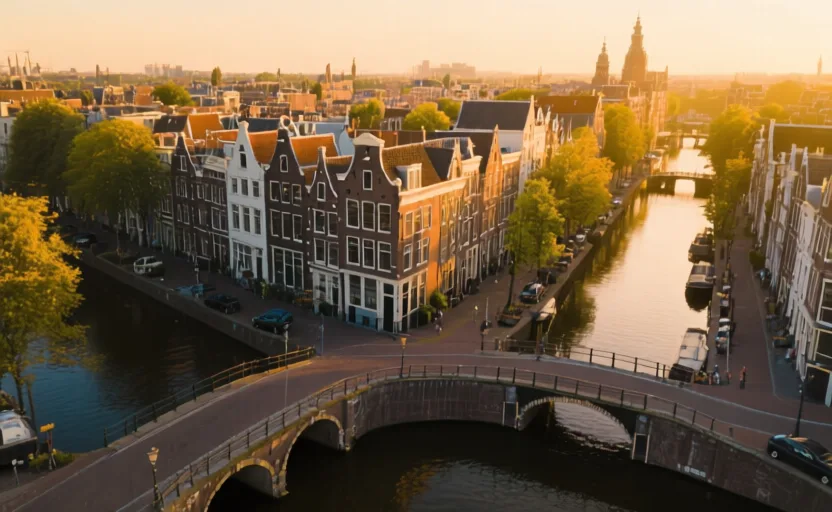 AI city illustration · Artistic impression
What people learn after moving
~920,000 (city), ~2.5 million (metro)
Dutch (English near-universal)
Euro (EUR)
Monday–Friday
AI city illustration · Artistic impressionCost of living in Amsterdam
Check your eligibility
Pick your passport to see entry rules and the long-stay routes we have researched.
Pick your passport to see whether you can enter Netherlands — and what it takes to stay.
Two very different paths converge on the same outcome. EU/EEA/Swiss citizens just register at the Amsterdam gemeente, get a BSN, and start working. Non-EU professionals need a residence permit before that, and the dominant route is the highly skilled migrant (kennismigrant) permit, which only an IND-recognised sponsor (your employer) can file against a fixed salary threshold. After arrival, everyone registers in the BRP (Personal Records Database) at the city to get a BSN, then activates DigiD, the national digital login. The BSN is the master key: no BSN, no salary, bank account, health insurance, or DigiD.
If your licence is from the EU/EEA you can swap it for a Dutch one with almost no friction. If it is non-EU, you can only exchange it freely when it comes from a government-'designated country' (aangewezen land) such as the UK, Japan, Singapore, South Korea, Taiwan or Israel — and even then often only for category B (car). From anywhere else you must pass the Dutch theory + practical exams at the CBR. The standout shortcut: anyone holding the 30% ruling (plus their partner and adult children at the same address) can exchange ANY valid foreign licence for a Dutch one without taking a single test, as long as the ruling is still active. You apply at the Amsterdam gemeente (which forwards it to the RDW), usually with a CBR health declaration, before your 185-day grace period runs out.
A full Dutch bank account legally needs your BSN (citizen service number), which you only get after registering with the gemeente. The work-around most newcomers use: open a Dutch-IBAN fintech account like bunq on day one and add your BSN within ~90 days, then optionally add a traditional bank (ING, ABN AMRO, Rabobank) once you have your BSN. Either way you'll lean on iDEAL and a debit card, not a credit card.
The Netherlands has no employer health plan and no free national health service at the point of need. By law you must buy your own private 'basisverzekering' (basic insurance) from a Dutch insurer within 4 months of becoming insured (your residence-permit / arrival date), and it backdates to that date so you pay from day one. You then register with a local huisarts (GP), who is the gatekeeper for almost all other care. Budget roughly €140-160/month plus a €385 annual 'eigen risico' deductible; lower earners can claw back up to ~€129/month via 'zorgtoeslag'.
Two routes. A prepaid SIM is the instant option: the Netherlands does NOT require SIM registration, so you walk into any KPN, Vodafone or Odido shop, supermarket (Albert Heijn, HEMA) or Schiphol kiosk, pay cash or card, and you're connected in minutes with just your passport. A monthly SIM-only contract (abonnement) is cheaper per GB but almost always needs a Dutch bank account/IBAN for direct debit (automatische incasso), and most ask for your BSN. Either way, every plan 'roams like home' across the EU at Dutch rates. Budget MVNOs (Simyo, Lebara, Simpel, Ben) are the cheap newcomer route.
If you work for a Dutch employer, you mostly pay income tax automatically: your employer withholds 'loonheffing' (wage tax plus social contributions) from every payslip, so many employees never owe a large bill. Employment income sits in 'Box 1' and is taxed on a progressive scale (around 35.75% / 37.56% / 49.50% in 2026, the lowest band being mostly social security). You still file an annual return ('aangifte') online with DigiD, usually 1 March-1 May. The headline perk for incoming talent is the 30% ruling: an employer-applied facility letting up to 30% of gross salary be paid tax-free for up to 5 years — but it's being cut (capped at the WNT norm since 2024, dropping to a flat 27% from 2027), so confirm the exact terms for your start date.
Each guide has verified costs, timelines, required documents, and the non-obvious gotchas — sourced from official government pages. Last verified June 2026.
Reading a list isn’t learning it. Globe Quest turns these into a trainer — hear each phrase spoken, drill them with spaced repetition, and get scored as you say them out loud.
Cyclists own Amsterdam and they will not stop for you. Never walk or stand in the red-paved bike lanes, look both ways twice, and remember bikes (and trams) generally have right of way over pedestrians.
The Dutch are famously blunt and value honesty over politeness. Direct feedback or a flat 'no' isn't rude — it's efficient and respectful. Say what you mean; they will.
Amsterdam is one of the most English-fluent cities on earth, so daily life is easy. A few Dutch words are still appreciated and genuinely help with bureaucracy and smaller towns.
The Netherlands runs on debit (Maestro/V-Pay) and iDEAL. Plenty of shops, markets and cafés are card-only or even refuse foreign credit cards, while others are cash-only — a Dutch debit card solves both.
Rentals are scarce, expensive and scam-prone. Start your search before you arrive, never pay before viewing and signing, and consider nearby towns (Haarlem, Amstelveen) if the centre defeats you.
Register at the gemeente to get your BSN (citizen number) and set up DigiD (the national login). These two gate work, banking, health insurance and basically all admin — make them your week-one mission.
Adyen, Booking.com, Mollie, Uber EMEA, Databricks
A leading European tech and fintech hub, with deep payments and SaaS scenes.
ABN AMRO, ING, Euronext Amsterdam
A historic financial centre and one of Europe's main stock exchanges.
Schiphol Airport, Port of Amsterdam, Flexport
A global gateway: one of the world's busiest airports and a major European port.
Netflix EMEA, gaming studios, ad agencies
A strong creative cluster across advertising, design, film and games.
Tesla, Uber, Netflix, Nike EMEA
A magnet for EU/EMEA headquarters, drawn by talent, English fluency and connectivity.
Amsterdam Science Park, food & agri innovators
Research-led life sciences plus the agritech edge of a top global food exporter.
Culture · Museum Quarter
Rembrandt, Vermeer and the Dutch Golden Age, on a square shared with the Van Gogh Museum.
Local tip: Book online and arrive at opening; Museumplein itself is a fine spot for a picnic between galleries.
Landmark · Centrum
The UNESCO-listed ring of 17th-century canals, gabled houses and arched bridges.
Local tip: See it from the water — a small rental boat or a quiet canal-side at dusk beats the packed tourist cruises.
Neighborhood · Jordaan
A charming maze of narrow streets, brown cafés, hofjes (courtyards) and markets.
Local tip: Saturday's Noordermarkt mixes organic food and antiques; duck into a brown café for a proper Dutch beer.
Nature · Oud-Zuid
The city's beloved green lung, full of picnics, joggers and open-air culture.
Local tip: On sunny weekends it's one big party; the open-air theatre runs free shows all summer.
Culture · Amsterdam-Noord
A former shipyard turned street-art, festival and food hub across the IJ.
Local tip: Take the free GVB ferry from behind Centraal — it's the creative Noord scene most tourists miss.
Food · De Pijp
The city's largest street market, in a lively, multicultural foodie neighbourhood.
Local tip: Get a fresh-pressed stroopwafel and try the raw herring; the surrounding bars are where locals go out.
Side-by-side cost of living, language, climate and careers — to help you choose.