
Population
~5.3 million urban, ~5.9 million province (2025)
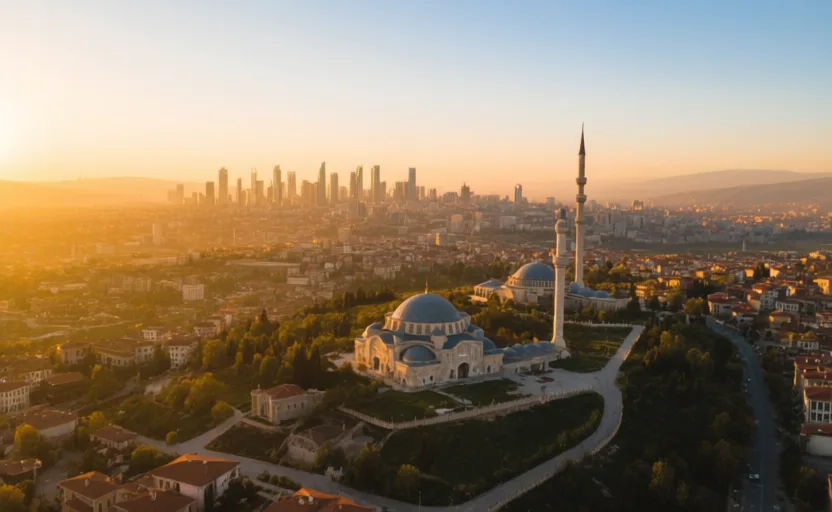 AI city illustration · Artistic impression
What people learn after moving
~5.3 million urban, ~5.9 million province (2025)
Turkish — English is much thinner here than in Istanbul, outside the universities and embassies
Turkish Lira (TRY, ₺) — high inflation; savings usually held in USD/EUR
TRT (GMT+3), no daylight saving
AI city illustration · Artistic impressionCost of living in Ankara
Check your eligibility
Pick your passport to see entry rules and the long-stay routes we have researched.
Pick your passport to see whether you can enter Turkey — and what it takes to stay.
Most Western nationals enter Türkiye visa-free for 90 days in any 180; anything longer requires a residence permit (ikamet izni), applied for online via e-İkamet and completed in person at the ANKARA İl Göç İdaresi Müdürlüğü. Ankara is meaningfully easier than Istanbul on one axis and harder on another. Easier: the 20% closed-mahalle rule bites far less here — the closures are concentrated in Altındağ rather than across the districts newcomers actually rent in. Harder: the file itself is scrutinised the same way everywhere, purely touristic applications are routinely refused, and there is less English at the counter. One local advantage is real and underrated: every foreign embassy in Türkiye is in Ankara, so the home-country documents your file needs — police certificates, apostilles, consular attestations — are a metro ride rather than a flight. On approval you receive a Yabancı Kimlik Numarası (YKN), an 11-digit ID starting with 99, which is the master key to a bank account, a tax number, a SIM, healthcare and e-Devlet.
Ankara's rail network is one spine, not a mesh. M1, M2 and M3 through-run as a single 46 km service from Koru in the southwest to OSB-Törekent in the northwest; M4 climbs north to Keçiören; Ankaray crosses east-west from AŞTİ coach station to Dikimevi; and everything meets at Kızılay. That is about 67 km of metro in total and it genuinely covers the western half of the city — but it barely touches Gaziosmanpaşa or eastern Çankaya, which is why Ankara, unlike Istanbul, is a city where owning a car is a reasonable decision. One card, the EGO transit card (long known as Ankarakart, now branded Başkentkart), covers metro, Ankaray, Başkentray suburban trains and every municipal bus. If you do drive: you may use your home licence for up to 6 months from entry with a notarised Turkish translation or an IDP, after which you exchange it for a Turkish sürücü belgesi — and most nationalities do so with no test at all.
The order matters more than the bank. First get a free Turkish tax number (vergi kimlik numarası) — online in minutes with just a passport, before you have any residency. Then open the account in person, typically with your passport, that tax number, proof of a Turkish address and a Turkish mobile number; since 2025-26 banks tightened KYC/AML and many branches now also want a residence permit or YKN, though this still varies branch to branch. Ankara has one structural quirk worth using: the three state banks — Ziraat, Halkbank and VakıfBank — are headquartered here, and their central Ankara branches deal with foreign diplomats, academics and posted staff constantly, so they are often more comfortable with an unusual file than a suburban branch elsewhere would be. Garanti BBVA and İş Bankası remain the usual private recommendations. Once you are in, the real skill is not holding idle lira.
In your first year you almost certainly rely on private health insurance: a compliant policy is mandatory to get and renew a residence permit, and basic plans are cheap by Western standards. If a Turkish employer hires you, SGK enrolment starts on day one; otherwise you can only opt into SGK voluntarily after a full year of legal residence. What is distinctive about Ankara is the supply. The city has an unusual concentration of reference medicine: Ankara Bilkent Şehir Hastanesi, opened in 2019 with roughly 3,700 beds, is one of the largest hospital campuses in the world and absorbed several older state hospitals; Hacettepe's İhsan Doğramacı children's hospital is the national paediatric reference centre; and Hacettepe, Ankara Üniversitesi (İbn-i Sina) and Gazi run major teaching hospitals. On the private side, Güven Hastanesi in Kavaklıdere is the long-standing diplomats' and expats' hospital, alongside Acıbadem, Medicana and Bayındır.
Local SIMs are cheap and coverage in Ankara is excellent, but the issue that actually costs people money is the handset rule, and it is national: a foreign phone's IMEI works on Turkish networks for only about 120 days from your entry, then is permanently blocked unless you pay a steep government registration fee — over 54,000 TL, about US$1,260, for 2026. Land connected with a data-only eSIM, but buy and install it BEFORE you fly, because BTK has blocked most foreign eSIM apps inside Türkiye since mid-2025. For a real Turkish number, buy a prepaid SIM at an official carrier store with your passport. Turkcell has the widest coverage and the highest prices; Vodafone and Türk Telekom are cheaper, and Türk Telekom is headquartered in Ankara with correspondingly strong fibre in the newer western districts.
Your vergi kimlik numarası is free, passport-only and obtainable online in minutes — it is the gateway to banking, property and utilities, and once you hold a residence permit your YKN doubles as it. The line that matters is residency: spend more than about 183 days in a calendar year, or establish a legal residence here, and Türkiye taxes your WORLDWIDE income, where non-residents are taxed only on Turkish-source income. Employees have tax withheld at source through payroll (stopaj) and usually never file. Freelancers open a sole proprietorship (şahıs şirketi), keep books through an accountant, charge and file VAT, and pay quarterly provisional tax. Ankara has one genuinely local wrinkle worth knowing: salaries for R&D, design and software personnel working inside a technology development zone — ODTÜ Teknokent, Bilkent Cyberpark, Hacettepe Teknokent — carry an income-tax exemption under Law No. 4691, which is why a teknokent offer can beat a nominally higher Istanbul salary.
Each guide has verified costs, timelines, required documents, and the non-obvious gotchas — sourced from official government pages. Last verified August 2026.
Reading a list isn’t learning it. Globe Quest turns these into a trainer — hear each phrase spoken, drill them with spaced repetition, and get scored as you say them out loud.
Every ministry, the Göç İdaresi headquarters, the NVİ, the GİB and roughly 130 foreign embassies sit inside Ankara. Errands that mean a flight and a hotel for someone in İzmir — a home-country police certificate, an apostille, a consular signature, a notarised translation the embassy will accept — are a metro ride here. Batch them into one week rather than making four separate trips.
The national rule still applies: any mahalle where foreigners exceed 20% of the population is closed to new residence-permit address registration, and a lease inside one sinks your ikamet. Ankara has far fewer closed neighbourhoods than Istanbul, and the concentration is in Altındağ rather than in the districts newcomers actually target. Confirm the exact mahalle against the current Göç İdaresi announcement anyway — the list moves.
Lira inflation is high enough that a rent quoted in TRY today is a different rent in real terms in six months. Keep savings in USD or EUR in a döviz sub-account and convert only what you're about to spend. Exchange offices (döviz) beat bank counters, and both beat Esenboğa airport by a wide margin.
At 938 m on the Anatolian steppe, Ankara gets snow that settles for weeks and nights well below freezing, while summers are hot but dry rather than muggy. Bring or buy proper boots and a coat, ask what a flat's heating is (doğalgaz kombi versus shared central heating changes your winter bill enormously), and check whether snow tyres are mandated by the valilik that season.
M1/M2/M3 through-run as a single 46 km line from Koru in the west to OSB-Törekent in the far northwest, M4 climbs to Keçiören, and Ankaray crosses from AŞTİ to Dikimevi. Everything meets at Kızılay. That covers a lot of the city and almost none of Gaziosmanpaşa or the eastern half of Çankaya — so unlike Istanbul, plenty of people here genuinely do drive, and traffic is bad but not Istanbul-bad.
Ankara is a working government and defence city, not a tourist one. Outside the universities, the embassy belt in Gaziosmanpaşa and the tech campuses, English gets thin fast. Learning numbers, 'anlamadım' and how to read a queue ticket buys you more here in a fortnight than it would in Istanbul in six months.
Every ministry, the Grand National Assembly, the central regulators
The single biggest employer in the city — the entire Turkish civil service is headquartered here, and it shapes rents, traffic and the working day.
ASELSAN, TUSAŞ/TAI, ROKETSAN, HAVELSAN, MKE
Türkiye's defence-industrial cluster is concentrated in Ankara — electronics, aircraft, missiles and simulation, mostly around Akyurt, Kahramankazan and the OSTİM belt.
ODTÜ Teknokent, Bilkent Cyberpark, Hacettepe Teknokent
Three university technology-development zones, where R&D and software salaries carry an income-tax exemption under Law No. 4691 — the main reason engineers stay in Ankara rather than moving to Istanbul.
ODTÜ (METU), Bilkent, Hacettepe, Ankara Üniversitesi, Gazi, TÜBİTAK
One of the densest concentrations of research universities in the region — ODTÜ and Bilkent both teach entirely in English, which is why so many academic arrivals land here.
~130 embassies, UN agencies, development banks
Every foreign mission in Türkiye is in Ankara (consulates are in Istanbul and İzmir), creating a steady international community concentrated in Gaziosmanpaşa and Çankaya.
OSTİM OSB, İvedik OSB, Sincan OSB
OSTİM alone hosts thousands of small and mid-sized engineering firms — machining, defence subcontracting, medical devices — and is the industrial counterweight to the ministries.
Landmark · Anıttepe, Çankaya
Atatürk's monumental mausoleum on its own hill — a colonnaded court, the Lion Road, and a museum of the War of Independence beneath it.
Local tip: Entry is free. Time your arrival for the hourly changing of the guard, and walk up the Lion Road rather than taking the vehicle entrance — the approach is the point.
Culture · Ulus, Altındağ
Hittite, Phrygian and Urartian collections housed in a restored 15th-century bedesten below the citadel — the best single explanation of Anatolia anywhere.
Local tip: Do it in the same morning as the castle above it; the two are a five-minute walk apart and the museum takes about ninety minutes.
Neighborhood · Altındağ (Ulus)
The old citadel walls with the whole city laid out below, and beneath them Hamamönü — a restored quarter of Ottoman timber houses, courtyards and craft workshops.
Local tip: Climb the castle late afternoon for the light, then drop into Hamamönü for a courtyard tea. Wear proper shoes: the castle lanes are steep, cobbled and genuinely uneven.
Neighborhood · Kavaklıdere, Çankaya
The swan park and the café-and-bookshop street running off it — the closest thing central Ankara has to a promenade, and the default place to arrange to meet someone.
Local tip: Tunalı is where the city actually socialises; walk south from Kuğulu towards Kavaklıdere for the older bars and north for the newer cafés.
Nature · Gölbaşı (managed by ODTÜ)
A long reed-fringed lake south of the city inside the METU campus land, with a flat loop road that Ankara runs, cycles and rows on at weekends.
Local tip: The standard Ankara Saturday: the loop on foot or by bike, then breakfast at one of the lakeside spots. Go early — the car park by the entrance fills by mid-morning.
Landmark · Çankaya
The 1989 observation tower on the highest ridge in the city, with a revolving restaurant on top and a big terraced park stepping down beside it.
Local tip: The view is best about an hour before sunset, when you can pick out Anıtkabir, the castle and the steppe behind the city in one sweep.
Side-by-side cost of living, language, climate and careers — to help you choose.