
Population
2,777,677 in the province (Göç İdaresi, 30 July 2026); roughly 1.5 million across the five central districts
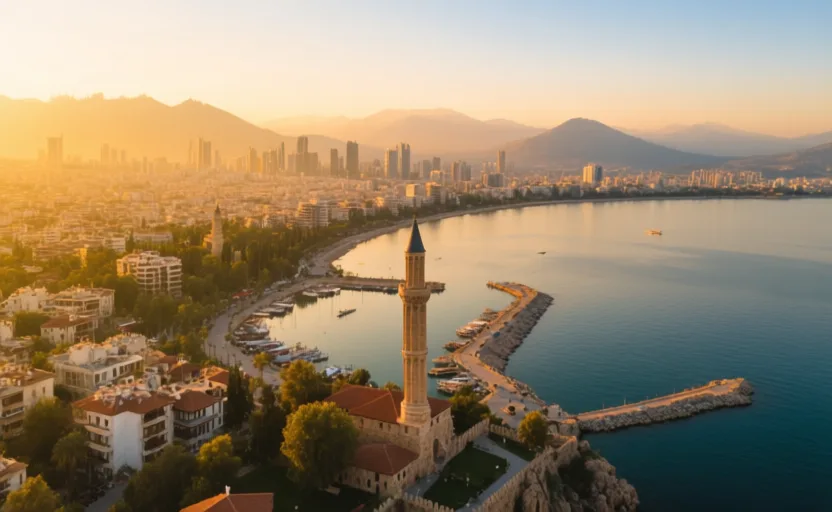 AI city illustration · Artistic impression
What people learn after moving
2,777,677 in the province (Göç İdaresi, 30 July 2026); roughly 1.5 million across the five central districts
Turkish — with Russian and German widely spoken; English is strong in tourism and thin outside it
Turkish Lira (TRY, ₺) — high inflation; savings usually held in USD/EUR
TRT (GMT+3), no daylight saving
AI city illustration · Artistic impressionCost of living in Antalya
Check your eligibility
Pick your passport to see entry rules and the long-stay routes we have researched.
Pick your passport to see whether you can enter Turkey — and what it takes to stay.
Most Western nationals enter Türkiye visa-free for 90 days in any 180; anything longer needs a residence permit (ikamet izni), applied for online through e-İkamet and completed in person at the Antalya İl Göç İdaresi Müdürlüğü — or, if you live along the coast, at its district offices in Alanya, Manavgat or Kemer, which matters because Alanya is 130 km from the provincial centre. Two things make Antalya different from the rest of Türkiye. First, scale: Göç İdaresi's figures for 30 July 2026 record 149,432 residence-permit holders in this province, second only to Istanbul, so every institution you deal with has done this a thousand times before. Second, the closed-mahalle rule bites in a very specific rather than a general way here — the official list names ten Antalya mahalles out of 1,162 nationally, but three of them (Liman, Hurma, Sarısu) are in Konyaaltı and one (Topçular) in Muratpaşa, which is to say in exactly the districts a newcomer looks at first. On approval you receive a Yabancı Kimlik Numarası (YKN), an 11-digit ID starting 99, which is the master key to a bank account, tax number, SIM, healthcare and e-Devlet.
One card runs the city: AntalyaKart covers the Antray light rail, the nostalgic tram along the old seafront and the municipal buses, with the dolmuş minibuses filling in everything the rails miss. The geography is the thing to understand. Antalya is a ribbon squeezed between the Taurus mountains and the sea, so the network runs east-west and almost nothing runs north-south; the Antray line links Kepez, the centre, the fairground and the airport, while Konyaaltı and Lara sit at opposite ends of the same long shore. Inside that ribbon you do not need a car. Outside it you do: Termessos, the yayla, Olympos, Side and the villages are effectively unreachable without one, and the D400 coast road that connects them is a long, beautiful, tiring drive with mountain sections. On licences, your home permit is valid for 6 months from entry with a notarised Turkish translation or an IDP, after which you exchange it — and most nationalities do so with no test at all.
The order matters more than the bank. First get a free Turkish tax number (vergi kimlik numarası) — online in minutes with just a passport, before you have any residency. Then open the account in person with your passport, that tax number, proof of a Turkish address and a Turkish mobile number; since 2025-26 banks tightened KYC/AML and many branches now also want a residence permit or YKN, which varies branch to branch rather than bank to bank. Antalya's advantage is volume: with 149,432 residence-permit holders in the province, branches in Konyaaltı, Lara and Alanya open foreigner accounts as ordinary daily business, frequently with Russian- or German-speaking staff, and property buyers arriving with a tapu are a familiar file rather than an awkward one. Garanti BBVA and İş Bankası are the usual general recommendations; DenizBank and state-owned Ziraat are the two most often reported as workable for owners who do not yet hold a permit. Once you are in, the real skill is not holding idle lira.
In your first year you almost certainly rely on private health insurance: a compliant policy is mandatory to get and renew a residence permit, and SGK does not count for the initial permit. If a Turkish employer hires you, SGK enrolment starts on your first working day; otherwise you can only opt into SGK voluntarily after a full year of legal residence. Antalya's public backbone is Akdeniz Üniversitesi's teaching hospital in Konyaaltı — the regional referral centre for the whole Mediterranean coast — alongside the Ministry of Health's Antalya Şehir Hastanesi and district state hospitals. The genuinely unusual thing here is the private sector: Antalya is one of the world's larger medical- and dental-tourism destinations, which means an ordinary resident can get a fast, English- or Russian-speaking private consultation for a fraction of Western prices, because the capacity was built for people flying in. The seasonal medical profile is its own subject: heat, jellyfish, road trauma on the D400, and wildfire smoke in bad summers.
Local SIMs are cheap and coverage along the coast is excellent, but the thing that actually costs people money is national: a foreign phone's IMEI works on Turkish networks for only about 120 days from your entry, then is permanently blocked unless you pay a steep government registration fee — over 54,000 TL, about US$1,260, for 2026. Land connected with a data-only eSIM bought and installed BEFORE you fly, because BTK has blocked most foreign eSIM apps inside Türkiye since mid-2025. For a real Turkish number, buy a prepaid SIM at an official carrier store with your passport — and specifically NOT at the airport, where Antalya's enormous tourist throughput supports a whole industry of overpriced arrival packages. The Antalya coverage question is about altitude and remoteness, not the city: the shore is uniformly good, the Taurus valleys and the yayla are not.
Your vergi kimlik numarası is free, passport-only and obtainable online in minutes, and once you hold a permit your YKN doubles as it. Beyond that, Antalya's tax life differs from the rest of Türkiye in one big way: a very large share of foreign residents here own property and let it, which turns a passive move into an annual filing obligation. Rental income from a Turkish property is Turkish-source and taxable whether or not you are a tax resident, and GİB's pre-filled Hazır Beyan system exists precisely for this. The residency line is the other thing to get right: spend more than about 183 days in a calendar year, or establish a legal residence here, and Türkiye taxes your WORLDWIDE income, where non-residents are taxed only on Turkish-source income. Employees have tax withheld through payroll (stopaj) and usually never file. Freelancers must open a sole proprietorship (şahıs şirketi) and file monthly VAT and quarterly provisional tax. R&D, design and software staff inside Antalya Teknokent carry an income-tax exemption under Law No. 4691, and the ASBAŞ free zone has its own regime.
Each guide has verified costs, timelines, required documents, and the non-obvious gotchas — sourced from official government pages. Last verified August 2026.
Reading a list isn’t learning it. Globe Quest turns these into a trainer — hear each phrase spoken, drill them with spaced repetition, and get scored as you say them out loud.
The national rule shuts any mahalle where foreigners exceed the threshold to new foreigner residence registration, and unlike Bursa or Istanbul the Antalya list is short enough to memorise. The Göç İdaresi spreadsheet names ten mahalles in the whole province: Liman, Hurma and Sarısu in Konyaaltı, Topçular in Muratpaşa, Kargıcak, Mahmutlar, Kestel and Avsallar in Alanya, and two industrial estates in Döşemealtı that nobody lives in. That is a narrow constraint aimed with unhappy precision — Konyaaltı is exactly the beach district a newcomer shortlists first. Check the current list before you sign, because it is republished as populations shift.
Lira inflation is high enough that a rent agreed in TRY is a different rent in real terms within months. Keep savings in USD or EUR in a döviz sub-account and convert only what you're about to spend. Central exchange offices (döviz) beat bank counters, and both comfortably beat anything inside the airport terminal.
Göç İdaresi's own figures for 30 July 2026 put 149,432 residence-permit holders in Antalya province — second to Istanbul's 599,798, and more than Ankara and Bursa combined. That cuts both ways. Estate agents, notaries, insurers, translators and hospital reception desks all handle foreigners as routine business, often in Russian or German. It also means you are quoted the foreigner price by default: check any rent, any fee and any 'special arrangement' against what a Turkish colleague pays.
Antalya runs one economy from April to October and a quieter, cheaper one from November to March. Many coastal landlords would rather take holiday rates for four months than a year's tenancy, so the twelve-month lease you need for an ikamet address is genuinely scarcer near the beach than the listings suggest. The local term for the off-season let is 'kışlık' — a winter rental, usually eight or nine months, which is exactly the length that does NOT cover a residence permit. Insist on a full-year written contract and check the dates before anything else.
Everyone arrives braced for the heat and is blindsided by the winter. MGM's 1930-2025 normals give Antalya 1,031 mm of rain a year, almost all of it between November and March, falling in short violent bursts rather than drizzle. Roads flood, the falez runs with water, and unheated flats built for summer are genuinely cold and damp in January, when the average low is 6.1°C. Ask what heating the flat has before you sign a winter lease, not after.
The Mediterranean pine forests behind the city burn most summers, and in late July 2021 the fires around Manavgat and Gündoğmuş became the worst in Turkish history, killing people and destroying whole villages inside this province. From June to September pay attention to burn bans, keep 112 and the forest-fire line 177 to hand, and if you take a house up in the Taurus, ask about the access road before you take the view.
The Lara, Belek, Side, Kemer and Alanya resort belts; Antalya Airport (AYT)
The single largest employer in the province by a distance, and the reason the airport handles more international summer traffic than most European capitals. Hospitality work here is seasonal by default — the year-round jobs are in management, revenue and sales.
The Kumluca, Demre, Serik and Aksu growing belt; the Antalya wholesale market
Türkiye's winter vegetable garden. Tomatoes, peppers and cucumbers under plastic along the coastal plain supply the domestic market and Russia through the winter, and citrus gave the city its Golden Orange.
Developers across Konyaaltı, Lara, Döşemealtı and the Alanya coast
Sustained by foreign buyers as much as domestic ones, and tightly coupled to the residence-permit and citizenship-by-investment rules — when the thresholds move, so does this industry.
Antalya Serbest Bölgesi (ASBAŞ), the Antalya OSB estates
The free zone next to the port hosts export manufacturers with real tax advantages, including a long-standing superyacht and marine-equipment cluster that has nothing to do with tourism.
Private hospital groups and dental clinics across Muratpaşa and Lara
One of the world's larger medical-tourism destinations, which has a useful side effect for residents: private care here is unusually cheap, unusually fast, and staffed by people who consult in English, German and Russian.
Antalya Teknokent (Akdeniz Üniversitesi), agri-tech and tourism software
Small next to Istanbul or Ankara and skewed toward agricultural technology and booking systems, but it carries the same Law No. 4691 income-tax exemption for R&D, design and software staff working inside the zone.
Landmark · Muratpaşa
The Roman-walled old town around the horseshoe harbour, entered through a three-arched marble gate built for the emperor Hadrian's visit in AD 130 and still the way in.
Local tip: Walk through the gate rather than photographing it — the original Roman road surface is preserved below, a couple of metres down, with the ruts worn by carts still in it. Then get lost in the lanes rather than following the harbour signs.
Nature · Konyaaltı
A continuous cliff-top park running for kilometres above the sea, with the Beydağları range rising to 2,300 m straight out of the water on the far side of the bay.
Local tip: Go at sunset in winter, when the mountains opposite are snow-capped and you are standing in 15°C. That contrast — snowline and shirtsleeves in one view — is the thing Antalya actually sells.
Culture · Konyaaltı
One of Türkiye's great archaeological museums, built around the sculpture halls from Perge — Roman emperors and dancing girls in marble, excavated 18 km east and displayed almost intact.
Local tip: Give it two hours and start with the Hall of Gods rather than working through chronologically. It is a short walk from the nostalgic tram terminus, so you can pair it with the cliff park.
Landmark · Güllük Dağı, ~35 km north-west
A Pisidian mountain city at 1,050 m that Alexander besieged and gave up on, now a ruined theatre and a hillside of smashed sarcophagi swallowed by pine forest inside a national park.
Local tip: It is a steep 30-40 minute climb from the car park and there is no shade — go early, take water, and go on a weekday. Almost nobody does, which is why it is the best ancient site in the province.
Food · Muratpaşa
The old commercial street behind the centre where the city eats lunch: şiş köfte off the grill with Antalya's tahini piyaz, pickles and a bowl of chickpeas, at counters that have run for decades.
Local tip: Order the köfte with piyaz rather than chips, and do it between noon and two. Several of these places sell out and shut in the afternoon, and the evening versions are aimed at visitors.
Neighborhood · Muratpaşa (east)
The eastern beachfront district of big blocks and hotels, ending where the Düden river reaches the edge of the falez and drops about 40 m off the cliff straight into the Mediterranean.
Local tip: See the lower falls from the water — the small boats from the old harbour get you under them, which the clifftop viewing park cannot. The upper falls, inland at Kepez, are a completely different and much greener place.
Side-by-side cost of living, language, climate and careers — to help you choose.