Population
462,241 in the city at the 2022 census; the surrounding Central department adds another 1,883,927, so metropolitan Asunción is roughly 2.3 million — a third of Paraguay
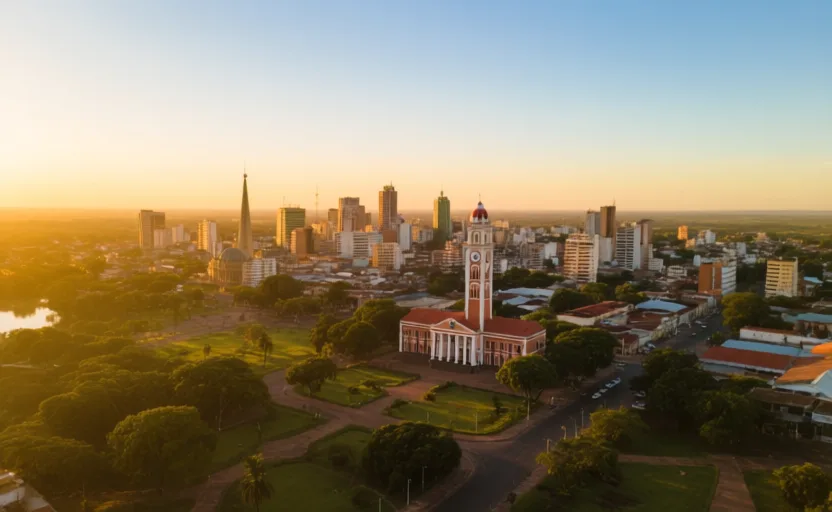 AI city illustration · Artistic impression
What people learn after moving
462,241 in the city at the 2022 census; the surrounding Central department adds another 1,883,927, so metropolitan Asunción is roughly 2.3 million — a third of Paraguay
Spanish and Guaraní, both official. Most people speak jopara, a fluid mix of the two; the 2002 census found Guaraní was the usual household language for 59% of the country
Paraguayan guaraní (PYG), around 5,949 to the US dollar in August 2026. Government fees are set in daily minimum wages, not guaraníes, so they reprice every July
GMT−4 in winter, GMT−3 in summer — Paraguay is one of the few South American countries that still observes daylight saving, so the gap to Europe and North America shifts twice a year
AI city illustration · Artistic impressionCost of living in Asunción
Check your eligibility
Pick your passport to see entry rules and the long-stay routes we have researched.
Pick your passport to see whether you can enter Paraguay — and what it takes to stay.
Paraguay's 2022 migration law made residence a two-stage process. You file for temporary residence — up to two years — with no financial test whatsoever, and convert to permanent at the end of it by proving economic solvency with documents rather than a deposit. Both stages cost Gs 2,926,925, both are filed in person at the Sede Central in Asunción, and both hand you a Paraguayan cédula.
Paraguay splits driving licences between a national rule-setter and municipal issuers. Asunción processes all of them on the ground floor of Bloque C at the Municipalidad, weekdays 08:00–15:00 and Saturday mornings, under Ordenanza N° 479/10. A first licence costs Gs 357,400 in itemised fees; a renewal Gs 239,400. You cannot hold two Paraguayan municipal licences at once.
The cédula is the gate. Paraguayan banks are conservative and document-driven, and a foreigner without residence will generally be offered nothing, or at most a non-resident product on much worse terms. Once you have the cédula the process is ordinary: proof of address, proof of income, a first deposit. Guaraní and US-dollar accounts are both routine and most people who earn abroad keep one of each.
The Ministerio de Salud Pública y Bienestar Social runs the free public network. IPS — the contributory social security institute — runs its own hospitals for registered employees and their dependants. Private prepaid plans (medicina prepaga) sit on top. Asunción is where the country's specialist capacity is concentrated: the Hospital de Trauma, the Instituto de Cardiología and the paediatric hospital are all here, and people travel from the whole country to use them.
Four mobile networks compete — Tigo, Personal, Claro and Vox, the last being the state operator Copaco's mobile arm. Prepaid is the default and coverage across metropolitan Asunción is good. Fixed internet is a mix of fibre from the mobile operators and Copaco's legacy network, and quality varies sharply street by street rather than barrio by barrio.
Paraguay taxes on a territorial basis and at low, flat-ish rates — that is the whole pitch, and it is the reason the country appears on every low-tax list. What matters practically for a newcomer is that a tax registration number (RUC) is not optional if you intend to invoice, and that DNIT tax documents are one of the ways Migraciones lets you prove economic solvency when you convert to permanent residence. Confirm current rates and bands with DNIT directly before relying on any figure.
Each guide has verified costs, timelines, required documents, and the non-obvious gotchas — sourced from official government pages. Last verified August 2026.
Reading a list isn’t learning it. Globe Quest turns these into a trainer — hear each phrase spoken, drill them with spaced repetition, and get scored as you say them out loud.
Every relocation agency page about Paraguay describes a one-step permanent residence bought with a deposit — the old SOLVE certificate. Under Ley N° 6984/2022 that is not how it works. You apply for TEMPORARY residence first, valid up to two years, and the Migraciones requirement list for it contains no financial test of any kind: identity, entry stamp, birth certificate, civil status, police and INTERPOL records, two sworn declarations. Economic solvency is only tested when you convert to permanent, and it is proved with documents — an IPS certificate, a stamped labour contract, tax returns, a pension statement, a registered title deed — under an annex of twelve categories, none of which is a deposit.
The change of category from temporary to permanent must be filed in the three months BEFORE the temporary carnet expires. One month after expiry you can still file, with the Art. 87 fine of Gs 702,462. Beyond that the permanent conversion is gone and all you can ask for is an extension, available up to six months past expiry, again with a fine. Put the date in your calendar the day the carnet is issued.
Migraciones publishes three columns per country: the bilateral agreement, the tourist visa, and — separately — the visa for extending a stay, residing, or carrying out gainful activity. For the United States, Germany, Spain and France the tourist column says NO REQUIERE VISA and the third column says REQUIERE VISA. The temporary residence requirement list asks for that consular visa, verified by the foreign ministry, 'where required'. Sort it out at a Paraguayan consulate before you fly. The US waiver is itself a dated instrument — Ley N° 7314 of 13 August 2024, expressed as valid until 13 August 2027.
Paraguay's Agencia Nacional de Tránsito y Seguridad Vial sets the requirements for every municipality, but the licence itself is issued by the municipality where you live. In Asunción that is the ground floor of Bloque C at the Municipalidad, weekdays 08:00–15:00 and Saturdays 07:30–11:00, under Ordenanza N° 479/10. A new licence costs Gs 357,400 all in and a renewal Gs 239,400. The catch nobody mentions: if you already hold a licence issued by another Paraguayan municipality you must cancel it and produce an OPACI cancellation certificate first. Two municipal licences at once is not a thing.
The Sede Central at Caballero 201 esquina Eligio Ayala opens to the public 07:00–14:30 on weekdays and works 'por orden de llegada' — no appointment system, you queue. Carnets are not collected there but at a separate office at Azara 304 esquina Iturbe. Investors under SUACE have their own counter at Tte. Bliloff, which opens until 15:00. Budget a morning, arrive at seven, and bring the certified copies — Migraciones will not return your originals without notarised copies to keep.
December to February regularly runs past 38 °C with high humidity off the Río Paraguay, and the city's low-rise sprawl holds heat late into the evening. Air conditioning is not a luxury here and the ANDE bill in January reflects it. The upside is a mild winter — the coldest months rarely need more than a jacket — and a genuine social rhythm built around it: the working day starts at seven, lunch is the main meal, and tereré exists precisely because of the heat.
The city proper had 462,241 people at the 2022 census; the surrounding Central department had 1,883,927. Most of the metro's professionals commute in from Luque, San Lorenzo, Fernando de la Mora, Lambaré or Capiatá, and since December 2025 the Viceministerio de Transporte's universal transfer scheme lets you combine buses within a 120-minute window at a discount or free, depending on the operator. Rent inside the city's four or five desirable barrios is a different market from anywhere else in the country; four kilometres out it is not.
Dirección Nacional de Migraciones, Policía Nacional, MTESS, MOPC, Ministerio de Salud Pública, Banco Central del Paraguay
Asunción is a capital in the fullest sense: the residence file, the cédula, the tax number, the company registration and the central bank are all physically here, which is why so much of the country's professional class is too.
Banco Continental, Itaú Paraguay, Ueno Bank, Sudameris, Banco Basa, Visión Banco, Banco Familiar
A compact, dollarised-at-the-edges banking sector supervised by the Banco Central del Paraguay, with a fast-growing digital layer. The guaraní's stability against the dollar — around 5,950 through 2026 — is a large part of why.
Cargill, ADM, Louis Dreyfus, Bunge, Copetrol, Puerto Villeta operators
Paraguay is one of the world's largest soy and beef exporters and the trading, financing and river-logistics arms sit in Asunción while the production sits in the east. The Paraguay–Paraná river barge convoy is among the biggest inland fleets anywhere.
Roshka, Possumus, Konecta, Tigo Business, Personal, regional back offices
A small but real export-services sector, helped by low costs, a young median age of 29 in the metro, and time-zone overlap with both North and South America. Salaries are low in dollar terms and that is precisely the pitch.
Barrail Hermanos, Tecnoedil, Grupo Raíces, Paseo La Galería developers
The Villa Morra–Aviadores del Chaco corridor has been rebuilding itself in towers for a decade, funded partly by agro money looking for a home. It is also the only part of Paraguay where high-rise construction is routine.
Aduanas, DNIT, freight forwarders, the Chaco'i and Villeta river terminals
Landlocked Paraguay moves almost everything by river to Montevideo and Buenos Aires, and the customs, brokerage and warehousing trade built around that is a major Asunción employer that outsiders never think of.
Nature · The riverfront north of the centre
The reclaimed Río Paraguay waterfront — a wide promenade, cycle lanes, the Costanera Norte beach and the best sunset in the city.
Local tip: Go on a Sunday evening when half of Asunción is out walking with a thermos and a guampa. The Municipalidad runs periodic 'activaciones' on the Costanera with food stalls and music; the stretch below the Palacio de López is the postcard, but the busier local scene is further north near the Chacarita end.
Food · Pettirossi, southeast of the microcentro
A vast, chaotic, entirely un-touristic market that spills across a dozen blocks — produce, herbs, meat, contraband electronics, and the best cheap food in the city.
Local tip: Come before nine for the herb stalls: the yuyeras sell the fresh medicinal herbs you crush into tereré, and they will tell you which ones are for the heat, the liver or the nerves. Keep your phone in your pocket and take cash in small notes.
Neighborhood · On the hill above the bay, west of the centre
Asunción's oldest neighbourhood, painted in saturated colours and turned into a walkable open-air museum without being emptied of its residents.
Local tip: It is a working neighbourhood that decided to paint itself, not a heritage project. Sunday lunch at one of the family kitchens — chipa guasu, sopa paraguaya, mbejú — is the point, and the view down over the bay from the top is free.
Landmark · Palma y Chile, the microcentro
The domed national mausoleum on Calle Palma, guarded around the clock, holding the remains of the marshals and the unknown soldiers of two catastrophic wars.
Local tip: Go at the changing of the guard, then walk Palma westward on a Sunday when it is closed to traffic and the street fills with stalls. The two wars in that building explain more about Paraguay's national character than any museum in the country.
Culture · Facing the Palacio de López
Nine restored colonial and nineteenth-century houses turned into a city museum, library and café, directly across from the presidential palace.
Local tip: Free, almost always empty, and the terrace of the Casa Viola café has the best framed view of the Palacio de López in the city — better than the one from the street, and with a coffee in your hand.
Nature · Santísima Trinidad, north-east of the centre
A 110-hectare park on the old López family estate — the largest green space in the city, with two colonial-era residences inside it.
Local tip: Most foreign residents never come this far out and it is where Asunceño families actually spend Sunday. The forest trails along the river side are genuinely cool in February, which is more than can be said for anywhere else in the city.
Side-by-side cost of living, language, climate and careers — to help you choose.