
Population
~660,000 (Athens municipality); ~3.6 million (Attica metro)
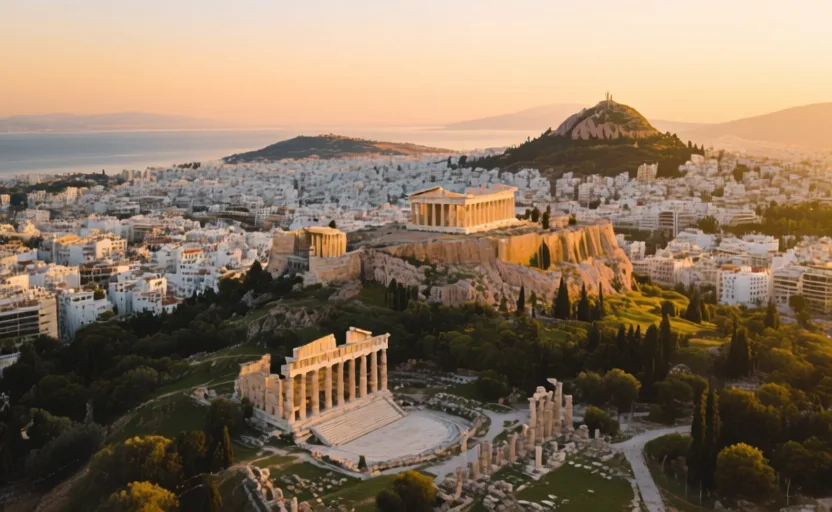 AI city illustration · Artistic impression
What people learn after moving
~660,000 (Athens municipality); ~3.6 million (Attica metro)
Greek (official, own alphabet); English widely spoken by the young and in tourism/business
Euro (EUR); Greece is in the Eurozone
Eastern European Time (GMT+2; GMT+3 in summer — observes EU daylight saving)
AI city illustration · Artistic impressionCost of living in Athens
Check your eligibility
Pick your passport to see entry rules and the long-stay routes we have researched.
Pick your passport to see whether you can enter Greece — and what it takes to stay.
Greece is in the Schengen area, so non-EU tourists get 90 days in any 180 visa-free — not enough to live on. EU/EEA/Swiss citizens just move, then register for a registration certificate after 90 days and pick up an AFM (tax number) and AMKA (social-security number). Non-EU nationals choose a route: the Digital Nomad Visa (remote workers, ~€3,500/month net), the FIP / Financially Independent Person visa (passive income, same ~€3,500/month bar), the Golden Visa (residence-by-investment, real-estate thresholds hiked to €800k in Athens since Sept 2024), or a sponsored work permit. Whichever route, get your AFM and AMKA early — without them you cannot rent, bank, work, or access healthcare. Most permits run through the Ministry of Migration & Asylum and issue a blue receipt (βεβαίωση κατάθεσης) that legalises your stay while the card is produced.
Most of Athens runs fine on the metro + the Ath.ena ticket — clean, cheap, and the airport sits on Line 3. Driving is optional and the licence rules are the real puzzle: EU licences just work; non-EU holders get 6 months, then must exchange (no test for a surprising list of countries, including the US, Canada and Australia).
In Greece the bank account is downstream of your AFM (ΑΦΜ tax number) — get that first and a Big Four account is often same-day to a few days. A Revolut GR IBAN covers you on arrival, but you'll still want a real Greek bank for salary, rent guarantees, and IRIS payments.
Greece has a universal public system (ESY), run through EOPYY/EFKA and unlocked by your AMKA social-security number — cheap and genuinely universal, but underfunded, slow, and largely Greek-speaking. Almost every expat pairs it with private insurance (~€400–1,200/yr) and uses Athens' excellent private hospitals. Here's how to get covered, what it costs, and the 2026 referral change nobody mentions.
Three networks blanket Athens with near-universal 4G and fast-expanding 5G: Cosmote (OTE/Deutsche Telekom, widest coverage and the best 5G), Vodafone Greece, and Nova (the merged Wind+Nova brand under United Group). Greek/EU law makes ID registration mandatory for every SIM, even prepaid — but a passport alone is enough for prepaid. A prepaid SIM with a generous monthly bundle (~€10–20) is the fast path for arrivals; it roams across the EU at no extra cost under 'Roam Like at Home'. A postpaid (συμβόλαιο) plan or home fibre is cheaper long-term but requires an AFM tax number, a Greek address, and usually a bank IBAN for direct debit.
Greece taxes residents on worldwide income at progressive rates (9% / 22% / 28% / 36% / 44%), with employees taxed by payroll withholding (παρακράτηση) and the self-employed paying advance tax (προκαταβολή) plus EFKA social contributions. You become a tax resident by spending 183+ days in Greece in a 12-month period. The annual E1 return is filed online via myAADE/TAXISnet in spring–summer (deadline usually late June–mid July, often extended). Three opt-in regimes make Greece attractive to newcomers: Art. 5C gives a 50% exemption on Greek-source employment/business income for 7 years; Art. 5A lets HNWIs pay a flat €100,000/year on all foreign income for up to 15 years; Art. 5B taxes foreign pensioners a flat 7% on foreign income for 15 years. A Greek accountant (λογιστής) is near-essential for the self-employed.
Each guide has verified costs, timelines, required documents, and the non-obvious gotchas — sourced from official government pages. Last verified 2026-06-29.
Reading a list isn’t learning it. Globe Quest turns these into a trainer — hear each phrase spoken, drill them with spaced repetition, and get scored as you say them out loud.
The AFM (tax number) and AMKA (social-security number) are the master keys to life in Greece: you can't sign a lease, open a bank account, get a postpaid SIM, start work, or access healthcare without them. The AFM is free at the local tax office (ΔΟΥ) or via gov.gr; the AMKA at a KEP citizen-service centre (non-EU need a residence permit first). Newcomers who flat-hunt before sorting these stall every other step. Do them first.
Greece offers three opt-in regimes for new tax residents. The standout for working people is Article 5C: move your tax residence to Greece, take up Greek employment or self-employment, haven't been Greek-resident 5 of the last 6 years, and commit to ≥2 years — and 50% of your Greek-source income is tax-free for 7 years. There's also a flat 7% on foreign income for foreign pensioners (15 years) and a €100,000/year non-dom lump sum for the wealthy. None is automatic and the deadlines differ: 5A and 5B applications go in by 31 March of the tax year, while 5C runs off when you start work — begin on or before 2 July and you apply by the end of that same year, begin later and you apply by the end of the following year.
The public system (ESY, via EOPYY/EFKA and your AMKA) is cheap and universal, but underfunded: long waits, crowded clinics, limited English. Almost every expat pairs it with a private policy (~€400-1,200/year) and uses Athens' excellent private hospitals — Hygeia, Metropolitan, Iaso, Errikos Dynan. Non-EU residents need private cover to get the residence permit in the first place, so budget for it from day one. Note: from April 2026 a registered personal doctor is the mandatory gate to public specialists.
A taverna dinner runs €12-20 a head, a gyros €3-4.50, and a freddo you can nurse all afternoon is €3-4. Rents, while rising fast (Golden-Visa and Airbnb pressure), are still well below Western Europe. Coffee culture is a competitive sport, the produce is superb, and the sea is a tram ride away. The trade-offs: bureaucracy is slow (embrace 'sigá sigá'), and much daily life still runs on cash plus the IRIS instant-payment app.
July-August bring 35°C+ heat and periodic heatwaves; the Acropolis even closes midday during extreme spells. Many Athenians decamp to the islands and villages in August, so some shops, clinics and services run reduced hours or shut entirely. Strikes (apergía) can pause transport with little notice. Spring and autumn are the city's sweet spots; a flat with good air-con and insulation is worth paying for.
Koukaki and Pangrati are the trendy, walkable nomad favourites near the centre; Kolonaki is upscale; Exarcheia is gritty-bohemian; the Riviera (Glyfada, Voula) trades the buzz for the sea. Many Athens flats are older polykatoikia apartments — check for a lift, heating type (autonomous vs central, which affects bills), insulation and air-con before signing. The metro reaches most central areas and the airport.
Greek shipowners (Angelicoussis, Tsakos, Star Bulk), the port of Piraeus (COSCO)
Greece controls one of the world's largest merchant fleets, and Piraeus is a global shipping hub. Maritime law, brokerage, management and finance cluster in and around Athens — a deep, internationally connected sector.
Major hotel groups, Aegean Airlines, a vast boutique-hotel and short-let scene
Tourism is a pillar of the Greek economy and booming post-pandemic. Athens' hospitality, F&B, guiding and short-let management offer abundant work — and a common entry point for foreign residents.
Workable, Blueground, Persado, Beat (legacy), Hellas Direct, Plum
Athens' startup scene has matured fast, with strong SaaS, fintech and proptech players and a growing VC presence. Lower costs plus the 50% tax break are pulling founders and engineers — an English-friendly, fast-growing ecosystem.
Public Power Corp (PPC/ΔΕΗ), Mytilineos/Metlen, TERNA Energy, HELLENiQ
Greece is investing heavily in solar and wind, grid interconnections and gas transit. The energy transition and the country's role as a Southeast-European energy hub drive engineering, project-finance and trading roles.
LAMDA (Hellinikon mega-project), Dimand, Golden-Visa developers
A construction and redevelopment boom — led by the giant Hellinikon coastal project and Golden-Visa-fuelled property demand — keeps real estate, architecture and construction unusually active for the region.
Olive-oil and wine producers, food exporters, a thriving specialty F&B scene
Olive oil, wine, honey and Mediterranean produce anchor a strong agri-food export sector, while Athens' modern-Greek culinary scene fuels restaurants, food-tech and artisanal production.
Landmark · Acropolis / Plaka
The 2,500-year-old sacred rock crowning the city — the Parthenon, the Erechtheion and the Propylaea, the defining image of Western antiquity.
Local tip: Enter at opening (08:00) or in the last two hours before closing to dodge crowds and the worst heat; in a midday heatwave it can close 12:00-17:00. Buy the timed e-ticket online, and pair it with the superb Acropolis Museum at the foot of the hill.
Neighborhood · Plaka
The old town beneath the Acropolis — neoclassical lanes, bougainvillea, and Anafiotika, a tiny whitewashed Cycladic-island village improbably tucked into the hillside.
Local tip: Wander Anafiotika's car-free alleys early morning for the island-in-the-city feel before the tour groups. Plaka's edges hide good tavernas; the streets nearest the metro are the touristy ones — go a block deeper.
Food · Monastiraki / Athinas St
The buzzing flea-market square and, up Athinas Street, the cavernous Varvakios meat-and-fish market flanked by spice and deli stalls — the city's raw, delicious heart.
Local tip: Eat a late lunch at one of the market's old mageiría (cook-houses) among the butchers, then browse the Sunday flea market at Avissinias Square for antiques. The rooftop bars around Monastiraki frame the Acropolis at sunset.
Nature · Kolonaki
The pine-covered peak that's the highest point in central Athens, with a little chapel up top and a 360° panorama from the Acropolis to the sea.
Local tip: Walk up through Kolonaki for the exercise or take the funicular from the top of the neighbourhood. Go at sunset for the city turning gold then glittering — but bring water; the climb is steep in summer.
Culture · Koukaki
The walkable, leafy district just south of the Acropolis — repeatedly rated one of the world's coolest neighbourhoods, full of cafés, wine bars and the world-class Acropolis Museum.
Local tip: Base yourself here as a newcomer: it's central, calm and packed with brunch spots and natural-wine bars. The pedestrianised Dionysiou Areopagitou promenade links it to Plaka and Thissio for a car-free Acropolis-side stroll.
Nature · Saronic coast (tram / day trip)
The coastline running south from the city — Glyfada's beaches and marinas, the Vouliagmeni thermal lake, and at the tip, the cliff-top Temple of Poseidon at Sounion.
Local tip: Take the tram to Glyfada for an after-work swim, or drive/bus the coast road to Cape Sounion for sunset behind the Temple of Poseidon — one of the great views in Greece. Vouliagmeni's lake is a warm year-round swim.
Side-by-side cost of living, language, climate and careers — to help you choose.