Population
~2.3 million (greater Baku); ~10 million (Azerbaijan)
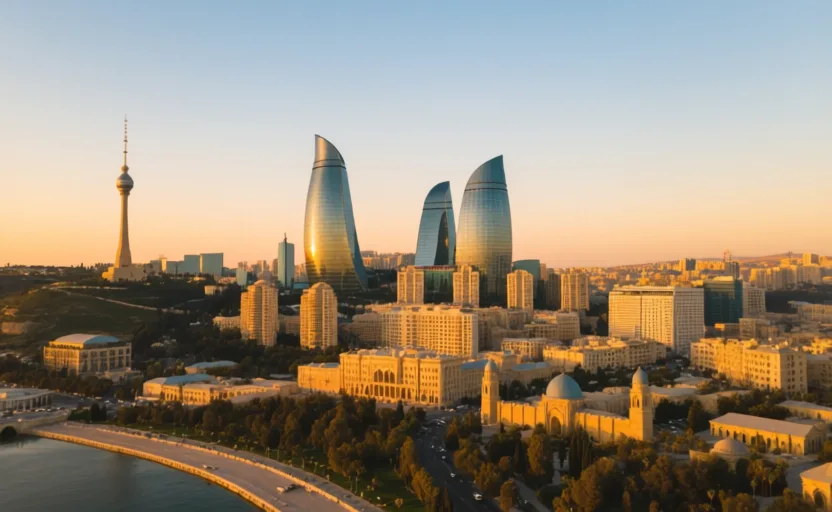 AI city illustration · Artistic impression
What people learn after moving
~2.3 million (greater Baku); ~10 million (Azerbaijan)
Azerbaijani (Turkic, Latin script); Russian widely spoken; English in the energy sector
Azerbaijani manat (AZN); pegged around AZN 1.70 = US$1
GMT+4, no daylight saving
AI city illustration · Artistic impressionCost of living in Baku
Check your eligibility
Pick your passport to see entry rules and the long-stay routes we have researched.
Pick your passport to see whether you can enter Azerbaijan — and what it takes to stay.
Azerbaijan is the most controlled immigration system in the region. Short visits run on the ASAN Visa e-visa or visa-free arrangements; anything longer needs a work permit obtained by an employer inside a national quota, with the temporary residence permit following it. Registration at place of stay within 15 days is compulsory and is where most people first go wrong. There is no digital nomad visa in force.
Azerbaijan drives on the RIGHT. Baku's metro is clean, deep and cheap at AZN 0.60 a ride since October 2025, paid with a BakıKart. Bolt is the main ride-hailing app and fares are low; Uber and Yandex Go do not operate here. Driving in Baku itself is assertive and parking is scarce, and once you are resident you should expect to convert your licence rather than run indefinitely on a foreign one.
Azerbaijani banking is more gated than its neighbours': the practical route to a full account runs through a residence permit and a local tax identification number, and non-residents are handled case by case rather than as a matter of course. Kapital Bank, PASHA Bank, International Bank of Azerbaijan and Unibank are the main options; the m10 wallet handles daily payments and transport top-ups.
Azerbaijan runs a compulsory medical insurance system (İcbari Tibbi Sığorta) funded through payroll contributions, which covers employees within a defined package. Foreign residents on local contracts are generally inside it; everyone else uses private clinics and private cover. Baku holds essentially all of the country's advanced hospital capacity, and the energy sector's presence means there is a well-developed private tier used to expatriate patients.
Three operators — Azercell, Bakcell and Nar — sell SIMs cheaply with mandatory passport registration. Azerbaijan also operates IMEI device registration, and a foreign handset used with a local SIM must be registered or it stops working. Data is reasonably priced and coverage in Baku is strong; fixed broadband is widely available and usually already installed in furnished flats.
The headline change is that Azerbaijan's seven-year personal income tax exemption for non-oil private-sector employees ended on 1 January 2026. The 2026 schedule for that sector is 3% up to AZN 2,500 a month, AZN 75 plus 10% from AZN 2,500 to AZN 8,000, and AZN 625 plus 14% above AZN 8,000 — with the first-band rate rising to 5% in 2027 and 7% from 2028. Oil-and-gas and state-sector employees sit on a separate, long-standing 14%/25% schedule.
Each guide has verified costs, timelines, required documents, and the non-obvious gotchas — sourced from official government pages. Last verified August 2026.
Reading a list isn’t learning it. Globe Quest turns these into a trainer — hear each phrase spoken, drill them with spaced repetition, and get scored as you say them out loud.
Any foreigner staying in Azerbaijan more than 15 days must register their place of stay, and the application must be in within 15 days of arrival. The legal duty sits on the HOST PARTY — the hotel, the landlord or the inviting company — which is why hotels do it silently and why people who move from a hotel into a rented flat get caught: the clock restarts and the landlord may not know it is their obligation. File it yourself through the State Migration Service e-services or at an ASAN centre. If you change address, re-register within five working days. Kazakh citizens get 30 days rather than 15; do not generalise from a colleague's deadline.
Unlike Georgia or Armenia, where you can build a residence basis yourself, Azerbaijan's mainstream route requires an employer. The company advertises the vacancy through the State Employment Agency, waits out the labour-market test, obtains a work permit from the State Migration Service naming you and the position, and only then can you apply for the temporary residence permit. The permit belongs to the employer and the job. Changing employers means starting again, and losing the job puts your residence status in question, not just your salary.
From 2019 to 2025, employees in the non-oil, non-state private sector paid NO personal income tax on monthly income up to AZN 8,000. That seven-year exemption expired and was not renewed. From 1 January 2026 the schedule is 3% on monthly income up to AZN 2,500, AZN 75 plus 10% on the slice from AZN 2,500 to AZN 8,000, and AZN 625 plus 14% above AZN 8,000 — with the first-band rate legislated to rise to 5% in 2027 and 7% from 2028. Any salary comparison based on the old exemption overstates your net pay.
'Digital Nomad Visa' and 'Digital Talent Visa' appear in the government's Action Plan for 2026-2028 on accelerating digital development — as things to be implemented, not as instruments in force. Sites advertising an 'Azerbaijan freelance visa' are describing the ordinary tourist e-visa with a marketing label attached. Working remotely for a foreign employer on a tourist visa is not a status Azerbaijani law recognises either way, which is a risk to weigh rather than a permission to rely on.
There is no land crossing between Azerbaijan and Armenia and no diplomatic relations between the two states. Any Caucasus itinerary taking in both Baku and Yerevan has to route through Georgia. Historically an Armenian entry stamp has caused difficulty at Azerbaijani entry; check the current position before you fly rather than at the airport. State this neutrally to yourself as a logistics fact, and avoid making it a topic of conversation with people you have just met.
Baku is the lowest-lying national capital in the world at about 28 m below sea level, sitting on the exposed Absheron peninsula. The name is popularly glossed as 'city of winds' and the northerly khazri can be genuinely violent — it strips heat out of a mild winter day and makes the seafront unwalkable. Summers are hot and humid rather than dry. Factor wind exposure into which side of a building you rent, not just the view.
SOCAR, BP Azerbaijan, Equinor, TotalEnergies, Lukoil
The gravitational centre of the whole economy. BP has operated the Azeri-Chirag-Gunashli field and the BTC pipeline for decades, and the expatriate professional community is largely built around it.
Schlumberger, Halliburton, Baker Hughes, Wood, local EPC contractors
The service layer around the fields — engineering, subsea, inspection and logistics. Most technical expatriate hiring in Baku sits here rather than with the operators.
International Bank of Azerbaijan, Kapital Bank, PASHA Bank, Unibank
A concentrated sector with a few dominant groups; digital banking has moved fast and m10 and Kapital's ecosystem handle a lot of daily payments.
PASHA Construction, Gilan, large state-linked developers
Baku has been rebuilt relentlessly for two decades. The Flame Towers and the White City redevelopment are the visible end; the sector is a major employer and a major driver of central rents.
Azerbaijan Railways, Baku International Sea Trade Port, Silk Way West Airlines
The Alat port and the Middle Corridor make Azerbaijan a transit state between Central Asia and Europe — a growth area independent of hydrocarbons.
International hotel groups, Old City operators, Formula 1 and event tourism
The Baku City Circuit brings a Formula 1 weekend through the Old City streets each year, and Gulf and regional tourism has grown steadily.
Landmark · Central Baku
The UNESCO-listed medieval core inside its walls — the Maiden Tower, the Shirvanshahs' Palace, caravanserais and narrow lanes, ringed by twenty-first-century towers.
Local tip: Go early morning before the tour groups. The contrast that makes Baku legible is best seen from the Maiden Tower roof: medieval stone in the foreground, glass towers behind, Caspian oil rigs on the horizon.
Nature · Caspian seafront
A seafront promenade running for kilometres along the bay — the city's outdoor living room, busiest on summer evenings.
Local tip: The Little Venice canals and the funicular up to Highland Park are on the same walk. Watch the wind: on a khazri day the boulevard is genuinely unpleasant and everyone is indoors instead.
Culture · Heydar Aliyev Avenue
Zaha Hadid's white wave of a building, one of the most photographed structures in the Caucasus, housing exhibition halls and a classic-car collection.
Local tip: The interior is worth the ticket for the architecture alone. Go on a bright day — the building is designed around light on the curved shell.
Food · Nasimi
The city's main produce market — Caspian fish, pomegranates, walnuts, saffron, cheeses and the best cheap eating in Baku.
Local tip: Buy saffron here rather than in the Old City tourist stalls, and taste before you buy — vendors expect it. Cash or a local card; bargaining is normal and good-natured.
Nature · ~60 km south-west
A UNESCO rock-art site with thousands of petroglyphs up to 40,000 years old, and a landscape of bubbling mud volcanoes on the plain below.
Local tip: The mud volcanoes need a high-clearance vehicle over the last stretch; local drivers wait at the site turn-off. Do both in one half-day, and go on a dry day — the track becomes impassable after rain.
Neighborhood · Central Baku
The pedestrianised shopping spine and the square it feeds into — nineteenth-century oil-boom facades, cafés and the city's main promenading ground.
Local tip: The side streets north of Nizami hold the better independent restaurants; the square itself is priced for visitors. The oil-boom mansions here were built by the same 1900s wealth that funded the Nobel brothers' operations.
Side-by-side cost of living, language, climate and careers — to help you choose.