
Population
~10.7 million (metro)
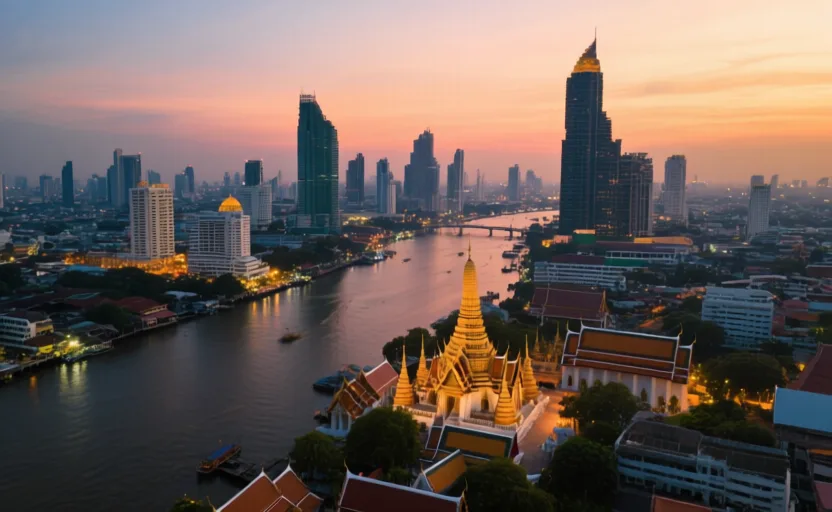 AI city illustration · Artistic impression
What people learn after moving
~10.7 million (metro)
Thai (English in business/tourism)
Thai Baht (THB / ฿)
Monday–Friday
AI city illustration · Artistic impressionCost of living in Bangkok
Check your eligibility
Pick your passport to see entry rules and the long-stay routes we have researched.
Pick your passport to see whether you can enter Thailand — and what it takes to stay.
Working legally in Bangkok means stacking three things: a Non-B visa, a work permit (sponsored by your employer), and ongoing reporting (TM30 + 90-day). They interlock, and the TM30 is the piece that trips almost everyone up. Here's how they fit together.
Converting a foreign licence at the Department of Land Transport (DLT) is usually a one-day job and you skip the road test — but only if your paperwork is perfect. The residence certificate and a same-month medical certificate are what people get wrong. Here's the real checklist.
On paper Thai banks ask for a work permit or a long-stay visa plus, increasingly, a certificate of residence. In practice the single biggest variable is which branch you walk into — two branches of the same bank can give you opposite answers on the same day. Here's what actually works.
Healthcare in Bangkok runs on two tiers. If you are employed on a work permit you are enrolled in Social Security (SSO), which ties you to one registered hospital. Almost everyone still buys private insurance, because the city's flagship private hospitals — Bumrungrad, Samitivej, BNH — are world-class but expensive. Here's how the pieces fit.
Thailand runs on three networks — AIS, True and dtac — with cheap, fast data and good Bangkok coverage. The catch is registration: by NBTC rule every SIM must be tied to its holder's identity, so you register in person with your original passport, and operators have rolled out facial-recognition (liveness) checks. eSIM is the way to skip the counter friction. Here is how to get connected.
Thai personal income tax is progressive, from 0% up to 35%. You become a tax resident at 180 days in a calendar year, your employer withholds tax monthly, and you file an annual return (PND.90/91) by end of March. The headline shift expats must understand: since 1 January 2024, foreign-sourced income you remit into Thailand as a tax resident can be taxable — a real break from the old practice. Here is the shape of it.
Each guide has verified costs, timelines, required documents, and the non-obvious gotchas — sourced from official government pages. Last verified June 2026.
Reading a list isn’t learning it. Globe Quest turns these into a trainer — hear each phrase spoken, drill them with spaced repetition, and get scored as you say them out loud.
Thailand has strict lese-majeste laws (Section 112): insulting the King, Queen, heir, or regent is a serious crime with prison sentences. Don't joke about, criticise, or deface images of the royal family — including on banknotes and coins, which bear the King's image. Stand still during the royal anthem in cinemas.
The wai (palms pressed together, slight bow) is the Thai greeting and sign of respect. Generally let the more senior person initiate, and return it with hands at chest-to-nose height. Don't wai children, waitstaff, or shopkeepers — a smile and nod is fine there.
Never touch anyone's head, even a child's. Don't point your feet at people, Buddha images, or photos of the King, and don't step over someone. Point with your whole hand, not a finger, and remove or tuck your feet when sitting near a shrine.
Remove your shoes before entering homes, temples, many guesthouses, some shops, and even certain offices and clinics. Watch for a pile of shoes at the door — that's your cue. Slip-on shoes make life much easier.
Losing your temper, raising your voice, or shouting in public makes you 'lose face' and is seen as deeply embarrassing in Thailand. The cultural ideal is jai yen (a cool heart). Stay calm and smiling even when frustrated — you'll get far better results.
At temples (wat) such as Wat Pho or the Grand Palace, cover shoulders and knees — no shorts, short skirts, or sleeveless tops. Sarongs are sometimes rented at the gate. Women must never touch a monk or hand anything directly to one.
Minor International, Centara, Dusit Thani
Bangkok is one of the world's most-visited cities; hospitality is a huge employer.
Toyota, Honda, Mitsubishi, BYD
The 'Detroit of Asia' — a major regional auto and EV production hub.
LINE MAN Wongnai, Ascend Money, Bitkit
Growing startup scene in fintech, e-commerce, and delivery; strong digital-nomad community.
Bangkok Bank, SCB, Kasikornbank (KBank)
Sathorn and Silom form Bangkok's financial district; fast-digitising banks.
WHA Group, Kerry Express, SCG Logistics
A Southeast Asian gateway linking China, the Mekong region, and ASEAN markets.
CP Group (Charoen Pokphand), Thai Union, Betagro
Thailand is a global food exporter; agritech and food processing are key sectors.
Neighborhood · Sukhumvit (Watthana)
Bangkok's trendiest district — craft coffee, izakayas, design hotels, and the city's best nightlife.
Local tip: This is where many young professionals and nomads settle; explore the sois (side streets) off the main road for the real gems.
Food · Chatuchak
An immaculate fresh market famed for premium fruit, prepared Thai dishes, and seafood — far calmer than the tourist markets.
Local tip: Go hungry and graze the ready-to-eat stalls; it's right by Chatuchak Weekend Market and the MRT.
Nature · Pathum Wan / Silom
Bangkok's central green lung — jogging paths, lakes, monitor lizards, and free outdoor aerobics at dusk.
Local tip: Locals come at dawn and after 5pm to dodge the heat; join the free open-air dance-aerobics sessions for a very Bangkok experience.
Food · Samphanthawong
One of the world's great street-food destinations, blazing with neon and woks after dark.
Local tip: Come after 7pm when the street stalls open; Soi Texas and the side lanes off Yaowarat Road are where to eat.
Culture · Phra Nakhon (Old City)
Home of the giant Reclining Buddha and the birthplace of traditional Thai massage.
Local tip: Get a proper Thai massage at the on-site school — cheaper and more authentic than tourist spas, and a calm break from the heat.
Nightlife · Sathorn
Sky-high rooftop bars (Vertigo at Banyan Tree, Sky Bar at Lebua) with jaw-dropping skyline views.
Local tip: Mind the smart-casual dress code (no shorts/sandals), arrive for sunset, and expect tourist-level prices for the view.
Side-by-side cost of living, language, climate and careers — to help you choose.