
Population
≈1.28 million in the district on DANE's 2026 projection; about 2.3 million across the metropolitan area with Soledad, Malambo, Galapa and Puerto Colombia
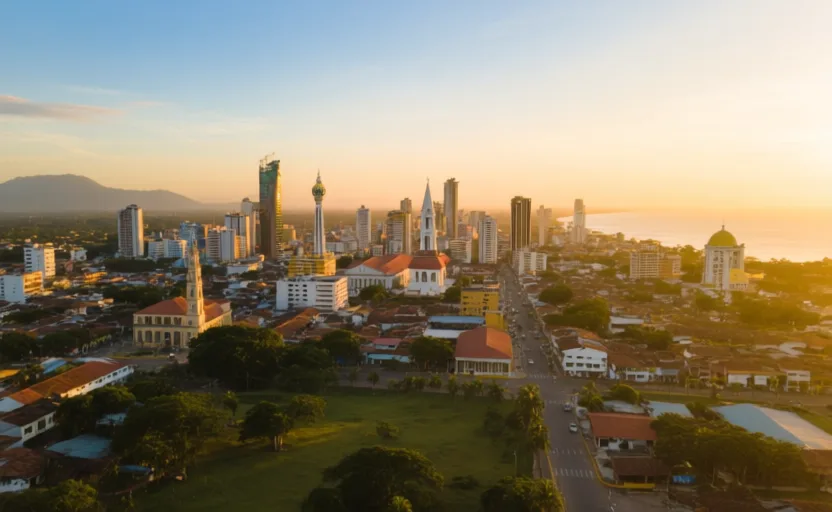 AI city illustration · Artistic impression
What people learn after moving
≈1.28 million in the district on DANE's 2026 projection; about 2.3 million across the metropolitan area with Soledad, Malambo, Galapa and Puerto Colombia
Spanish, in a fast costeño accent that drops the final s and softens r — harder for learners than Bogotá's
Colombian peso (COP)
COT (GMT−5), no daylight saving
AI city illustration · Artistic impressionCost of living in Barranquilla
Check your eligibility
Pick your passport to see entry rules and the long-stay routes we have researched.
Pick your passport to see whether you can enter Colombia — and what it takes to stay.
Colombia sorts long stays into three classes: V (Visitante, including the digital-nomad visa), M (Migrante — work, marriage, pensionado, investment) and R (Residente). You apply online through the Cancillería portal, with a published thirty-day decision window and usually no consular interview. The step people underestimate comes after approval: any visa valid more than three months must be registered with Migración Colombia within fifteen calendar days, producing the cédula de extranjería that unlocks banking, EPS affiliation, leases and utility contracts. A tourist stamp gives 90 days, extendable to 180 days maximum per calendar year, and confers no right to reside or work. Barranquilla's particular pattern is that most foreigners here arrive through a job — the industrial, port and outsourcing employers sponsor M-class work visas routinely — so the employer's legal department usually drives the process, which is faster but also means you should read what they are applying for rather than assume it is the class that leads to residency.
Barranquilla is the rare large Colombian city where owning a car is not rationed: Decreto Distrital 0450 of 7 July 2025 lifted pico y placa for every category, including taxis, which had been restricted since 2009. Only Carnival brings a temporary restriction back, by district decree, for those four days. Transmetro is the articulated-bus system running two trunk corridors — Murillo and Olaya Herrera — with feeder routes beyond, and the Área Metropolitana de Barranquilla set the fare at COP 3,700 on weekdays and COP 3,800 on Sundays and holidays from 19 January 2026, a COP 400 rise of 12.1% applying to conventional buses as well. Ride apps work well and street taxis here do run meters, unlike Cartagena's. The genuine hazard is water: the city's storm drainage historically used the streets themselves, and the arroyos that form in heavy rain can move a car. Colombia does not exchange most foreign licences, so after six months you need a Colombian one via the RUNT.
The cédula de extranjería is the gate: with one you can open an account at Bancolombia, Davivienda, BBVA, Banco de Bogotá, Banco Popular or Scotiabank Colpatria, and without one you generally cannot, because anti-money-laundering rules key on it. Until then you run on a foreign card, cash and Wise. Two national things matter more than the choice of bank. Bre-B, the Banco de la República's interoperable instant-payments scheme, has been live since 2025 and lets you pay any participating bank or wallet using a registered llave, which ended the old Nequi-versus-Daviplata split. And the 4x1000 (GMF) takes 0.4% of most withdrawals and transfers unless you nominate one account as exempt — which you have to ask for. If you are arriving on a local contract, ask your employer which bank they pay through: a payroll account at the same institution clears the same day and removes a layer of friction you will otherwise meet every month.
Colombia's contributory system runs through EPS insurers. Employees contribute 4% of salary with employers adding 8.5%; the self-employed pay the full 12.5% of a declared income base that cannot fall below one minimum wage — roughly COP 219,000 a month in 2026. Affiliation needs a cédula, and some visa classes, notably M-Pensionado and several V categories, cannot affiliate at all. The usual foreign setup is EPS plus a medicina prepagada plan for fast specialist access. The sector is mid-reform with several large insurers under Superintendencia intervention and 2026 rules restricting an EPS from operating where it holds too small a share of a department's members, so verify your insurer is functioning in Atlántico. The good news is that Barranquilla is where Santa Marta, Valledupar and Riohacha send their complex cases, so unlike most cities this size you are unlikely to be referred somewhere else.
A prepaid (prepago) SIM takes fifteen minutes, costs almost nothing and needs only your passport, which the clerk registers because the law requires the line to be in a name. The trap is the handset, not the line: Colombia runs a national IMEI database against phone theft, and a device bought abroad that is never registered gets cut off after roughly three to four weeks. Claro has the broadest coverage, Movistar and Tigo sit between, WOM is cheapest and thinner outside the built-up area. Home internet is comparatively easy here — Barranquilla is a business city and the northern corridor from El Prado up to Villa Campestre is well fibred by Claro, Tigo and Movistar, with real competition on price. The two local caveats are that coverage thins sharply in the south-western barrios, and that the brisa loca between December and March is hard enough on antennas, dishes and loose rooftop cabling that outages cluster in those months.
Colombia taxes residents on worldwide income, and residency is a day count: 183 days or more within any rolling 365-day period. A digital-nomad visa does not exempt you and neither does being paid abroad. Rates are progressive to 39% and every threshold is expressed in UVT, a peso unit DIAN republishes each December. You register a free RUT with DIAN, then file the declaración de renta between August and October on a date fixed by the last two digits of your NIT. Barranquilla adds the Impuesto de Industria y Comercio, a district tax on business and independent professional activity carried on here, charged on gross receipts at a rate per thousand set by activity code and filed with the district rather than DIAN. Salaried employment is outside ICA — which matters, because Barranquilla is a salary city and a large share of arrivals never touch it. Property owners also pay annual predial to the district, which runs its own calendar and its own early-payment discount.
Each guide has verified costs, timelines, required documents, and the non-obvious gotchas — sourced from official government pages. Last verified August 2026.
Reading a list isn’t learning it. Globe Quest turns these into a trainer — hear each phrase spoken, drill them with spaced repetition, and get scored as you say them out loud.
Barranquilla is having a bad run and euphemism does not help anyone. The five metropolitan municipalities closed 2025 with roughly 725 homicides, and the Defensoría del Pueblo issued a public warning in early July 2026 after twenty-five killings in the last weekend of June alone. The driver is a fight over extortion rents between Los Costeños, Los Pepes and splinters of both, not street robbery of foreigners — the risk to a newcomer is much more about running a visible small business than about walking around. Live in the northern corridor, do not advertise a new shop or restaurant before you have local advice, and know that 165 is the Gaula line for extortion. None of that makes the city unliveable; pretending the numbers are fine would.
Barranquilla lifted vehicle circulation restrictions for every category by Decreto Distrital 0450 of 7 July 2025, including taxis, which had been restricted since 2009. So unlike Bogotá, Medellín, Cali or Cartagena, owning a car here does not cost you a day a week. The exception is Carnival: Decreto 0036 of 26 January 2026 imposed a temporary restriction from Friday 13 to Monday 16 February 2026, by last plate digit and with motorcycles exempt. Expect the same shape each Carnival, and check the district decree rather than a national pico-y-placa app, which will often show you a stale permanent rule that no longer exists.
Air-e, which supplies Atlántico, Magdalena and La Guajira, has been under Superintendencia de Servicios Públicos intervention since 2024, and the tariff is set under that supervision rather than by a normal commercial operator. It was held at COP 796 per kilowatt-hour at the start of 2026 and rose 5.5% to COP 840.15 in June. Layer the estrato on top — every dwelling carries a 1-to-6 rating and estratos 5 and 6 pay a solidarity surcharge — and then layer on the fact that this is a city where the aircon runs most of the year. Ask for an actual bill from a hot month before you sign anything.
The Carnaval de Barranquilla runs the Saturday to Tuesday before Ash Wednesday — UNESCO proclaimed it a Masterpiece of the Oral and Intangible Heritage of Humanity in 2003 and inscribed it on the Representative List in 2008. Offices close, flights and hotels sell out months ahead, rents on short lets triple, and the events calendar around it stretches from January. If you have a deadline, a flight or a house move anywhere near it, look up the date first: it moves with Easter, so it lands in February or early March depending on the year.
That is the quiet advantage over Cartagena and Santa Marta. There is no tourist market bidding up ordinary flats, so a good one-bed in Alto Prado or Villa Country costs what a professional here can pay rather than what a holiday let could earn. The trade-off is that the nice parts are a narrow corridor running north from El Prado, and the difference between the right side and the wrong side of a boundary street is larger than the map suggests. Rent for six months in the north before you buy anywhere.
Barranquilla sits on slopes draining to the Magdalena, and for decades storm water ran down the roads themselves — the famous arroyos, torrents strong enough to carry a car away within minutes of a downpour. A long canalisation programme has tamed the worst of them, but not all, and the August-to-November rains still produce genuinely dangerous flows on specific streets. Learn which ones near you are arroyo routes, and if it is raining hard, wait it out somewhere rather than driving through moving water.
Grupo Puerto de Barranquilla, Palermo, freight forwarders, customs agencies
Barranquilla is a river port near the Magdalena's mouth rather than a deep-water sea port, which makes the dredging of the access channel a permanent commercial and political issue and the reason the logistics sector here is so lawyer- and paperwork-heavy.
Tecnoglass, Cementos Argos, Monómeros, Procaps, Superbrix
The Vía 40 and Malambo industrial corridors make this Colombia's most industrial Caribbean city. Tecnoglass, listed on NASDAQ, ships architectural glass from Barranquilla into US high-rise construction — an unusual export profile for a Latin American mid-size city.
Promigas, Air-e (under state intervention), Gases del Caribe
The Caribbean's gas transport and distribution sector is headquartered here. Note that the electricity distributor has been run under Superintendencia intervention since 2024, which shapes both tariffs and the local politics of any energy job.
Clínica Portoazul, Clínica General del Norte, Clínica de la Costa, Organización Clínica Bonnadona
Barranquilla is the referral centre for the whole eastern Caribbean coast — Santa Marta, Valledupar and Riohacha send complex cases here, which makes it a genuine medical employment market rather than just a place with hospitals.
Bilingual contact centres, shared-services operations, software houses
A young, comparatively bilingual workforce from Universidad del Norte and a cost base well below Bogotá's have made the northern office corridor a real BPO and nearshore development cluster.
Olímpica, Tiendas Ara distribution, Postobón, Coolechera
Olímpica, one of Colombia's largest supermarket and pharmacy chains, is a Barranquilla company, and the city is the distribution hub for the entire coast — which is why so much of the private-sector job market here is commercial rather than technical.
Landmark · Barrio Abajo to Vía 40, along the Magdalena
Five kilometres of riverside promenade built along a working river, with food halls, sculpture, a Ferris wheel and cargo ships sliding past a few metres away.
Local tip: Go at dusk when the heat breaks and the river turns copper. The Barrio Abajo end has the better food stalls; the Vía 40 end has the better views of ships turning in the channel.
Neighborhood · Between the centre and the river
The old low-lying quarter where Carnival is made — one-storey painted houses, comparsa rehearsal yards, the Museo del Caribe and the Casa del Carnaval.
Local tip: In January the rehearsal patios open up and you can watch a garabato or a congo group drilling for free. That is a far better introduction to Carnival than a grandstand seat in February.
Nature · End of the Magdalena's western breakwater, north of the city
The point where Colombia's biggest river meets the Caribbean, reached along a stone jetty that runs several kilometres out to sea with brown river water on one side and blue sea on the other.
Local tip: Take the little rail trolley (planchón) from Las Flores rather than walking the whole jetty in the sun, and go on a clear morning. Ask locally about conditions first — this is an exposed working breakwater, not a promenade.
Food · South-east of the centre
The vast, loud, entirely unpolished market where the city actually buys fish, yuca, plantain and everything else, spilling across streets near the old customs house.
Local tip: Go early with someone who knows it, carry nothing you mind losing, and eat a bollo de yuca with butifarra from a stall. It is not a curated experience and that is the point.
Culture · Barrio Boston
The bar where the Grupo de Barranquilla — Gabriel García Márquez, Álvaro Cepeda Samudio, Alejandro Obregón — drank and argued in the 1950s, now a restaurant and small museum.
Local tip: Sit at the bar rather than the tables, order a whisky and look at the Obregón mural. It is a working restaurant, not a shrine, and the food is decent coastal cooking.
Nature · North-west, toward Puerto Colombia
A large coastal lagoon and mangrove system on the city's edge, recently opened up with boardwalks, a viewing tower and canoe routes through the mangrove channels.
Local tip: Go at first light for the birds — flamingos turn up seasonally — and combine it with the old iron pier at Puerto Colombia twenty minutes further on, which was once one of the longest in the world.
Side-by-side cost of living, language, climate and careers — to help you choose.