
Population
≈21.8 million in the municipality, spread across an area larger than many countries
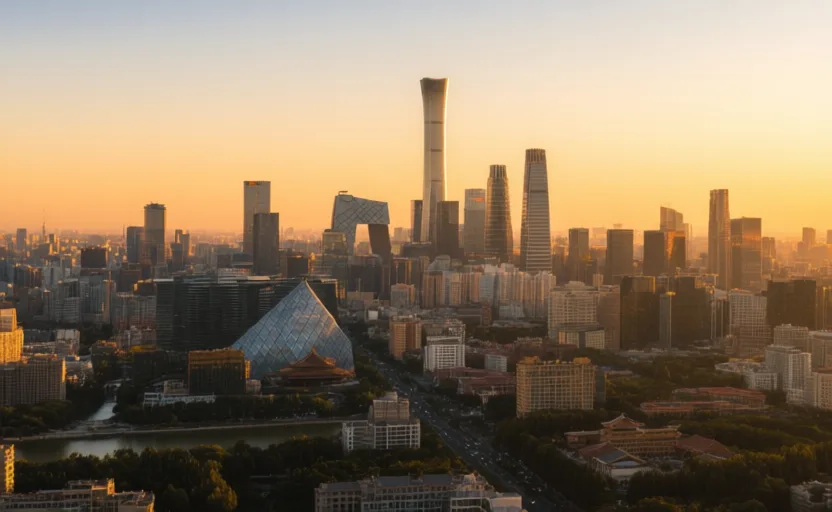 AI city illustration · Artistic impression
What people learn after moving
≈21.8 million in the municipality, spread across an area larger than many countries
Mandarin, in the standard-setting Beijing accent with heavy 'r' colouring. English is common in the embassy and tech districts and scarce elsewhere
Renminbi / Chinese yuan (CNY, ¥)
CST (GMT+8) — the whole of China runs on Beijing time, with no daylight saving
AI city illustration · Artistic impressionCost of living in Beijing
Check your eligibility
Pick your passport to see entry rules and the long-stay routes we have researched.
Pick your passport to see whether you can enter China — and what it takes to stay.
The sequence is national and rigid: your employer obtains the Notification Letter of Foreigner's Work Permit, you convert it into a Z visa abroad, you enter China, you collect the physical work permit card, and you apply for a residence permit within 30 days of entry. Sitting across all of it is the 24-hour police registration for anyone living outside a hotel. Beijing's distinguishing feature is not different rules but consistent enforcement of the ones that exist — this is the capital, and the registration slip is asked for at points where other cities wave it through.
Converting a foreign licence is straightforward — a translation, a medical, and the hundred-question written theory test, with the practical tests waived for ordinary car categories. Owning a car is the hard part. Beijing allocates petrol-car plates by lottery, with a winning rate that hit roughly 0.3% in 2025; new-energy plates are queued rather than drawn and the queue has run beyond eight years. A car registered elsewhere needs a limited entry permit to come into the city, and one plate-ending digit is banned from the roads each weekday.
Alipay and WeChat Pay now accept foreign Visa and Mastercard, capped at USD 5,000 per transaction and USD 50,000 a year after verification, which makes a short stay painless. Living here still requires a local account, and a local account requires a Chinese mobile number registered against your passport. Beijing's advantage is that the head offices of every major bank are here and the branches near the embassy district and the CBD deal with foreign customers constantly.
Beijing has the strongest concentration of tertiary hospitals in China — Peking Union Medical College Hospital, Beijing Hospital, the Peking University hospitals — and the practical question is which door you use. Ordinary outpatient departments are cheap, excellent and entirely Mandarin-speaking; the same hospitals run international wings with English support at several times the price; private international hospitals sit above that. Enrolment in social insurance is compulsory for foreign employees, and separately, air quality is a health variable here in a way it is not in most cities.
Getting a SIM takes twenty minutes and a passport, and it should be the first thing you do, because the phone number is the key to the bank account, the payment apps and most of daily life. The harder half is that a substantial part of the Western internet is unreachable from an ordinary Chinese connection, and in Beijing — where many foreign residents work for institutions with international dependencies — this is a live operational question rather than an inconvenience. Ask what your employer provides before you accept the job.
Employers withhold monthly, and residents complete an annual reconciliation between 1 March and 30 June for the previous calendar year. Two rules decide how much of your global life China taxes: the 183-day residence test and the six-year rule on worldwide income, which resets with a single absence of more than thirty consecutive days. Separately, foreign nationals choose annually between the preferential expatriate fringe-benefit exemptions and the standard itemised deductions — and that election is often worth more than everything else on this page.
Each guide has verified costs, timelines, required documents, and the non-obvious gotchas — sourced from official government pages. Last verified August 2026.
Reading a list isn’t learning it. Globe Quest turns these into a trainer — hear each phrase spoken, drill them with spaced repetition, and get scored as you say them out loud.
The obligation is national — Article 39 of the Exit and Entry Administration Law requires anyone staying outside a hotel to register with the local public security organ within 24 hours of arrival. What differs in Beijing is that it is actually checked. The registration slip is requested at the residence permit application, at renewal, at some bank branches, and sometimes during a neighbourhood check. Go to your local pàichūsuǒ with your passport, your visa, your lease and your landlord, and get the slip. Re-register every time you move, and after any trip abroad if your local station asks for it — practice varies by district and asking is free.
The Z visa is a single-entry entry document. Within 30 days of arrival you must apply to the Beijing Public Security Bureau's Exit–Entry Administration for a foreigner's residence permit, having first collected the physical work permit card. Employers here are usually well drilled on this because so many of them are large multinationals or research institutions, but the legal deadline attaches to you rather than to your HR department.
Beijing rations plates by lottery rather than by auction. The winning rate for an ordinary petrol-car plate reached a record low of about 0.3% in 2025, and the new-energy vehicle queue — first come, first served rather than a draw — has run to more than eight years. Worse, a car registered outside Beijing needs a separate entry permit to come into the city at all, and those are limited in number and duration. Combine this with a weekday driving ban that excludes one plate-ending digit per day, and the answer is the metro, a bike and DiDi.
Beijing's annual average PM2.5 fell from about 89.5 micrograms per cubic metre in 2013 to 27 in 2025, and the city recorded good air on 95.3% of days that year with a single heavy-pollution day. That is one of the fastest urban air quality improvements ever recorded and the 2013 'airpocalypse' picture is genuinely out of date. It is also still several times the World Health Organization's guideline of 5, winter inversions still produce bad stretches, and spring sandstorms from the north are a separate phenomenon that no emissions policy fixes. Buy a decent air purifier for the bedroom and check the AQI daily in winter — you will use both less than you feared and more than never.
Chinese public schooling is organised around the hùkǒu household registration, which allocates a place by registered address, and foreign-passport children fall outside it entirely — a small number of designated public schools accept foreign students, but the mainstream route is closed. In practice that means an international school, at fees that assume a corporate education allowance rather than a salary, plus a place on a waiting list secured months ahead. If you have school-age children, settle the school before you settle the district: the good ones cluster in Shunyi and eastern Chaoyang and they will decide where you live.
The city is organised as concentric ring roads around the Forbidden City, and Beijingers describe locations by ring rather than by district. Inside the second ring is the old city and the hutongs; the third and fourth carry the CBD, the embassy quarter and Haidian's universities; Shunyi and the international schools sit beyond the fifth. A cross-city journey can take an hour and a half in traffic and forty minutes on the metro. Choosing a home more than one ring away from your office is a decision about your evenings, not just your commute.
ByteDance, Baidu, Xiaomi, Meituan, JD.com, Kuaishou
Beijing, not Shenzhen, is China's consumer internet capital. Zhongguancun in Haidian is the original cluster and ByteDance's headquarters here is one of the largest technology employers in the world.
State ministries, the central SOEs, the major regulators
Almost every Chinese ministry, regulator and centrally-administered state enterprise is headquartered here. It is the reason so much foreign business maintains a Beijing office regardless of where its revenue is.
People's Bank of China, ICBC, Bank of China, CITIC, the securities regulator
Financial Street in Xicheng holds the regulators and the head offices of the big state banks, which makes Beijing the policy centre of Chinese finance even as Shanghai holds the markets.
Tsinghua University, Peking University, Chinese Academy of Sciences, Beihang
The densest concentration of top universities and state research institutes in China, and the main reason foreign researchers and postdocs end up in Haidian.
CCTV, Xinhua, China Daily, the diplomatic corps, international NGOs
Beijing hosts every embassy in China and the state media apparatus, which supports an unusual concentration of foreign journalists, translators, diplomats and cultural institutions.
AVIC, CASC, China Academy of Space Technology, Beijing Automotive
China's space and aviation programmes are administered and largely engineered from Beijing, with a supplier and research base that extends across Haidian and Fengtai.
Landmark · Dongcheng, dead centre
Five centuries of imperial palace on the city's axis, with an artificial hill directly behind it built from the moat spoil.
Local tip: Skip the palace queue on your first visit and climb Jingshan opposite instead. It costs almost nothing, takes fifteen minutes, and gives you the only view that makes the scale of the place legible — the whole grid of golden roofs laid out below you.
Neighborhood · Dongcheng, around the Drum and Bell Towers
The best-surviving stretch of old Beijing — grey-brick lanes, courtyard houses, small bars and the city's most liveable historic quarter.
Local tip: Nanluoguxiang is the tourist lane and is best avoided. Walk one street east or west into Baochao Hutong or Fangjia Hutong, where the same architecture is full of workshops, cafés and people who live there.
Culture · Chaoyang, north-east
A 1950s East German-designed electronics factory complex turned into China's best-known contemporary art district.
Local tip: The galleries have become commercial and the district is very busy at weekends. Go on a weekday and walk beyond the main strip into the adjacent Caochangdi area, where the smaller, more serious galleries relocated when 798 got expensive.
Food · Dongcheng, Dongzhimen Inner Street
A kilometre of red-lanterned restaurants that stays open through the night, built around crayfish, hotpot and grilled fish.
Local tip: It is loud, red and unapologetically for eating late. Order the málà xiǎolóngxiā in season and expect gloves. For the quieter Beijing classic, go instead for copper-pot mutton shuàn yángròu — plain broth, sesame dip, and nothing else.
Nature · ≈130 km north-east, Miyun district
A long, partly restored and partly wild section of wall along a ridge, with a fraction of the crowds of the nearer sites.
Local tip: Badaling is the coach-park version and Mutianyu is the comfortable one. Jinshanling is the walk — three to four hours of ridge with the wall running out of sight in both directions. Go on a weekday, take water, and start early.
Culture · Shijingshan, western outskirts
A small Ming temple from the 1440s holding some of the finest surviving mural painting in China, viewed by torchlight in a dark hall.
Local tip: Almost nobody goes, because it is out west and there is nothing else nearby. The murals were painted by imperial court artists and are shown to small groups with a guide and a hand torch — a genuinely extraordinary hour, and the closest thing Beijing has to a secret.
Side-by-side cost of living, language, climate and careers — to help you choose.