
Population
147,012 in the city (July 2026) — against 201,800 jobs, so Bern has far more workers than residents
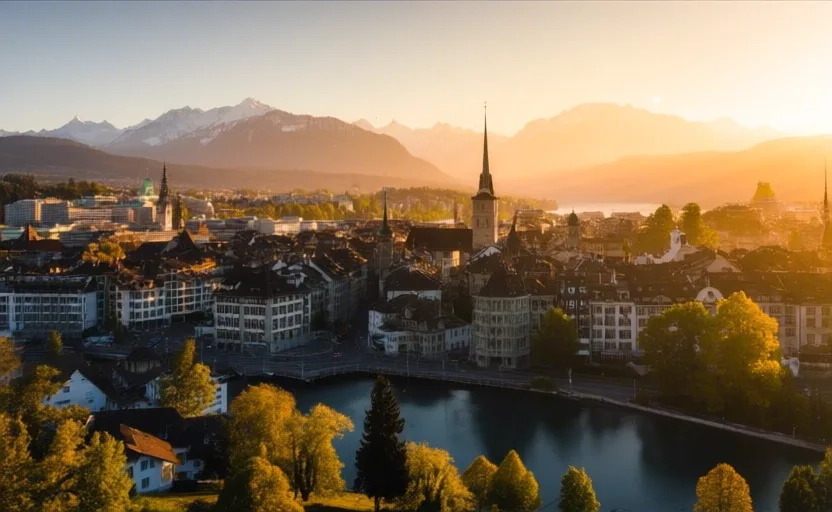 AI city illustration · Artistic impression
What people learn after moving
147,012 in the city (July 2026) — against 201,800 jobs, so Bern has far more workers than residents
German, spoken as Bärndütsch. Canton Bern also has a French-speaking region, so cantonal business runs in both languages; English is standard in the international organisations
Swiss franc (CHF)
CET (GMT+1); CEST (GMT+2) in summer
AI city illustration · Artistic impressionCost of living in Bern
Check your eligibility
Pick your passport to see entry rules and the long-stay routes we have researched.
Pick your passport to see whether you can enter Switzerland — and what it takes to stay.
Register your address within 14 days — in Bern, Swiss and EU/EFTA nationals can do that online. For third-country nationals the real gate is the cantonal Amt für Wirtschaft, which must approve the job before the migration service will issue a permit, and which wants the application eight weeks before your start date. Switzerland's 2026 third-country quota is 4,500 B and 4,000 L permits nationally, allocated to the cantons at the start of the year with a federal reserve held back for special cases — and unlike Zurich, Canton Bern does not publish how much of its share is left.
You may drive on a valid foreign licence for twelve months after taking up residence, and must exchange it within that window at the cantonal road traffic office. A resident also cannot keep a foreign-plated car indefinitely — it has to be cleared through customs and re-registered. Bern makes both easy to forget, because the city is compact, flat along the river and served well enough that a great many residents genuinely do not drive.
Once you are registered, opening an account is straightforward: the Berner Kantonalbank, UBS, Raiffeisen or the markedly cheaper digital banks. Two things catch newcomers. US citizens face FATCA-driven refusals as everywhere in Switzerland. And Swiss household bills arrive as QR-bills that you scan and pay yourself — rent, insurance, tax instalments and the Serafe broadcasting fee do not auto-debit unless you set that up.
Basic KVG cover is compulsory and you have three months from registration to choose an insurer, with cover backdating to your arrival. The Bern-specific part is geography: Canton Bern is one of only five cantons whose communes are divided into three premium regions, so the same policy costs different amounts in the city, the agglomeration and the rural canton. The 2026 national average adult premium is CHF 465.30 a month, up CHF 18.50 or 4.1% on 2025.
Swisscom, Sunrise and Salt run the networks, with discount brands riding on the same masts. Switzerland sits outside EU roaming rules in both directions, so an EU SIM is expensive here and a Swiss SIM is expensive in the EU. Unlike Basel or Geneva there is no border effect to worry about — Bern is deep in the interior, so the only decision is price against coverage in the Alps.
Swiss income tax is levied federally, cantonally and communally. Holders of a B or L permit are taxed at source through payroll and owe nothing further at the point of payment. The variable you control is the commune: the canton sets the scale, each commune sets its own multiplier on top, and in an agglomeration where living outside the city is completely normal that choice is worth real money over a career.
Each guide has verified costs, timelines, required documents, and the non-obvious gotchas — sourced from official government pages. Last verified August 2026.
Reading a list isn’t learning it. Globe Quest turns these into a trainer — hear each phrase spoken, drill them with spaced repetition, and get scored as you say them out loud.
At 1 June 2025 the City of Bern had 351 empty dwellings out of a stock of 79,797, a vacancy rate of 0.44% against a Swiss national figure of 1.00%. That is not a tight market, it is barely a market. Viewings are group appointments, dossiers are compared side by side, and a complete file with a Betreibungsregisterauszug and a reference beats a higher offer. Arrange something temporary and search from inside the city.
The 14-day deadline is federal and everything hangs off it: your permit card, the three-month health-insurance clock and the twelve-month driving-licence window. What is easier here than in most Swiss cities is the mechanism — Swiss and EU/EFTA nationals can register the move online through the eUmzugCH portal rather than at a counter. Third-country nationals still go through the cantonal migration service in person.
Basic cover is compulsory, bought individually per person, and is never an employer benefit. Canton Bern is one of only five cantons — with Graubünden, Lucerne, St. Gallen and Zurich — whose communes are divided into three premium regions, so two addresses twenty minutes apart can carry different bills for the same policy. The 2026 national average adult premium is CHF 465.30 a month, up 4.1%. Compare on the federal calculator before you sign a lease, not after.
The federal administration is Bern's dominant employer and the standard assumption is that a foreigner cannot work for it. That is wrong. Article 23 of the Bundespersonalverordnung allows access to be limited to Swiss citizens only where a sovereign task requires it, and lists exactly where: the justice and police department for policing and prosecution, the defence department for national defence and the intelligence service, the foreign ministry for staff posted abroad, the finance department for the Border Guard Corps, and departments for staff representing Switzerland in international negotiations. Any such restriction must be stated in the job advertisement — so read the ad rather than ruling yourself out.
201,800 people work in the city against 147,012 who live in it. A large share of your colleagues will commute in from Thun, Biel, Fribourg, Solothurn or Burgdorf, all inside an hour by train. Two consequences: the after-work social life is thinner than in Zurich because half the office is on a train by 18:00, and living outside the city is completely normal here rather than a compromise — though it means a different commune, a different tax multiplier and possibly a different health-premium region.
The river loops around the Old Town and from June the whole city gets in it after work. It is also cold, fast and unforgiving: the exits are specific points with handrails, and if you miss one you are carried to the next. Go with someone who knows the route the first time, get in above the Eichholz or the Marzili and know which steps you are aiming for before you get in. This is standard local advice, not squeamishness.
The federal departments, the Federal Chancellery, the federal courts' Bern offices, the City and Canton of Bern
The reason the city exists in its modern form. Most posts are open to foreign nationals — art. 23 BPV restricts only enumerated sovereign functions, and the vacancy notice has to say when it applies.
Universal Postal Union, the diplomatic missions accredited to Switzerland
The UPU has been headquartered in Bern since 1874 and is the second-oldest international organisation in the world, with 192 member countries. Its international staff hold FDFA legitimation cards rather than ordinary permits — the same two-track system as Geneva, at a much smaller scale.
Swisscom, Swiss Post, SBB, BKW
The big federally-linked infrastructure companies are run from Bern rather than Zurich, which gives the city a large, stable engineering and IT employment base that has nothing to do with government.
Die Mobiliar, Swiss pension and social-insurance institutions
Bern is an insurance town as well as a government one. Die Mobiliar, Switzerland's oldest private insurer, is headquartered here.
CSL Behring, Ypsomed, the Insel Gruppe and Inselspital, sitem-insel
The Inselspital is one of Switzerland's five university hospitals, and the medtech cluster around it and Burgdorf is the canton's main private-sector research employer.
University of Bern, Bern University of Applied Sciences (BFH), the Insel research campus
The University of Bern is strong in climate science, space research and medicine, and its research groups are among the few Bern employers that hire internationally at scale outside the federal orbit.
Nature · The river loop below the Old Town
A free riverside lido under the Bundeshaus, and a green-glacial river the whole city floats down on summer evenings.
Local tip: Entry to the Marzili is free — it always has been, and it is a point of civic pride. Get in at the Eichholz for the longer float, and identify the exit steps before you get in; the current does not negotiate.
Landmark · The Old Town peninsula
Kilometres of covered sandstone arcades along a medieval street grid, with the astronomical clock tower at the centre of it.
Local tip: The Zytglogge's mechanical figures perform a few minutes before each hour, which is when the crowd forms — the interior tower tour is the better half. In the rain, the Lauben mean you can cross the whole Old Town without a coat.
Culture · Above the Aare bend, city centre
The seat of the federal government, open to visitors, with a square in front that hosts a market twice a week and a light show in autumn.
Local tip: Free guided tours of parliament run when it is not sitting, and you can watch debates from the public gallery during sessions. The 26 fountain jets on the square, one per canton, are a swimming pool for small children in July.
Neighborhood · North of the Aare, across the Lorrainebrücke
The younger, less formal side of the river — cooperative housing, independent bars and the city's best casual eating.
Local tip: This is where people go when the Old Town feels like a museum. The Lorrainebad, the outdoor river pool on this bank, is the local alternative to the Marzili and much quieter.
Nature · Above Wabern, funicular from the city
The city's house mountain — a flat green plateau with a view across the whole Mittelland to the Bernese Alps.
Local tip: The funicular is included in a Libero season ticket to the right zone, which most people discover only after paying for it twice. Go on a clear winter day: the Eiger, Mönch and Jungfrau line up on the horizon.
Food · Old Town and Bundesplatz
A twice-weekly produce market on the parliament square, and once a year an onion market that starts before dawn in late November.
Local tip: Zibelemärit runs on the fourth Monday of November from about four in the morning. Go early rather than at lunchtime, eat a Zwiebelkuchen standing up, and accept that you will be hit with confetti.
Side-by-side cost of living, language, climate and careers — to help you choose.