
Population
About 588,000 in the city of Bremen and roughly 707,000 in the Land, which also contains Bremerhaven's ~119,000 — Germany's smallest state by area
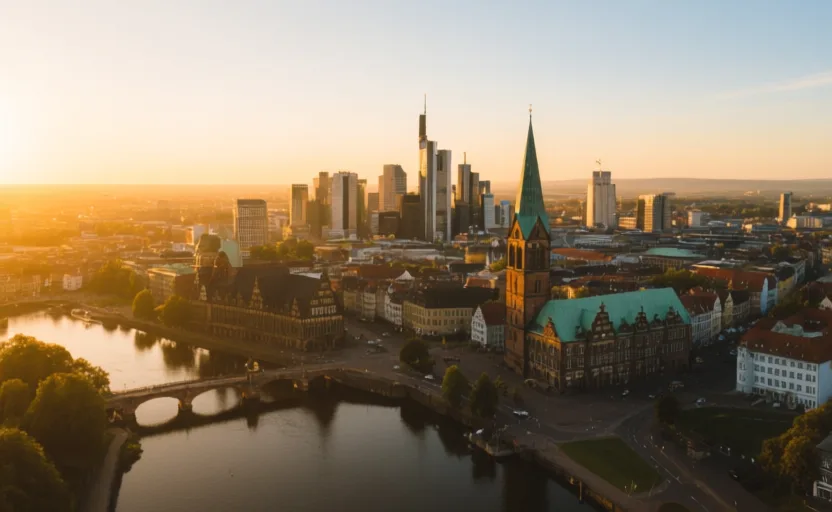 AI city illustration · Artistic impression
What people learn after moving
About 588,000 in the city of Bremen and roughly 707,000 in the Land, which also contains Bremerhaven's ~119,000 — Germany's smallest state by area
German; Low German (Plattdeutsch) is a recognised regional language and survives in everyday words rather than full sentences; English is normal in the aerospace and research sector
Euro (EUR)
CET (GMT+1); CEST (GMT+2) from late March to late October
AI city illustration · Artistic impressionCost of living in Bremen
Check your eligibility
Pick your passport to see entry rules and the long-stay routes we have researched.
Pick your passport to see whether you can enter Germany — and what it takes to stay.
Germany's sequence is rigid and identical everywhere: register your address within two weeks of moving in, which produces the confirmation needed for a tax ID, bank account, health insurance and residence permit. What Bremen changes is who does it. There is no surrounding Land to pass work to, so the same government runs the state and the city, and both the registration offices and the Migrationsamt sit inside it. Appointments are booked through the Serviceportal, and the city's own advice is to look again in the late afternoon when fresh slots are released.
EU and EEA licences remain valid without action. Non-EU licences are valid for six months from taking up residence, after which you need a German licence — and whether tests are required depends on the issuing country and, for federal countries, the specific state or province. Bremen is flat, compact and heavily cycled, and the tram network is dense enough that a large share of households manage without a car. The fare network you will actually use, the VBN, covers Bremen and a large slice of Lower Saxony, because Bremen's commuter belt is in a different Bundesland.
You need a German account for salary, rent and the direct debits German life runs on. Traditional banks require an Anmeldung first, creating a sequencing problem; digital banks generally do not. Bremen's rental market is tight enough that the state renewed its rent cap in November 2025, but it is not Munich — an employer letter from Airbus, Mercedes or the university still does a lot of work, and applicants are counted in handfuls rather than dozens.
Germany requires everyone to hold health insurance. Employees below an annually-set income threshold must join the statutory system, where contributions are a percentage of income shared with the employer and dependants are covered free. Above the threshold, and for the self-employed, private cover becomes available — cheaper when young and healthy, considerably more expensive later, and very difficult to leave. Bremen's own hospital landscape is dominated by the four municipal Gesundheit Nord clinics and the Klinikum Bremen-Mitte, and the poison information centre covering the state sits across the border in Göttingen.
Germany requires identity verification for every SIM including prepaid — passport or ID, verified in a shop, by video call or at a post office. Prepaid needs no Anmeldung or Schufa. Postpaid contracts run a Schufa check a newcomer will fail or pass marginally, so start prepaid and switch once you have a record. Bremen's own quirk is its housing stock: the Altbremer Haus terraces that make up much of the inner city are narrow, old and privately owned building by building, so what is available in the street tells you little about what is available in your flat.
German income tax is progressive and deducted at source, with your tax class determining monthly withholding. Church tax adds 9% of your income tax liability if you declared a religious affiliation at Anmeldung. A solidarity surcharge applies to higher incomes. On top of the national picture Bremen adds a compulsory employees'-chamber contribution that no other state except the Saarland levies, and — if you buy rather than rent — a property tax the state redesigned for itself and set at markedly different rates in its two cities.
Each guide has verified costs, timelines, required documents, and the non-obvious gotchas — sourced from official government pages. Last verified August 2026.
Reading a list isn’t learning it. Globe Quest turns these into a trainer — hear each phrase spoken, drill them with spaced repetition, and get scored as you say them out loud.
The Anmeldung is a legal deadline, not a guideline, and the Meldebescheinigung it produces gates your tax ID, bank account, health insurance and residence permit. Bremen books it through the Serviceportal, and the city's own guidance is that every BürgerServiceCenter releases additional appointments for the coming days in the late afternoon — so if the calendar looks empty in the morning, check again after four rather than giving up. Everyone registering, children included, has to attend in person, and if your German is thin you are expected to bring someone who can interpret.
Declaring membership of a recognised church at your Anmeldung triggers automatic deduction of church tax at 9% of your income tax liability — the standard rate in Bremen as in most German states, against 8% in Bavaria and Baden-Württemberg. Declaring no affiliation means no church tax. It is decided in a five-minute appointment most newcomers do not realise carries an annual cost, and formally leaving later requires its own appointment and a fee.
Bremen and the Saarland are the only two German states with a statutory chamber for employees. Everyone working in Bremen — employees and apprentices alike — contributes 0.12% of taxable pay, falling to 0.11% from 1 January 2026, withheld by the employer and remitted alongside income tax. It is not optional and it will appear on your first payslip as a line nobody in another German city has. What it buys is genuinely useful and almost nobody claims it: free legal advice on employment contracts, dismissals, social insurance and tax, plus help with the annual return.
Bremen passed a new Mietenbegrenzungsverordnung on 18 November 2025, in force from 1 December 2025 until 31 December 2029: on a re-letting the rent may not exceed the local comparative rent by more than 10%. A separate Kappungsgrenzen-Verordnung holds increases during a tenancy to 15% over three years rather than 20%, running to 31 August 2029. Both apply to the city of Bremen only. The Senate's own reasoning excluded Bremerhaven on the grounds that its housing market is not tight — the same Land, the same parliament, and deliberately different rules. Flats first let after 1 October 2014 and comprehensively modernised flats are exempt from the cap in both cities.
The Land of Bremen is two enclaves inside Lower Saxony, and the city boundary is a state boundary. Delmenhorst, Stuhr, Weyhe, Achim, Lilienthal and Ritterhude are all a different Bundesland: different school holidays, a different property tax model, different public holidays in some years, and rules like the rent cap that simply stop. If you live in one and work in the other — thousands do — check which side of the line each rule applies to rather than assuming the metro area is one jurisdiction.
Everyone resident in Germany must hold health insurance. Employees below an annually-set income threshold join the statutory system, where contributions are shared with the employer and dependants are covered free; above it, private cover becomes available and is very hard to leave. For urgent but non-emergency problems, 116117 is the national medical on-call number. The poison information centre serving Bremen is the Giftinformationszentrum-Nord in Göttingen on 0551 19240, which covers Bremen, Hamburg, Lower Saxony and Schleswig-Holstein between them — save it before you need it.
Airbus Defence and Space, OHB SE, ArianeGroup, Rheinmetall Electronics, DLR Institute of Space Systems, ZARM
Bremen's business development agency counts more than 140 aerospace companies and around 12,000 jobs in the sector — the Columbus laboratory now on the International Space Station was assembled here, and OHB is the first German space group to have listed on the stock exchange.
Mercedes-Benz Werk Bremen (Sebaldsbrück)
The single largest private employer in the city, building saloons and electric models in Sebaldsbrück and anchoring a supplier network across the whole Weser region.
ArcelorMittal Bremen
An integrated steelworks on the Weser employing around 3,000 people, and the centre of the city's long-running argument about how a heavy-industry port town decarbonises.
BLG Logistics, Eurogate, bremenports, Beluga-era shipping and forwarding firms
Bremen handles the general cargo and the corporate functions; Bremerhaven, 60 km downriver but in the same Land, handles the container terminal and one of the world's largest car terminals. The two halves of the state are effectively one logistics business.
Beck's (AB InBev), Vitakraft, Hachez, Melitta's Bremen operations
Bremen was built on coffee, tea, tobacco and cotton imports, and the descendants of that trade are still here — the Beck's brewery on the Neustadt bank is the most visible, but the commodity trading houses behind it are the older story.
Universität Bremen, Constructor University, Alfred-Wegener-Institut (Bremerhaven), MARUM, Fraunhofer IFAM, DFKI Bremen
Marine and polar science is the genuine specialism — MARUM holds one of the world's largest seabed core repositories and the Alfred Wegener Institute runs Germany's polar programme from Bremerhaven. The university's 146-metre drop tower does the microgravity research that the aerospace cluster feeds off.
Landmark · Altstadt
The 15th-century town hall with its Weser Renaissance facade and the 1404 Roland statue in front of it, jointly inscribed on the UNESCO World Heritage list in 2004 as symbols of civic self-government.
Local tip: The Ratskeller beneath the Rathaus holds one of the oldest wine cellars in Germany, including barrels of Rüdesheim from the 1650s that are not for drinking. Book the guided Rathaus tour rather than admiring the outside — the upper hall is where the Schaffermahlzeit has been held every February since 1545, which makes it plausibly the oldest continuously observed banquet anywhere.
Neighborhood · East of the Altstadt
A single long street of bars, second-hand shops, cinemas and 19th-century terraces that is Bremen's cultural centre of gravity, ending at the Sielwall crossroads.
Local tip: The Sielwall corner is the city's unofficial meeting point and the Sielwallfähre crosses the Weser from the end of it in summer. Ostertorsteinweg's bars run late on weeknights in a way the rest of the city does not — if you want to know whether you will like living in Bremen, spend a Wednesday evening here rather than a Saturday.
Culture · Between Marktplatz and the Weser
A 110-metre street rebuilt in the 1920s and 30s by the coffee merchant Ludwig Roselius as a work of Expressionist brick architecture — one of the strangest streets in Germany and condemned as degenerate by the Nazis.
Local tip: Stand under the Glockenspiel at noon, three or four in the afternoon and it plays on Meissen porcelain bells while a panel rotates through Atlantic crossings. The Paula Modersohn-Becker museum halfway along was the first museum in the world dedicated to a woman painter — go for that rather than the souvenir shops.
Nature · North of the Hauptbahnhof
A 200-hectare landscape park running from behind the main station into the Stadtwald, laid out from 1866 and still owned and financed by a citizens' association rather than the city.
Local tip: It takes no regular municipal money — it runs on donations, a lottery and the cafés inside it, which is the most Bremen fact about Bremen. Rent a rowing boat on the Emmasee, and in autumn walk the whole length to the Stadtwald; the park starts three minutes from the station platform, which no other German city of this size manages.
Nightlife · The Weser bank, west of the Altstadt
The old riverside quay turned into a promenade of bars and moored ships, running west into the Überseestadt — 300 hectares of former harbour basin being rebuilt into offices, lofts and studios.
Local tip: The Schlachte is where the city drinks outdoors in summer and where the Christmas market's Hanseatic half sits in December. Keep walking west past it: the Überseestadt's Speicher XI holds the university's art college and a port museum, and the mix of container cranes and new build is a better evening walk than the tourist stretch.
Landmark · Universität Bremen campus, Horn-Lehe
A 146-metre drop tower on the university campus where experiments fall 110 metres in an evacuated tube to buy 4.74 seconds of near-weightlessness — one of very few facilities of its kind anywhere.
Local tip: It is visible from half the city and almost nobody who lives here knows what it is for. ZARM runs public tours and open days; going on one explains in twenty minutes why an aerospace cluster ended up in a Hanseatic port town, which no museum in the city does.
Side-by-side cost of living, language, climate and careers — to help you choose.