
Population
≈120,000 across the whole municipality, of which only a fraction lives inside the ring canal — most Bruggelingen live in the eight villages merged in in 1971
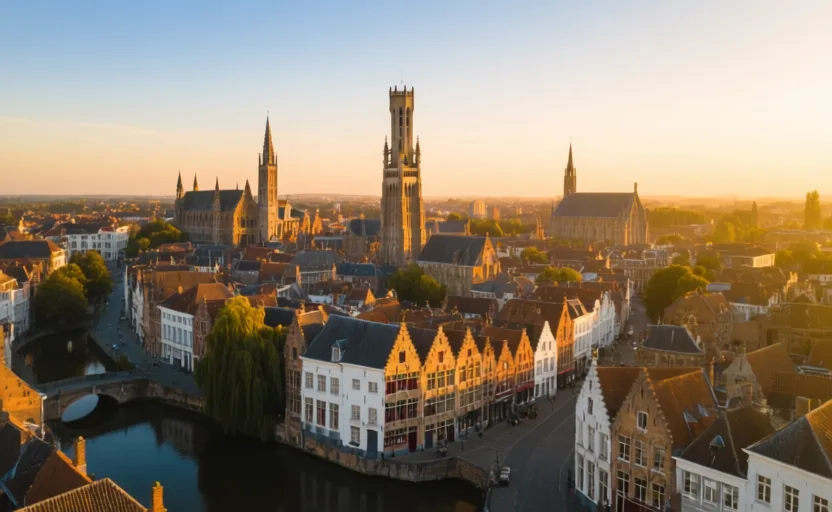 AI city illustration · Artistic impression
What people learn after moving
≈120,000 across the whole municipality, of which only a fraction lives inside the ring canal — most Bruggelingen live in the eight villages merged in in 1971
Dutch, in a West Flemish dialect that other Flemings find hard. English is universal in the centre because of tourism; French is understood but is not the administrative language
Euro (EUR)
CET (GMT+1), CEST (GMT+2) from late March to late October
AI city illustration · Artistic impressionCost of living in Bruges
Check your eligibility
Pick your passport to see entry rules and the long-stay routes we have researched.
Pick your passport to see whether you can enter Belgium — and what it takes to stay.
One permit, three levels of government. Your employer lodges a single permit with the Flemish government, which decides the work half against Flemish salary floors and a Flemish migration list, while the Immigration Office decides the residence half. On arrival you report to the city, receive a Bijlage 15, and wait for a neighbourhood police officer to verify you live at the address. Most non-EU newcomers then pick up a compulsory civic integration obligation — and unlike Antwerp and Ghent, which run their own agencies, Bruges is served by the regional one.
EU and EEA licences remain valid and can be exchanged at the city. A non-EU licence can only be exchanged if the issuing country is on the FPS Mobility recognition list, and you have roughly 185 days from registration to do it — after that, the Belgian theory and practical exams. Once driving, the notable thing about Bruges is what it does not have: no low emission zone, so an older diesel barred from Antwerp, Ghent and Brussels is legal here. What constrains you instead is a medieval street plan, a ring canal with a handful of entry points, and parking that is scarce and expensive by design.
Belgian banks want your national register number and an eID, which puts the city registration first in the queue. Most Belgian current accounts carry an annual fee, which surprises arrivals from free-banking markets. The thing that actually determines how painless your first months are is itsme, the national digital identity app that unlocks tax filing, government portals and bank logins — and which normally needs a Belgian eID or a Belgian bank card to activate.
Belgian healthcare is fast and good, and works by reimbursement rather than free-at-point-of-use: you pay the doctor and get most of it back, usually automatically within days. Cover is compulsory but enrolment is not automatic — you choose a ziekenfonds and join. Two decisions then set what you actually pay: registering a global medical file with one GP, and checking whether the doctors you see have signed the national fee agreement. Bruges is unusually well served for a city its size, because AZ Sint-Jan is a referral hospital for the whole province.
Every SIM in Belgium, prepaid included, must be registered to an identified person under the 2017 anti-terrorism rules. Mobile pricing is high by EU standards and the smaller operators reselling on the same networks are dramatically cheaper. For fixed internet, Bruges is largely served by the Flemish coax network alongside Proximus copper — and a protected medieval centre is exactly the kind of place where laying fibre is slow, so what your building actually has is a question to ask before you sign.
Belgium taxes employment income about as heavily as any country in the OECD: four brackets rising to 50%, employee social security of 13.07% off the top, and a communal surcharge on the tax you owe — 6.9% in Bruges for assessment year 2026. What makes the surcharge unusually visible here is the neighbours: the coastal municipalities include the only 0% commune in the country, which is a twenty-minute drive and a genuinely different tax bill on identical income.
Each guide has verified costs, timelines, required documents, and the non-obvious gotchas — sourced from official government pages. Last verified August 2026.
Reading a list isn’t learning it. Globe Quest turns these into a trainer — hear each phrase spoken, drill them with spaced repetition, and get scored as you say them out loud.
An absolute vakantiewoningenstop applies inside the historic centre: no new holiday accommodation, full stop. Outside the centre it is possible but conditional — the property must exceed 200 m², sleep no more than eight, and the rules are relaxed only in the Zeebrugge beach district and certain port zones. A selective hotel stop applies in the centre too. In February 2025 the city published a three-part enforcement plan: neighbourhood screenings run jointly by city services and the local police, direct legal action against operators of unlicensed lets with no chance to regularise first, and tax inspections. Two things follow for a newcomer. If you are letting a room in your own home, that is a gastenkamer and a different, permitted category. And if a landlord offers you a short furnished let in the centre 'as a holiday flat', check very carefully what you are actually signing.
Belgium's single permit is decided by the region where the job sits, so a Bruges job is judged by Flanders — not by the federal state and not by Brussels. Flanders states its floors annually rather than monthly: €48,912 gross for a highly skilled worker, €39,129.60 for under-30s on a local contract, €78,259 for management, and €63,586 for an EU Blue Card, which is set at 130% of the average gross annual salary. From 1 January 2026 the rest tightened: level-2 low-skilled roles no longer qualify at all, the mid-skilled migration list lost functions, level 3–4 roles need a VDAB vacancy published for nine weeks first, and diploma authenticity can be demanded. Flanders also charges a non-refundable €180 regional retribution on applications lodged from 1 September 2026, on top of the federal contribution, and will not begin processing until it is paid.
Third-country nationals on a long-stay visa must report to the city within eight working days of arriving. You receive a Bijlage 15, and a wijkagent then calls at the address to confirm you live there. Until that report is positive there is no national register number, and without the number there is no eID, no bank account, no ziekenfonds and no phone contract. Put your name on the letterbox and the doorbell the day you get the keys. A failed check restarts the sequence and routinely costs a month.
Non-EU newcomers aged eighteen or over with a permit of more than three months, registered in a Flemish municipality, must follow the inburgering path: social orientation, Dutch, individual guidance towards work and diploma evaluation, with 80% attendance across each part. Since September 2023 the newcomer pays €180 for the social orientation classes and first test and €180 for the Dutch classes and first test, with retakes and books extra. The identical programme is free of charge in Brussels. Unlike Antwerp and Ghent, which run their own city agencies, Bruges is served by the regional Agentschap Integratie en Inburgering.
For assessment year 2026 Bruges charges 6.9% on top of the income tax you already owe, against 7.0% in Antwerp, 6.7% in Leuven, 6.5% in Ghent, 4.9% in the City of Brussels and 8.0% in Liège. Nationally the FPS Finance table runs from 0% in Knokke-Heist — twenty minutes up the coast — to 9.0% in Mesen. Separately, and unlike Antwerp and Ghent, Bruges operates no low emission zone, so an older diesel that is barred from those cities and from Brussels can be driven and parked here without a permit. Parking, not emissions, is the constraint in the centre.
The historic centre inside the ring canal holds only a fraction of the city's roughly 120,000 people. The rest live in the deelgemeenten merged into Bruges in 1971 — Sint-Andries, Sint-Michiels, Assebroek, Sint-Kruis, Koolkerke, Dudzele, Lissewege and Zeebrugge — which is where the family housing, the schools, the supermarkets and most of the rental stock actually are. Newcomers search the centre, find a handful of small expensive flats competing with second homes and short lets, and conclude the city has no housing. It has plenty; it is ten minutes further out and considerably cheaper.
Port of Antwerp-Bruges, Fluxys LNG terminal, ICO and car-handling terminals, RoRo operators
Zeebrugge merged with Antwerp in 2022 to form a single port authority. Its LNG bunkering volumes reached 234,580 tonnes in 2025, roughly three and a half times the 2024 figure, and the new Zeebrugge lock is one of the region's largest infrastructure projects.
Elia, offshore wind operators and maintenance contractors based at Zeebrugge
Zeebrugge is the operations base for the Belgian offshore wind zone, and the Princess Elisabeth energy island being built off this coast is the first artificial island of its kind — the installation campaign for 2025 finished in October.
Musea Brugge, hotels, the Concertgebouw, Historium, De Halve Maan
A UNESCO World Heritage centre draws several million visitors a year into a city of 120,000, which is why the city runs planning stops on both new hotels and new holiday lets rather than simply taxing them.
AZ Sint-Jan Brugge-Oostende, AZ Sint-Lucas, residential care providers
AZ Sint-Jan is one of the largest hospitals in Flanders and a referral centre for the whole coastal province — in a small city that makes healthcare one of the biggest single employers, and one of the few reliably recruiting internationally.
College of Europe, VIVES University of Applied Sciences, the KU Leuven Bruges campus
The College of Europe takes around 350 postgraduates a year from over fifty countries onto ten-month advanced Master's programmes — an unusually direct pipeline into the EU institutions, and the reason Bruges has a small, very international academic population that turns over annually.
Province of West Flanders, City of Bruges, the courts, notaries and law firms
Bruges is the provincial capital, so the province's administration and the judicial district sit here rather than in the larger coastal towns — a steady, Dutch-language public-sector employment base.
Landmark · Centre
The market square and its leaning thirteenth-century tower, inscribed by UNESCO as part of the Belfries of Belgium and France.
Local tip: It is 366 steps and the ticket caps numbers, so book a slot rather than queueing in the passage. Better still, be on the Markt at seven in the morning: the carillon is audible, the square is empty, and the terraces that charge tourist prices by ten have not opened.
Landmark · Centre, behind the Markt
The old administrative square — Gothic town hall, Renaissance registry, and a chapel holding a relic paraded through the city every Ascension Day.
Local tip: The Heilig Bloedprocessie on Ascension Day is not a re-enactment for visitors; it has run for centuries and much of the city takes part. If you are here in May, that is the day to be in town. The upper chapel is free to enter and almost always quiet.
Nature · South of the centre
A walled courtyard of white houses under poplars, part of the UNESCO Flemish Béguinages, opening onto the lake at the city's southern edge.
Local tip: Benedictine sisters live here, so it closes in the evening and silence is asked for rather than suggested. Go in late March when the courtyard fills with daffodils, and walk on round the Minnewater and up the Begijnenvest — a green rampart walk most visitors never find.
Culture · Dijver and Mariastraat
Two small museums holding Jan van Eyck, Hans Memling and the Flemish Primitives — painted here, for patrons here.
Local tip: The Groeninge is deliberately small and you can see it properly in ninety minutes, which is more than can be said for most European collections of this quality. Sint-Janshospitaal keeps the Memlings in the building they were painted for, alongside a preserved apothecary — that combination is the reason to go.
Neighborhood · North-east of the centre
The quiet quarter inside the ring canal where Bruggelingen actually live — brick almshouses, a Jerusalem chapel built by a merchant family, and canal frontage with nobody on it.
Local tip: Walk out along the Langerei towards the Dampoort and you leave the visitors behind within four minutes. The godshuizen — tiny whitewashed almshouse courtyards scattered through this quarter — are still lived in and mostly unmarked; you find them by pushing on a gate that turns out to be open.
Food · Walplein, centre
A working family brewery in the middle of a World Heritage site, connected to its bottling plant by 3.3 kilometres of underground beer pipe.
Local tip: The pipeline opened in September 2016 and was funded partly by crowdfunding — a few hundred thousand euros raised from people who took beer as their return. It moves 4,000 litres an hour under the medieval streets and exists solely so tankers stop grinding through the centre. The rooftop of the brewery tour is one of the best views in Bruges and almost nobody comes for that.
Side-by-side cost of living, language, climate and careers — to help you choose.