
Population
≈1.25 million across the nineteen communes; ≈2.1 million in the wider metropolitan area
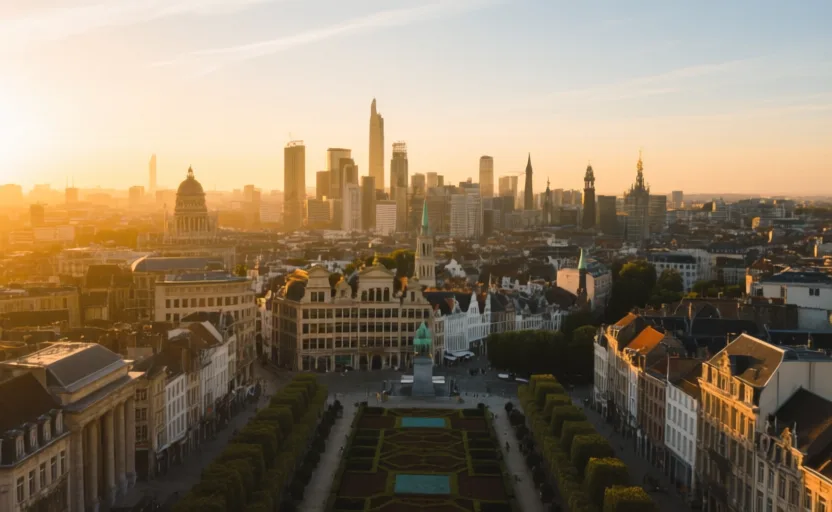 AI city illustration · Artistic impression
What people learn after moving
≈1.25 million across the nineteen communes; ≈2.1 million in the wider metropolitan area
Officially bilingual French and Dutch. French dominates daily life, English is near-universal in the European quarter, Dutch matters in administration and Flemish-community services
Euro (EUR)
CET (GMT+1), CEST (GMT+2) from late March to late October
AI city illustration · Artistic impressionCost of living in Brussels
Check your eligibility
Pick your passport to see entry rules and the long-stay routes we have researched.
Pick your passport to see whether you can enter Belgium — and what it takes to stay.
Belgium splits one apparently simple process across three levels of government. Your employer lodges a single permit with the Brussels region, which decides the work half while the Immigration Office decides the residence half. Once here you report to your commune, receive an Annexe 15, and wait for a neighbourhood police officer to call at your address and confirm you live there. Only after a positive report do you get a national register number and an electronic residence card — and almost everything else in Belgian life is gated behind that number.
EU and EEA licences stay valid and can be exchanged at your commune. Licences from outside the EU can only be exchanged if the issuing country is on the FPS Mobility recognition list, and you have roughly 185 days from registration to do it — after that you drive on a Belgian licence or you take the Belgian test in full. Once driving, two Brussels-specific regimes apply: a 30 km/h default across nearly the whole region since 2021, and a low emission zone that banned Euro 5 diesels from 1 January 2026 after a court struck down the postponement, with the enforcement regime still being rebuilt.
Belgian banks want a national register number and an eID, which means the commune comes first. Once you have both, opening an account is straightforward, though most Belgian banks charge an annual account fee — a small shock for anyone arriving from a free-banking market. The thing that actually determines how smooth your first months are is itsme, the national digital identity app: it unlocks tax filing, government portals and most online services, and you generally need a Belgian eID or a Belgian bank card to activate it.
Belgian healthcare is excellent, fast by European standards, and built on a reimbursement model rather than free-at-point-of-use: you generally pay the doctor and get most of it back. Insurance is compulsory but enrolment is not automatic — you must pick a mutuelle and join. Two things then decide what you actually pay: whether you have registered a global medical file with one GP, and whether the doctors you see have signed the national fee agreement.
Belgium abolished anonymous prepaid cards in 2017, so every SIM, prepaid included, must be tied to an identified person. Prices have historically been high by EU standards and the market is concentrated around Proximus, Orange and Telenet/BASE, with smaller operators reselling on the same networks for much less. Fixed broadband in Brussels is good and improving as fibre is rolled out, but what your building actually has is a lease-signing question rather than a marketing one.
Belgium taxes employment income heavily: four brackets rising to 50% at a threshold most professionals clear, plus employee social security, plus a communal surcharge that varies by where you are registered. Two things matter disproportionately to someone arriving now. The first is the inbound taxpayer regime — the replacement for the pre-2022 expat status, which was rewritten again for income from 2025. The second is the commune: on identical income, registering in Ixelles rather than the City of Brussels costs you meaningfully more, every year.
Each guide has verified costs, timelines, required documents, and the non-obvious gotchas — sourced from official government pages. Last verified August 2026.
Reading a list isn’t learning it. Globe Quest turns these into a trainer — hear each phrase spoken, drill them with spaced repetition, and get scored as you say them out loud.
Third-country nationals arriving on a long-stay visa must report to the foreigners' desk of their commune within eight working days. You get an Annexe 15 slip, and then a neighbourhood police officer calls at the address to confirm you genuinely live there. Nothing moves until that report comes back positive: no eID, no national register number, no bank account, no mutuelle. People assume the visit is a formality they can skip by being out; it is not, and a failed check restarts the clock. Make sure your name is on the letterbox and the doorbell before you go anywhere.
Belgium's communal surcharge is a percentage added to the income tax you already owe, set by each commune and published by FPS Finance. For assessment year 2026 it runs from 4.9% in the City of Brussels to 7.5% in Ixelles, with Schaerbeek at 5.0%, Uccle at 5.6%, Saint-Gilles at 6.3% and Anderlecht, Forest and Molenbeek at 7.0%. That is a real, checkable difference on the same salary in the same region, decided by which side of a street you sign a lease on — and it is your registered address on 1 January that counts.
The special regime for foreign executives ended on 1 January 2022 and was replaced by the inbound taxpayer regime (BBIB/RSII) and its researcher variant (BBIO/RSICI). The internet is still full of the pre-2022 rules, which are simply wrong now. Under the current regime a portion of gross pay can be treated as tax-free expense reimbursement — raised from 30% to 35% and the old €90,000 cap abolished, with the minimum gross salary lowered from €75,000 to €70,000, applying to pay from 1 January 2025. Belgian social security has not followed: for contributions the 30% and €90,000 limits still apply. The employer must apply within a short window after you start; miss it and you do not get it.
Coverage in Belgium runs through a mutuelle/ziekenfonds that you pick yourself: CM, Solidaris, Partenamut, the neutral and liberal funds, or the free public fund CAAMI/HZIV. Your employer does not do it and the commune does not do it. Until you have joined, you carry the full cost of any treatment. If you were insured in another EU country, bring the S1 or E104 form — it carries your prior cover across and removes any waiting period a fund would otherwise apply.
Brussels is officially French and Dutch, and every regional service, form and street sign must be in both. In practice French dominates daily life, English is ubiquitous in the European quarter and Dutch is a real working language in parts of the administration and in Flemish-community services. The fork that matters is schooling: you choose a French-language or a Dutch-language school system, they are run by different communities with different curricula and calendars, and moving a child between them mid-education is genuinely disruptive. Decide before you enrol, not after.
Under the Protocol on the Privileges and Immunities of the EU, officials pay an EU internal tax on their institutional salary, are exempt from national income tax on it, and are deemed to keep their tax domicile in the country they came from. They are also covered by the EU's own health scheme rather than a Belgian mutuelle. If your neighbour tells you Belgian tax is manageable and their pay comes from an institution, they are describing a different system from yours. It also lifts rents in Etterbeek, Ixelles and the European quarter well above what local salaries alone would support.
European Commission, Council, Parliament, EEAS, trade associations, consultancies and law firms
Brussels hosts the largest concentration of lobbyists and public-affairs professionals outside Washington, and the EU Transparency Register lists thousands of organisations working the same square kilometre.
NATO HQ, national delegations, Eurocontrol, hundreds of embassies and missions
NATO's headquarters sits on Boulevard Léopold III beside Brussels Airport, and Belgium hosts more accredited diplomats than almost any other country.
Euroclear, Swift, BNP Paribas Fortis, ING Belgium, Belfius, Degroof Petercam
Euroclear is one of the world's two international central securities depositories, and Swift — which routes interbank messaging globally — has its headquarters in La Hulpe on the city's southern edge.
UCB, GSK Vaccines, Pfizer Puurs, IBA, university hospitals
UCB is headquartered in Anderlecht, and Belgium punches far above its weight in vaccines and clinical trials — GSK's global vaccines business is run from Wavre, half an hour south.
Proximus, Orange Belgium, RTBF, VRT, Euronews Brussels bureau, Collibra
Brussels is the base for both national broadcasters and one of the densest international press corps in the world, alongside a small but real data and SaaS scene.
The Brussels bar, the big four, global firms' EU antitrust practices
Because the European Commission's competition, trade and state-aid decisions are taken here, Brussels holds the deepest concentration of EU regulatory lawyers anywhere.
Landmark · Centre
A UNESCO-listed square of guildhalls rebuilt after the 1695 French bombardment, and still the city's ceremonial heart.
Local tip: Come at seven in the morning when it is empty and the gilding catches the light, or after eleven at night. In between it belongs to tour groups. The Îlot Sacré lanes behind it are a tourist trap with prices to match.
Neighborhood · South of the centre
A working-class quarter below the Palace of Justice with a daily flea market that has run since 1873.
Local tip: The market runs every morning of the year and prices drop sharply after about eleven when sellers start packing. The free lift from Place Poelaert down into the Marolles saves a steep climb and most visitors never spot it.
Neighborhood · Ixelles
A 1930s modernist broadcasting building, two ponds, and the densest concentration of cafés and terraces in the city.
Local tip: Sunday morning is the food market on Place Flagey; the rest of the week the square is a car park. Walk five minutes up to the Ixelles cemetery quarter for cheaper terraces and the student crowd from ULB and VUB.
Nature · Etterbeek / European quarter
A triumphal arch and three museums in a formal park built for Belgium's fiftieth anniversary — the EU quarter's back garden.
Local tip: The Art & History museum next to the arch is enormous and rarely busy, and on the first Wednesday afternoon of the month federal museums are free. The Autoworld collection in the south wing is far better than it sounds.
Culture · Saint-Gilles / Ixelles border
The streets where Victor Horta invented art nouveau, with his own house and studio now a museum.
Local tip: The Horta Museum caps visitor numbers and sells out, so book. But the free version is better value: walk Rue Defacqz, Rue Faider and Avenue Louis Bertrand and read the façades. Several private houses open one weekend a year during Heritage Days.
Nature · Southern edge, from Uccle to Watermael
Four thousand hectares of ancient beech forest on the city's southern boundary, part of it UNESCO World Heritage.
Local tip: Sections of it were inscribed on the UNESCO list in 2017 as part of Europe's ancient and primeval beech forests — the same status as Slovakia's Carpathian stands. Tram 44 from Montgomery drops you at Tervuren on the far edge through an avenue of chestnuts; almost nobody living in the European quarter realises it is twenty minutes away.
Side-by-side cost of living, language, climate and careers — to help you choose.