
Population
~3 million city / ~15.6 million metro (AMBA)
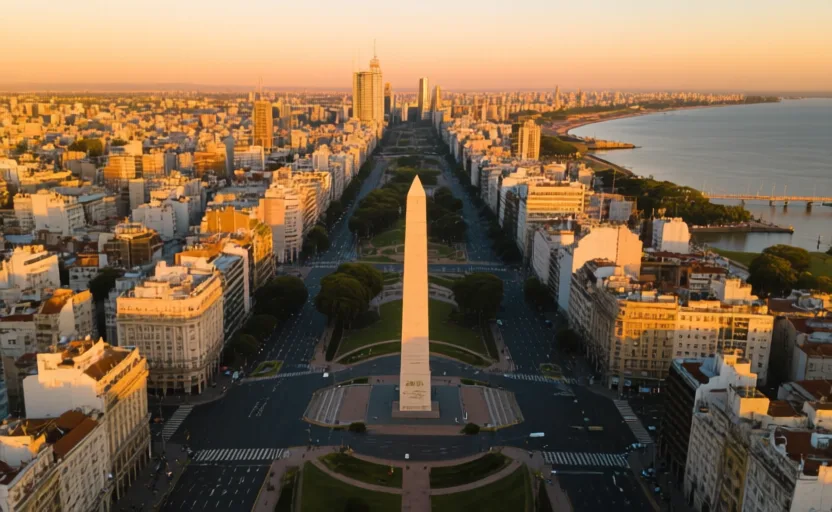 AI city illustration · Artistic impression
What people learn after moving
~3 million city / ~15.6 million metro (AMBA)
Spanish (Rioplatense — voseo, Italian-inflected)
Argentine Peso (ARS) — floating band since Apr 2025; check today's rate
ART (GMT-3), no daylight saving
AI city illustration · Artistic impressionCost of living in Buenos Aires
Check your eligibility
Pick your passport to see entry rules and the long-stay routes we have researched.
Pick your passport to see whether you can enter Argentina — and what it takes to stay.
Most Western nationals (US, EU, UK, Australia, Canada) enter visa-free for 90 days, extendable once by another 90 via a prorroga, but living here legally long-term means applying for temporary residency. For a remote worker the two realistic routes are the Digital Nomad visa (fast, foreign income, up to ~360 days but a dead end for residency) and the Rentista visa (proof of stable foreign passive income, renewable yearly, and a genuine path to permanent residency and citizenship). You apply almost entirely online through RADEX while physically in Argentina; once filed you immediately get a residencia precaria that legalizes you while the file processes, and the goal document is the DNI national ID. Argentina is unusually fast to citizenship (two continuous years of legal residency), but a 2025 reform (Decree 366/2025) tightened the rules: absences abroad now break the qualifying clock and economic means must be proven.
Honestly, most expats in Buenos Aires never drive — the city has one of the best and cheapest public transport networks in Latin America, all run off a single SUBE card covering the Subte (metro), colectivos (buses) and trains. Taxis are everywhere and apps like Cabify, DiDi and Uber are widely used (Cabify being the cleanest legally). You can drive on your home national licence plus an International Driving Permit (IDP) as a tourist for the length of your stamped stay, and temporary residents get roughly a year from entry. To get an Argentine Licencia Nacional de Conducir you effectively need to be a resident with a DNI, then go through CABA's process: a road-safety course, a psychophysical exam, and theory and practical tests. Buenos Aires traffic is fast and aggressive and lane discipline is loose — between that, parking and paperwork (seguro, VTV, patente), car ownership is something most newcomers skip.
For decades Argentina ran multiple dollar rates because of currency controls (the 'cepo'), and the parallel 'dolar blue' could be nearly double the official rate. That changed in April 2025: the Milei government lifted the cepo for individuals and moved to a floating band, so by mid-2026 the official, MEP and blue rates sit within roughly 2-5% of each other and foreign Visa/Mastercard now get a fair (near-MEP) rate automatically. The catch that hasn't changed: you generally cannot open a real peso bank account ('caja de ahorro') as a tourist — that needs a DNI, or at minimum a CUIL/CDI plus a residencia precaria. Fintech wallets (Mercado Pago, Uala, Brubank) are the realistic entry point, and with high inflation the local instinct still holds: don't sit on pesos.
Argentina runs three parallel healthcare tiers. The PUBLIC system (tax-funded hospitals) is excellent value and historically treated everyone for free, including foreigners; emergencies are still free for absolutely everyone, but since Decree 366/2025 tourists and temporary residents without a DNI can now be billed for scheduled, non-emergency public care in several jurisdictions including the City of Buenos Aires. OBRAS SOCIALES are union/employer health funds that come automatically with a formal job. PREPAGAS are private prepaid plans (OSDE, Swiss Medical, Galeno, Medicus, plus the famous hospitals' own plans) and are what most expats and the local middle class actually use — affordable by Western standards, with short waits, modern facilities and English-speaking specialists. Practically: get a prepaga if you can, lean on the free public system and SAME (107) for emergencies, and note that temporary residents are now legally required to hold private health insurance anyway.
Prepaid ('prepago') SIMs in Argentina are dirt cheap and a passport is legally all a foreigner needs to register one. The catch is activation: since March 2025, ENACOM rules tie every line to an identity, and local SIMs are built around the DNI 'numero de tramite' — so the reliable path is registering in person at an official carrier store (a kiosco-bought chip often won't activate cleanly on a passport). The big three are Claro (widest coverage, best data-for-money), Movistar (easy to find, urban-friendly), and Personal (most flexible short-term packs and the smoothest online eSIM). Bridge your first days with a Holafly or Airalo eSIM so you land connected, then sort out a local SIM. Above all: in Argentina everything runs on WhatsApp — landlords, plumbers, banks, restaurants — so a working number plus WhatsApp is the real goal.
Argentina has three tax/labour IDs and they are not interchangeable: a CUIL (issued by ANSES) for employees, a CUIT (issued by ARCA, the agency that replaced AFIP in late 2024) for the self-employed and businesses, and a CDI for people who need a tax ID but do not yet qualify for the others (e.g. to open a bank account or buy property). Most freelancers and remote workers operate under Monotributo — a single monthly payment that bundles income tax, VAT, and pension/health contributions, sorted into categories (A, B, C...) by your annual billing. Higher earners and employees fall under the regimen general (Impuesto a las Ganancias), with progressive rates and, for employees, payroll withholding. The big trap: once you have lived here past the 12-month mark you generally become an Argentine tax resident, taxed on WORLDWIDE income — and the Bienes Personales wealth tax can then reach your assets abroad. Argentina has no income-tax treaty with the US, so Americans keep filing with the IRS too.
Each guide has verified costs, timelines, required documents, and the non-obvious gotchas — sourced from official government pages. Last verified June 2026.
Reading a list isn’t learning it. Globe Quest turns these into a trainer — hear each phrase spoken, drill them with spaced repetition, and get scored as you say them out loud.
For years the official and parallel ('blue') rates diverged sharply and working the gap was the first thing anyone told you. The cepo was lifted for individuals in April 2025 and the peso moved to a floating band; the rates have sat within a few percent of each other since, so a foreign Visa or Mastercard now gets you a fair rate automatically — just always choose to be charged in ARS, never in USD, at the terminal. Crisp, unmarked US$100 bills are still useful for rent and private deals, and Western Union still works, but neither is the arbitrage it was. Argentina's monetary settings change fast, so check today's spread rather than trusting any figure you read, this one included.
Prices change fast and are often quoted in USD for big-ticket items (rent, electronics). Don't hold large peso balances — spend or convert. Always carry cash; many small places prefer it, and exact change ('¿tenés cambio?') is perpetually scarce.
Almost everything formal — a job, a bank account, a phone contract, a lease — needs a CUIL (if you work) or CDI (if you don't yet). It's issued by ANSES and is the Argentine equivalent of a tax/social-security number. Sort it in your first weeks.
Dinner starts at 9-10pm, bars fill after midnight, clubs after 2am. Shops may shut midday. Embrace the rhythm: a late merienda (afternoon coffee + medialunas) bridges lunch and a very late dinner.
One rechargeable SUBE card covers the Subte (metro), colectivos (buses) and trains. Buy it at kiosks or stations and load it with cash. Buses are dense and cheap but you must know the route; the Subte is fastest for central trips.
Buenos Aires is a big city: watch for phone-snatching and distraction thefts in crowded spots (Subte, San Telmo fair, Retiro, La Boca beyond the tourist street). Keep your phone off the table at cafés, use a money belt for cash, and take Cabify/registered taxis at night.
MercadoLibre, Globant, Despegant, Auth0, Ualá
Latin America's startup powerhouse — home to several 'unicorns' and a deep software-engineering talent pool.
Globant, Accenture, IT outsourcing firms
A huge software-export and IT-services sector; Argentine devs work remotely for the world, often paid in USD.
Grain, beef and wine exporters
The country's economic backbone — soy, beef and wine — much of it traded and financed from Buenos Aires.
Ualá, Mercado Pago, Naranja X, banks
A booming fintech scene born of a population that distrusts banks and inflation, plus traditional finance.
Film, design, ad agencies
A renowned creative hub — advertising, film production, design and a vast independent arts scene.
Hotels, gastronomy, tango
Tango, steak, wine and football draw the world; a major employer across the city.
Landmark · Recoleta
An astonishing city-of-the-dead of marble mausoleums, including Eva Perón's tomb — the city's most famous sight.
Local tip: Go early, then walk to the adjoining Recoleta Cultural Centre and the grand cafés along Avenida Quintana.
Culture · San Telmo
Cobblestoned old town with antiques, street tango and a sprawling Sunday market down Calle Defensa.
Local tip: Come Sunday for the feria, but mind your phone and bag in the crowds; the covered Mercado de San Telmo is great any day.
Nature · Palermo
The city's great green lung — lakes, the Rosedal rose garden, and joggers, cyclists and picnickers all weekend.
Local tip: Rent a bike or rollerblade the lakes on Sunday; the nearby planetarium and Japanese Garden round out a day.
Culture · La Boca
Brightly painted tin houses, tango on the street and the Boca Juniors stadium (La Bombonera) nearby.
Local tip: Strictly daytime, and stick to the tourist streets — La Boca gets dodgy a block or two off Caminito.
Food · Monserrat
The city's grand 1858 café, all marble and stained glass, on the elegant Avenida de Mayo toward the Congreso.
Local tip: Expect a queue at Tortoni; for the same belle-époque feel without the wait, try other 'bares notables' around town.
Landmark · Recoleta
A sumptuous old theatre turned bookshop — frescoed ceiling, boxes and a stage-set café — often called the world's most beautiful.
Local tip: Have a coffee on the former stage; it's free to wander and a perfect rainy-afternoon stop.
Side-by-side cost of living, language, climate and careers — to help you choose.