
Population
≈3.3 million and falling — down from a 1995 peak near 3.9 million
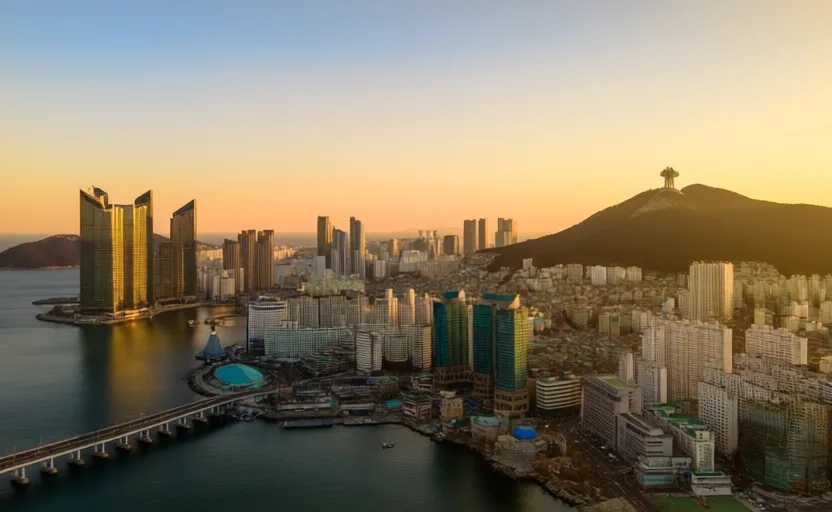 AI city illustration · Artistic impression
What people learn after moving
≈3.3 million and falling — down from a 1995 peak near 3.9 million
Korean, in the Gyeongsang dialect: pitch-accented, blunt, and with -노/-나 question endings that mark you as southern the moment you speak
South Korean won (KRW, ₩)
KST (GMT+9) — Korea does not observe daylight saving
AI city illustration · Artistic impressionCost of living in Busan
Check your eligibility
Pick your passport to see entry rules and the long-stay routes we have researched.
Pick your passport to see whether you can enter South Korea — and what it takes to stay.
Korea separates entry from residence completely. Visa-free entry or a K-ETA lets you visit; it never lets you work or stay. The long-stay category — E-7 skilled work, E-2 teaching, D-8 startup, D-10 job search, D-2 study, F-6 spouse, F-1-D remote work — is normally issued by a Korean consulate before you fly. Once here, you have ninety days to register at the immigration office and obtain the Alien Registration Card, and its thirteen-digit number is what every Korean system authenticates you against. Busan adds a route the capital does not have: three of its districts are designated population-decline areas where a local recommendation can open the F-2-R regional residence visa.
You may drive on your home licence plus a Geneva Convention International Driving Permit for one year from the date of entry, and the IDP must be issued at home before you fly — you cannot obtain a recognised one here. Once you hold an ARC, KoROAD will exchange your foreign licence, and for countries with reciprocity that means an eyesight and aptitude check rather than any test. Busan itself is a poor place to need a car: mountains squeeze the city into a coastal ribbon with no fast crosstown route, and the metro plus the Donghae coastal line covers most of it.
Korea runs a real-name financial system: an account belongs to a verified identity, and for a foreigner that identity is the ARC. Before it arrives some banks will open a deposit-and-withdraw-only account on your passport, with no transfers, no online banking and no outward remittance. A full account needs the ARC plus a Korean mobile number registered in exactly the same name. Even then, anti-fraud rules open every new account as a limited-transaction account capped around ₩1 million a day until you prove what the account is for. Busan's own bank, BNK Busan Bank, is a genuine option here and is often better at local landlord and utility arrangements than the national names.
Enrolment in National Health Insurance is compulsory for foreigners once you pass six months of residence, and it is not something you can decline because you hold private cover. With an employer the premium is split and deducted from payroll. Without one you are enrolled as a local subscriber and billed a premium set by reference to the national average rather than to your Korean income — which surprises people earning nothing here. Arrears can block a visa extension. Pension contributions are equally compulsory, and whether you can claim them back on leaving depends entirely on your nationality.
The important thing about a Korean phone number is not the calls. Korean identity verification binds your name, birth date, registration number and phone line together, and only a line registered to you personally passes it. Banking apps, delivery, government services and most of the useful parts of the internet check that. A data eSIM or a passport-bought prepaid SIM gives you connectivity and a number but will not clear the verification, so the sequence is eSIM on landing, ARC, then a postpaid or MVNO line in your own name. Home fibre is fast and cheap; Busan's older hillside buildings are where it gets complicated.
You become a Korean tax resident by having a settled life here or by spending 183 days or more in a tax year. Residents are taxed on worldwide income at progressive rates plus a 10% local surtax. Two reliefs matter to foreigners: if you have been resident five years or fewer of the last ten, your foreign-source income is taxed only when a Korean payer pays it or you remit it into Korea; and foreign employees may elect a flat 19% rate on Korean employment income instead of the progressive scale, forfeiting all deductions. Most employees never file a return — the employer's year-end settlement in January and February does it.
Each guide has verified costs, timelines, required documents, and the non-obvious gotchas — sourced from official government pages. Last verified August 2026.
Reading a list isn’t learning it. Globe Quest turns these into a trainer — hear each phrase spoken, drill them with spaced repetition, and get scored as you say them out loud.
Under the Housing Lease Protection Act your deposit is only protected once you have actually moved in and filed the move-in report (전입신고), and the resulting opposing power takes effect from 00:00 the following day. A landlord who registers a mortgage on the same day you hand over the money therefore ranks ahead of you. This one-day gap is the mechanism behind a large share of Korea's deposit fraud cases. File the report and get the fixed-date stamp (확정일자) immediately, and check the property register again the morning after.
The small-tenant priority repayment scheme protects part of your deposit ahead of every other creditor, but only if your deposit falls under a regional ceiling. In Busan the ceiling is ₩85 million and the protected slice is ₩28 million — against ₩165 million and ₩55 million in Seoul. That is a real difference if you are moving down from the capital with the same money. The figures are set by decree and revised, so confirm the current numbers before you sign.
Staying longer than 90 days means registering at the immigration office covering your district — for most of Busan that is the Busan Immigration Office — and paying the ₩30,000 fee. Appointments are booked through HiKorea and cannot be walked in. The 13-digit number on the card is what banking, phone contracts, health insurance and almost every Korean app authenticate against, so nothing else in your setup moves until it exists.
The Ministry of Justice runs a regional-specialised visa programme for officially designated population-decline areas. Three of Busan's old downtown districts — Dong-gu, Seo-gu and Yeongdo-gu — are on the designated list, with Jung-gu and Geumjeong-gu as areas of concern, and a local-government recommendation there can open the F-2-R residence visa at thresholds below the ordinary points route. The quotas, criteria and district list are reissued annually, so check the current year's plan rather than an old blog.
Busan takes the brunt of the typhoons that reach the peninsula, and the damage is storm surge rather than rain. Typhoon Maemi in 2003 drove the sea over the Suyeong and Millak waterfronts, and the high-rise seafront at Marine City has flooded repeatedly since. Ask which floor you are on, whether the underground car park has flood gates, and what the building did in the last big storm. Insurance and management practice vary a lot between towers.
Mountains push the built-up area into a long strip from Gangseo in the west to Gijang in the east, and there is no fast crosstown route. Haeundae to Sasang is an hour on the metro. Pick your neighbourhood against your actual workplace and metro line rather than against the beach photos — Line 2 serves the east coast, Line 1 the old spine through Seomyeon, and the Donghae Line runs up the eastern seaboard past the airport-bound interchanges.
Busan Port Authority, PSA and Hutchison terminals, HJ Shipbuilding, Korea Marine Environment Management Corp
Busan is one of the world's largest container ports and by far its biggest transshipment hub in the region. The New Port in Gangseo has taken most volume growth, while the old North Port is being redeveloped.
Korea Exchange (KRX), KAMCO, Korea Housing Finance Corporation, HUG, Korea Southern Power, BNK Financial Group
The Munhyeon financial district in Nam-gu is Korea's designated second financial centre. HUG — the state guarantor behind jeonse deposit insurance — is headquartered here, which is an odd thing to discover while worrying about your own deposit.
HJ Shipbuilding & Construction, Korea Marine Equipment Research Institute, Korea Maritime & Ocean University
Yeongdo has built ships since the 1930s and the surrounding cluster of marine equipment suppliers is the densest in the country, with the big hulls now assembled at Geoje and Ulsan nearby.
Renault Korea Motors, Sungwoo Hitech, parts suppliers across Gangseo and Sasang
The Renault Korea plant at Sinho in Gangseo is Busan's largest single manufacturing employer and its output is heavily export-oriented, which makes the local supply chain unusually sensitive to European demand.
Busan International Film Festival, Korean Film Council, Busan Cinema Center, BEXCO
The Korean Film Council relocated its headquarters here from Seoul, and Centum City hosts both the festival and the country's second-largest convention centre. Production support and location permits are handled locally.
Hotels and operators across Haeundae and Gwangalli, Busan Tourism Organization
Busan became the first Korean metropolitan city to pass 20% of its population aged 65 or over, and city policy is explicitly steering care, health and leisure services toward that market as well as toward visitors.
Nature · Suyeong-gu
A city beach facing a suspension bridge that is lit differently every night, with a drone show over the water most weekends.
Local tip: Haeundae gets the tourists; Gwangalli is where people who live here actually go. The cafés along the back street have better views than the seafront ones and half the queue.
Food · Jung-gu
Korea's largest fish market, where you buy the fish downstairs and carry it upstairs to be cooked, beside the old downtown's cinema street.
Local tip: The rule is that you pay a per-plate charge upstairs on top of what the fish cost — agree both before anyone picks up a knife. The narrow lanes behind the market sell the same catch for less.
Neighborhood · Saha-gu
A hillside of pastel houses built by refugees during the Korean War, now painted, mapped and heavily visited.
Local tip: People live here and the alleys are their front doors. Go on a weekday morning, walk uphill first and coast down, and skip the photo spots with queues — the views from the unmarked side lanes are the same.
Landmark · Seo-gu
Korea's oldest public beach, with a glass-floored pier and a cable car strung across the bay to Amnam Park.
Local tip: Not to be confused with Songdo in Incheon, which confuses even Koreans. Take the cable car one way and walk back along the Amnam Park cliff path — it is the best coastal walk inside the city.
Culture · Geumjeong-gu
A 7th-century mountain temple at the foot of the ridge that forms Busan's spine, with a long fortress wall along the top.
Local tip: The temple is twenty minutes' bus ride from Beomeosa station on Line 1. Walking the Geumjeong fortress wall north to south takes most of a day and is the closest thing Busan has to a hiking rite of passage.
Neighborhood · Yeongdo-gu
A single-file cliff path above the shipyards on the island side, with the sea on one hand and tiny houses on the other.
Local tip: Most visitors do the fifteen-minute photo stop and leave. Carry on around the island to Jeoryeong coastal walk and Taejongdae and you get three hours of empty cliff path. Yeongdo is also one of the districts on the population-decline visa list — cheap rents and a genuine neighbourhood behind the view.
Side-by-side cost of living, language, climate and careers — to help you choose.