
Population
≈950,000 in the municipality of Benito Juárez and growing fast — a city that did not exist before 1970
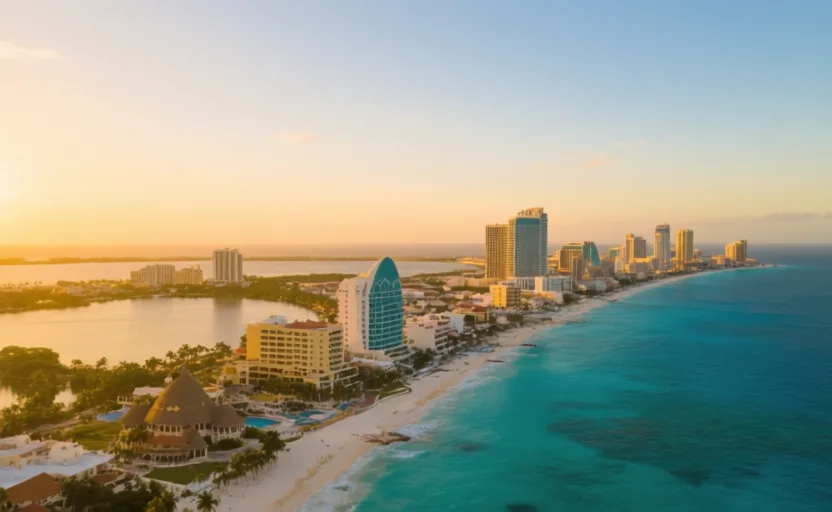 AI city illustration · Artistic impression
What people learn after moving
≈950,000 in the municipality of Benito Juárez and growing fast — a city that did not exist before 1970
Spanish, with widespread hospitality English and a significant Maya-speaking population from the peninsula
Mexican peso (MXN, $). Dollars are accepted in tourist areas, always at a poor rate
Southeast Time, GMT−5 all year — Quintana Roo left Central Time in 2015, so Cancún is an hour ahead of Mérida and the rest of Mexico
AI city illustration · Artistic impressionCost of living in Cancún
Check your eligibility
Pick your passport to see entry rules and the long-stay routes we have researched.
Pick your passport to see whether you can enter Mexico — and what it takes to stay.
Mexican temporary residency starts outside Mexico. A consulate abroad issues a visa sticker, you enter Mexico with the entry record marked for canje, and you then have 30 days to begin the exchange at INM for the physical Tarjeta de Residente. Cancún's particular hazard is cultural rather than legal: this is the city where more foreigners live semi-permanently on repeated tourist entries than anywhere else in Mexico, and where the folklore about 'just doing a border run' is loudest. Officers at this airport are also among the most practised at declining to grant the full 180 days. The card carries your CURP, and the CURP is what unlocks the bank account, IMSS, a postpaid phone line and an RFC.
You may drive in Mexico on a valid foreign licence, and an International Driving Permit is a translation rather than an authorisation. The Quintana Roo licence is obtained at a state module with a CURP, proof of address, a medical check and a theory exam, and is issued in several validity bands. What is genuinely local is everything after the licence: the city floods in the rainy season because it is built on flat limestone with limited drainage, the Zona Hotelera has one road in and out, and Highway 307 south towards Playa del Carmen and Tulum is a fast, heavily policed road with a long history of incidents involving foreign drivers.
Mexican accounts are tiered by regulation. A Nivel 2 account from a fintech opens from your phone in minutes with a passport and CURP and no proof of address, but caps monthly deposits. A Nivel 4 account has no cap, can receive a salary, and needs a comprobante de domicilio and usually an RFC. Cancún adds a second banking relationship most Mexican cities do not: if you buy property, a Mexican bank will be the trustee of your fideicomiso, charging an establishment fee and an annual fee for the rest of the trust's life. Those are two separate relationships and it is worth shopping them separately.
A formal Mexican job enrols you in IMSS automatically and by law, which in Cancún means most of the hotel and airport workforce. Everyone else can buy into IMSS voluntarily through Seguro de Salud para la Familia, with waiting periods and permanent exclusions, or buy private cover, which is cheap by US and European standards. Cancún's private hospitals are used to foreign patients and to insurers, which is convenient and also means they are practised at billing them. The genuinely local health content is tropical: dengue and other mosquito-borne disease, sun and heat, and what happens to a healthcare plan during a hurricane.
Buy a prepaid SIM at any OXXO on arrival and start on Telcel Amigo for the widest coverage. Linking every Mexican line to a CURP and a photo ID became compulsory on 9 January 2026, and unregistered prepaid numbers are being suspended through the second half of 2026 on a calendar set by the last digit — the non-biometric successor to the PANAUT registry the Supreme Court struck down. Fixed internet in the supermanzanas is fast and cheap. The Cancún-specific planning is redundancy: a storm, or even a heavy afternoon downpour, takes down power and sometimes the local network, and a remote worker with one connection has one point of failure.
Income tax in Mexico is federal, and a Mexican employer withholds ISR through payroll. Freelancers and small businesses can elect RESICO, taxing gross receipts at 1–2.5% up to MXN 3.5 million a year. Quintana Roo's own layer is where Cancún differs from every other Mexican city here: a state payroll tax raised to 4%, a lodging tax on short-term accommodation that was increased for 2026 and applies to platform lettings, a per-room-night environmental levy that funds beach and sargassum cleaning, and the Visitax charged to foreign visitors — which residents do not pay, and which is widely mis-sold by third-party websites at a markup.
Each guide has verified costs, timelines, required documents, and the non-obvious gotchas — sourced from official government pages. Last verified August 2026.
Reading a list isn’t learning it. Globe Quest turns these into a trainer — hear each phrase spoken, drill them with spaced repetition, and get scored as you say them out loud.
Article 27, section I of the constitution bars foreigners from acquiring direct ownership of land within 100 km of a border and 50 km of a coast. Cancún is on the Caribbean, so it is inside the coastal strip on any reading, and unlike Mérida — where the distance to the sea makes it genuinely arguable — there is nothing to debate here. A foreign buyer holds residential property through a fideicomiso: a bank trust authorised by the SRE under articles 10 and 11 of the Ley de Inversión Extranjera, running 50 years and renewable, in which the bank holds title and you hold every ownership right including the right to sell, lease, improve and bequeath. Budget roughly MXN 15,000–25,000 to establish it plus an annual bank fee in the hundreds of dollars, and confirm both with the bank rather than the agent. The 'buy through a Mexican company instead' shortcut does not work for a home: under article 10 a Mexican company with foreign shareholders may hold restricted-zone property only for non-residential purposes, and agents who suggest otherwise are describing a structure that does not survive scrutiny.
NOAA's outlook for the 2026 Atlantic season leaned below-normal — a 55% chance of a below-normal season, with six to sixteen named storms — but a quiet season is a statement about frequency, not about your building. What matters is the specific property: does it have hurricane shutters or laminated glass, what floor is it on, does the building have a generator and independent water storage, how does the underground parking drain, and what does the lease say happens if the property is uninhabitable for a month. Wilma in 2005 sat over Cancún for the better part of two days and the recovery took a year. Ask these questions in February when nobody minds answering them.
The Caribbean-facing beaches receive brown seaweed from roughly March to October, and 2026 has run far above every previous year — state monitoring put the season's collection past 93,000 tonnes by late July with forecasts running towards 130,000, and Benito Juárez alone accounted for more than 21,000 tonnes. The practical local knowledge is that Cancún's north-facing beaches at the top of the strip — Playa Las Perlas, Tortugas, Caracol, Langosta, facing the sheltered Bahía de Mujeres — get dramatically less of it than the east-facing beaches further down the island, which take the open Caribbean head-on. If beach access is part of why you are moving here, that geography is the single most useful thing to know, and it also explains why Isla Mujeres and Puerto Juárez stay usable when Playa Delfines does not.
The state left Central Time in February 2015 and has been on UTC−5 year-round ever since, and it does not observe daylight saving. That means Cancún is one hour ahead of Mérida, Mexico City and almost all of Mexico for the whole year, and that its offset against the US east coast changes twice a year even though Cancún's own clock never moves. It is the single most common scheduling error people make in their first months, and it catches domestic flights, video calls with the rest of Mexico and anything booked by a system that assumes Mexico is one time zone.
Cancún was master-planned in the 1970s and is organised into numbered supermanzanas ringed by main avenues, with quiet interior streets, a park and a school inside each. Addresses are given as SM, manzana and lote rather than as a street and number, taxi drivers navigate by supermanzana, and delivery apps frequently need the same. Beyond the supermanzanas are the numbered regiones, where most of the city's workforce lives. Learning to read an address this way, and learning which numbers are near which avenues, is a genuinely useful first-week task with no equivalent in any other Mexican city.
The 22 km hotel strip is a barrier island with one road down it, hotel-priced everything, and a bus service designed for tourists. Long-term rentals exist there and cost a large multiple of the equivalent in the city, with a commute that becomes untenable the moment the single road is congested. Residents live in the supermanzanas, in Puerto Cancún, along the Bonampak and Huayacán corridors, or in the newer developments to the south and west. Visit the strip, use its beaches, and rent somewhere with a supermarket.
Grupo Xcaret, Palace Resorts, RIU, Iberostar, Hilton, Marriott, Grupo Posadas
The dominant employer by a wide margin. Cancún and the Riviera Maya carry a large share of Mexico's international leisure arrivals, which makes hotel operations, F&B, revenue management and guest experience the deepest professional job market in the state — and makes the whole local economy sensitive to a bad season.
Cancún International Airport (ASUR), Aeroméxico, Volaris, Viva, international carriers, ground handlers
Cancún is Mexico's second-busiest airport and one of the best-connected in Latin America, with direct services across North America, Europe and the Caribbean. For a remote worker it is a genuine and underrated advantage; for the local economy it is infrastructure and employer at once.
Local and national developers across Puerto Cancún, Puerto Morelos and the Huayacán corridor
A permanently active development market driven by second homes, rental investment and rapid population growth — and the reason the fideicomiso question comes up in almost every conversation a foreigner has here.
Tren Maya operations, Puerto Juárez and Punta Sam ferry terminals, cruise terminals at Puerto Morelos and Cozumel
The Tren Maya, which runs a station at Cancún airport, reconfigured travel across the peninsula and brought with it an ongoing infrastructure and logistics employment base that did not exist a decade ago.
Coworking operators, agencies serving US clients, a large independent freelance population
Cheap fibre, an hour-or-less time difference to the US east coast, and an airport with direct flights everywhere have made Cancún one of Mexico's larger remote-work bases outside Mexico City — quieter and more residential than Playa del Carmen or Tulum.
Dive operators, the MUSA underwater museum, national park and reef management bodies
The Mesoamerican Reef runs the length of the coast, and diving, marine conservation and reef research are a real professional niche here alongside the recreational industry — as, increasingly, is sargassum management.
Landmark · Zona Hotelera, km 17
A small Maya site of platforms and a pyramid base right on the hotel strip, overrun with iguanas and almost always empty.
Local tip: It takes forty minutes and costs very little, and it is the reminder that this was a Maya coast long before it was a resort. Go at opening time and you will likely have it to yourself except for the iguanas, which are numerous and unbothered.
Food · SM 28 and SM 23
Two very different markets: 28 is the handicraft one everyone is sent to, 23 is the working market where the city actually shops and eats.
Local tip: Go to 23, not 28. It has the fondas where you get a full comida corrida for a fraction of Zona Hotelera prices, the herbalists, the fish counter, and no one trying to sell you a sombrero.
Nature · 13 km offshore, ferries from Puerto Juárez
A small, flat, largely car-free island with the best swimming beach in the region at Playa Norte and a slower version of the same coast.
Local tip: Take the Puerto Juárez passenger ferry rather than a Zona Hotelera one — cheaper, more frequent and used by residents. Go on a weekday, and get to the south end at Punta Sur before the day trippers arrive at eleven.
Nature · North end of the Zona Hotelera, facing the Bahía de Mujeres
The north-facing public beaches at the top of the strip — shallow, calm, and largely spared the sargassum that hits the Caribbean-facing side.
Local tip: This is the local answer to a bad sargassum year, and in 2026 it has mattered a lot. Las Perlas is the smallest and the most residential; go early and park before the strip fills.
Culture · SM 22, city centre
The city's main square: food stalls under palapas, a bandstand, children's rides, and every family in the neighbourhood on a Saturday evening.
Local tip: This is the evening that tells you Cancún is a real city and not a resort. Come after eight, eat marquesitas and elotes from the carts, and notice that almost nobody here is a tourist.
Culture · Zona Hotelera, km 16.5
A modern archaeology museum with pieces from across the peninsula, attached to the San Miguelito ruins in the jungle behind it.
Local tip: The ticket covers both and most visitors do only the museum. The San Miguelito path behind it is shaded, nearly empty, and takes twenty minutes — do it first, while it is cool.
Side-by-side cost of living, language, climate and careers — to help you choose.