
Population
≈1.1 million in the district; the third-largest city on Colombia's Caribbean coast after Barranquilla
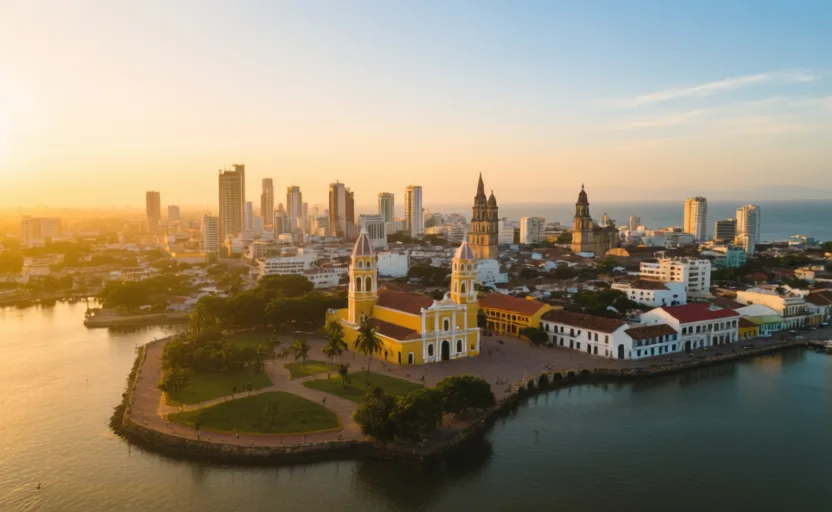 AI city illustration · Artistic impression
What people learn after moving
≈1.1 million in the district; the third-largest city on Colombia's Caribbean coast after Barranquilla
Sea level — no altitude effects, and parts of Bocagrande and the centre flood in heavy rain at high tide
Spanish, in a fast costeño accent that drops final s and softens r — noticeably harder for learners than Bogotá's
Colombian peso (COP)
AI city illustration · Artistic impressionCost of living in Cartagena
Check your eligibility
Pick your passport to see entry rules and the long-stay routes we have researched.
Pick your passport to see whether you can enter Colombia — and what it takes to stay.
Colombia sorts long stays into three classes: V (Visitante, including the digital-nomad visa), M (Migrante — work, marriage, pensionado, investment) and R (Residente). You apply online through the Cancillería portal, with a published thirty-day decision window and usually no consular interview. The step people underestimate comes after approval: any visa valid more than three months must be registered with Migración Colombia within fifteen calendar days, producing the cédula de extranjería that unlocks banking, EPS, leases and utility contracts. A tourist stamp gives 90 days, extendable to 180 days maximum per calendar year, and confers no right to reside or work. Cartagena's particular flavour is that a large share of foreigners arrive as property buyers, and the investment route to an M visa depends on the purchase being made through the formal exchange market and registered with the Banco de la República — get that wrong and both the visa and the eventual repatriation of your money become problems.
Cartagena is compact and hot, which makes walking pleasant for ten minutes and unpleasant for thirty. TransCaribe is the articulated-bus system, with the fare set at COP 3,900 by district decree from late January 2026. The city's defining transport fact is that taxis carry no meters: fares are agreed before the trip, which is why ride apps with a fixed in-app price are the standard answer for foreigners. Pico y placa here is unusual — private cars are restricted only in the two peaks, roughly 7–9am and 6–8pm, while motorcycles are restricted from 5am to 11pm on their day, and the digit-to-weekday table is redrawn every few months. Colombia does not exchange most foreign licences: after six months you need a Colombian one, obtained through the RUNT, a medical assessment, a driving school and both exams.
The cédula de extranjería is the gate: with one you can open an account at Bancolombia, Davivienda, BBVA, Banco de Bogotá or Scotiabank Colpatria, and without one you generally cannot, because anti-money-laundering rules key on it. Until then you run on a foreign card, cash and Wise. Two national things matter more than the choice of bank. Bre-B, the Banco de la República's interoperable instant-payments scheme, has been live since 2025 and lets you pay any participating bank or wallet using a registered llave, ending the old Nequi-versus-Daviplata split. And the 4x1000 (GMF) takes 0.4% of most withdrawals and transfers unless you nominate one account as exempt — which you have to ask for. On top of that, Cartagena adds the exchange-control layer: money brought in to buy property must move through the formal exchange market and be registered as foreign investment, or you cannot lawfully send the proceeds back out later.
Colombia's contributory system runs through EPS insurers. Employees contribute 4% of salary with employers adding 8.5%; the self-employed pay the full 12.5% of a declared income base that cannot fall below one minimum wage — roughly COP 219,000 a month in 2026. Affiliation needs a cédula, and some visa classes, notably M-Pensionado and several V categories, cannot affiliate at all. The usual foreign setup is EPS plus a medicina prepagada plan for fast specialist access. The sector is mid-reform with several large insurers under Superintendencia intervention and 2026 rules restricting an EPS from operating where it holds too small a share of a department's members, so verify your insurer is functioning in Bolívar. Cartagena's private hospitals are good but fewer than in the big interior cities, and genuinely complex care is often referred to Barranquilla, Medellín or Bogotá — worth knowing before you need it rather than after.
A prepaid (prepago) SIM takes fifteen minutes, costs almost nothing and needs only your passport, which the clerk registers because the law requires the line to be in a name. The trap is the handset, not the line: Colombia runs a national IMEI database against phone theft, and a device bought abroad that is never registered gets cut off after roughly three to four weeks. Claro has the broadest coverage, Movistar and Tigo sit between, WOM is cheapest and thinner outside the city. Home internet is the Cartagena-specific problem: fibre is straightforward in Bocagrande, Manga and the newer northern developments, but in the Centro Histórico and parts of Getsemaní the IPCC's heritage rules prohibit visible antennas and dishes on elevations and prohibit perforating façades, so what a provider can physically install in a colonial house is sometimes genuinely limited. Ask before you sign a lease you intend to work from.
Colombia taxes residents on worldwide income, and residency is a day count: 183 days or more within any rolling 365-day period. A digital-nomad visa does not exempt you and neither does being paid abroad. Rates are progressive to 39% and every threshold is expressed in UVT, a peso unit DIAN republishes each December. You register a free RUT with DIAN, then file the declaración de renta between August and October on a date fixed by the last two digits of your NIT. Cartagena adds two layers. The district levies ICA on business and independent professional activity carried on here, filed with the district hacienda rather than DIAN. And if you let a property for stays under thirty days, that is a tourism activity: it requires registration in the Registro Nacional de Turismo, your building's horizontal-property by-laws must expressly permit accommodation, and the income and its consumption taxes follow from that. Cartagena's heritage properties also sit inside a Plan Especial de Manejo y Protección whose incentives — partial predial relief, and lower utility strata in specific cases — were approved in June 2026 and await formal ministerial resolution.
Each guide has verified costs, timelines, required documents, and the non-obvious gotchas — sourced from official government pages. Last verified August 2026.
Reading a list isn’t learning it. Globe Quest turns these into a trainer — hear each phrase spoken, drill them with spaced repetition, and get scored as you say them out loud.
Cartagena taxis do not run meters and never have. The fare is negotiated or assumed by zone, which means every ride is a small price discovery exercise and foreigners routinely pay two or three times the local rate. Ask a Colombian colleague or your building's portero what a given trip should cost, state your price rather than asking theirs, and default to Uber, DiDi or InDrive where the fare is fixed in the app. This is the single most common way newcomers quietly overpay every single day.
Cartagena sits at sea level and runs at 28–32°C with humidity above 80% for most of the year. Air conditioning is not a luxury and running it is the largest variable in your monthly costs. Layer on the estrato: every dwelling carries a 1-to-6 rating attached to the property, and estratos 5 and 6 pay a solidarity surcharge on utilities — capped at 20% of the service value for electricity and piped gas by Ley 142 de 1994 art. 89.1, but much heavier on water, sewerage and rubbish, where Ley 1450 de 2011 art. 125 sets floors of 50% for estrato 5 and 60% for estrato 6. A Bocagrande flat with aircon running all day is a different financial proposition from the same flat in Manga. Ask for an Afinia bill from a hot month, not an average.
The Centro Histórico is a national heritage asset and the IPCC's rules prohibit visible air conditioning units, water tanks and antennas on external elevations, and prohibit perforating walls, doors, windows and façades to fit air conditioners or extractors. That is a genuine constraint on a colonial house in a city this hot, and it also complicates satellite dishes and some external cabling. A new Plan Especial de Manejo y Protección was approved by the National Council of Cultural Heritage in June 2026 and awaits its ministerial resolution; until it is formally in force, ask precisely who authorises what before you commit to any works.
Short-term tourist letting in Colombia requires registration in the Registro Nacional de Turismo, and in an apartment building the horizontal-property by-laws must expressly permit the provision of accommodation. Administrators can and do report unauthorised units, and the Superintendencia de Industria y Comercio enforces. A draft decree circulating in 2026 would push platforms to verify hosts' registrations every six months and delist those without one. If part of your plan is to buy in Cartagena and let it out, read the building's reglamento before you read the listing.
Cartagena restricts private cars only in the two peaks — roughly 7am to 9am and 6pm to 8pm — while motorcycles are restricted from 5am to 11pm on their day. The digit-to-weekday table changes every few months rather than every six, so it is not a rule you memorise once. Weekends and public holidays are exempt. Given the short car windows and the traffic through the centre, most residents drive little and walk, take TransCaribe or use apps.
Sea air corrodes everything: hinges, laptop ports, bicycle chains, air conditioning coils, car bodywork. Humidity above 80% grows mould in wardrobes and behind furniture within weeks if a flat is shut up. Run the aircon or a dehumidifier periodically even when away, leave air gaps behind furniture, and expect to service split units more often than the manual suggests. In older Getsemaní and Centro houses, ask specifically about damp in the walls before you sign.
Reficar (Ecopetrol), Esenttia, Dow, Cabot, Ajover
The Mamonal industrial corridor south of the city is Colombia's petrochemical heartland — Reficar is one of Latin America's largest refineries and the reason Cartagena is an industrial city as well as a tourist one.
Puerto de Cartagena, Contecar, Compas, freight forwarders
Cartagena handles the largest container throughput in Colombia and is a major transhipment hub for the Caribbean, supporting a deep customs, freight and shipping-agency sector.
Hotel groups, tour operators, cruise terminal, event venues
The visible economy: hotels, restaurants, weddings, congresses and one of the busiest cruise terminals on the continent. It also shapes the housing market more than any other single force.
COTECMAR, Colombian Navy, ship repair yards
Cartagena is the Colombian Navy's principal base, and COTECMAR designs and builds vessels here — an engineering employer that has nothing to do with tourism.
Bocagrande and Zona Norte developers, Serena del Mar
A long high-rise construction cycle along the peninsula and northward toward Serena del Mar, driven heavily by second homes and short-let investment rather than local demand.
Bilingual contact centres, shared-services operations
A growing nearshore sector taking advantage of a young bilingual workforce and costs below Bogotá's, concentrated around the Bocagrande and Pie de la Popa office corridors.
Landmark · Centro Histórico
Eleven kilometres of seventeenth-century fortification wrapping the old city, with vaulted powder magazines at the northern end now full of craft stalls.
Local tip: Walk the ramparts at sunset from the Baluarte de Santo Domingo — it is free, it is the best view in the city, and it is the one tourist thing locals also do.
Neighborhood · Just outside the walls, east of the centre
The old working-class quarter of the walled city — umbrella-strung lanes, murals, plaza life around Trinidad church and the last genuinely residential streets in the historic core.
Local tip: Come to the Plaza de la Trinidad after 7pm, when the neighbourhood eats, drinks and plays football in the square. Gentrification is real here, so the tenor changes street by street.
Food · Bazurto, east of the centre
The chaotic, sprawling market where the whole city actually buys its fish, fruit and meat — nothing curated, nothing for visitors, everything real.
Local tip: Go early with a local, take no valuables and eat the mote de queso from a stall. It is intense and grubby and it explains Cartagena better than any guided tour of the walls.
Nightlife · Calle del Guerrero, Getsemaní
A live salsa bar with a horn section and a ceiling fan, plus the rooftop bars and street drinking that fill Getsemaní after dark.
Local tip: Cash only at Havana, and the queue is worst between 11pm and midnight. Go at 10pm or after 1am, and drink the aguardiente the band drinks.
Culture · Pie de la Popa
The largest Spanish fortress in the Americas, honeycombed with tunnels, built to hold the city against a British fleet — which it did.
Local tip: Go at opening time or late afternoon; the stone reflects the midday heat brutally. Pair it with the Convento de la Popa on the hill above for the full defensive geography.
Nature · Island, 10 minutes by boat from Bocagrande
A large island in plain sight of the skyline with fishing villages, quiet beaches and Spanish fortifications, and almost none of the Rosario Islands' crowds.
Local tip: Take the local lancha from the Bocagrande pier rather than a tour boat — it costs a fraction and takes ten minutes. Bocachica's Fuerte de San Fernando is genuinely worth the walk.
Side-by-side cost of living, language, climate and careers — to help you choose.