
Population
≈3.5 million in the city; over 5 million across the Casablanca-Settat conurbation — Morocco's largest by a wide margin
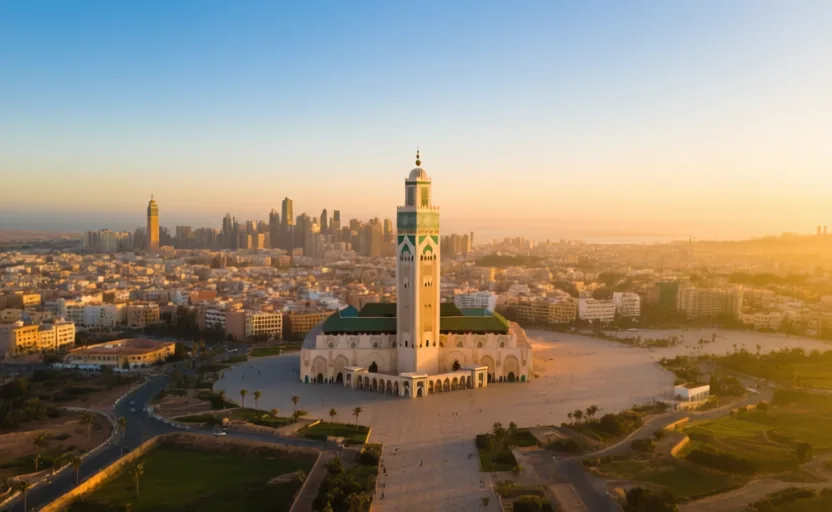 AI city illustration · Artistic impression
What people learn after moving
≈3.5 million in the city; over 5 million across the Casablanca-Settat conurbation — Morocco's largest by a wide margin
Moroccan Arabic (Darija) and French in daily use, Modern Standard Arabic and Amazigh official. French dominates business, banking and higher education; English is rising fast in offshoring and tech
Moroccan dirham (MAD) — not freely convertible, and subject to Office des Changes rules
GMT+1 year-round, except that Morocco reverts to GMT+0 for the month of Ramadan
AI city illustration · Artistic impressionCost of living in Casablanca
Check your eligibility
Pick your passport to see entry rules and the long-stay routes we have researched.
Pick your passport to see whether you can enter Morocco — and what it takes to stay.
Every foreigner staying beyond three months must hold a carte d'immatriculation — universally called the carte de séjour. It is a single card carrying a 'mention' that describes why you are here: travail, étudiant, visiteur, or a commercial activity. The card is cheap and issued in around thirty-five days once accepted. Almost all the difficulty is in the file, and specifically in three documents: proof of address, an attestation de résidence from your local authority, and a criminal-record extract from your country of origin.
A foreign licence is valid in Morocco for twelve months from the date you take up residence. Within that window NARSA will exchange it for a Moroccan licence if your country has a reciprocity agreement with Morocco; France, Spain, Belgium, Italy and Germany are among those that do. Miss the window or come from a country without an agreement, and you sit the Moroccan theory and practical tests as a new driver. Casablanca traffic is the real subject, though — the city has four tram lines and a busway network precisely because driving here is unrewarding.
The Moroccan dirham is not freely convertible. That single fact organises everything. An ordinary resident dirham account holds money that can be spent in Morocco but cannot be sent back out. A convertible-dirham account — or a foreign-currency account — holds money you imported from abroad and keeps its right to leave, and the Office des Changes lets foreign residents open one on production of a passport, without prior authorisation. Choosing wrongly is a mistake you generally cannot undo.
If you are employed in Morocco, your employer must register you with the CNSS from your first day — this is not optional and applies to foreign employees. AMO contributions are deducted from your salary and give access to reimbursed care. In practice Casablanca's professional class supplements AMO with private insurance and uses the private clinics, because the reimbursement rates leave a substantial gap and public hospital capacity is stretched. If you are not employed here, you are buying private cover.
SIM registration against an identity document has been mandatory since the ANRT ended anonymous prepaid cards, so you buy a SIM in an operator shop with your physical passport, not a copy. Prepaid is the norm and is cheap; postpaid contracts generally want a carte de séjour and a Moroccan bank account. Mobile data in Casablanca is fast and reliable. Fixed fibre is good in the central and newer districts and patchy in older buildings, which matters if you work from home.
Article 23 of the Code Général des Impôts makes you a Moroccan tax resident if you have your permanent home here, or your centre of economic interests here, or you spend more than 183 days here over any 365-day period. Any one of the three is enough. A Moroccan tax resident is taxable on worldwide income, subject to double-taxation treaties. Employees have IR withheld at source and mostly do not file. The two things worth understanding in advance are the CFC flat-rate option and the pension reduction under article 76.
Each guide has verified costs, timelines, required documents, and the non-obvious gotchas — sourced from official government pages. Last verified August 2026.
Reading a list isn’t learning it. Globe Quest turns these into a trainer — hear each phrase spoken, drill them with spaced repetition, and get scored as you say them out loud.
You need one to stay beyond three months, and you apply at the commissariat or préfecture de police covering your address, not at a central office. The card itself is cheap and issued in around thirty-five days. What actually costs people months is the file: a legalised lease or an attestation d'hébergement, an attestation de résidence from the moqata'a, a medical certificate less than three months old, a criminal-record extract from your home country, and legalised copies of everything. Start assembling those before you fly, and get the home-country police certificate while you are still in the country that issues it.
The dirham is not freely convertible. An ordinary resident dirham account can be spent in Morocco but the money cannot be sent back out. A convertible-dirham account, or a foreign-currency account, holds money you brought in from abroad and keeps its right to leave. If you are paid from outside Morocco, you want the convertible account and you want to fund it by importing foreign currency with the exchange receipts kept. Converting into an ordinary account is a one-way door, and it is the mistake foreigners here most regret.
Moroccan law requires a foreign national's employment contract to be approved by the labour ministry, and before that the employer must obtain an ANAPEC attestation certifying no suitable Moroccan candidate was found — or that an exemption applies. The process now runs through the ministry's TAECHIR platform. It is the employer's job, but it is your problem: the ANAPEC step alone can take a couple of months, and a carte de séjour with the 'travail' mention is issued on the strength of the visaed contract.
A foreign licence is valid in Morocco for one year from the date you take up residence. NARSA will exchange it for a Moroccan one if your country has a reciprocity agreement with Morocco — France, Spain, Belgium, Italy and Germany among them — on production of your carte de séjour or its récépissé plus a residence certificate less than three months old. Fees run to a few hundred dirhams. Miss the window, or come from a country without an agreement, and you take the Moroccan theory and practical tests like a new driver.
CFC status is granted to companies serving markets outside Morocco: regional headquarters, financial firms, professional services. Qualifying companies get a corporate tax holiday for their first five years and a preferential rate afterwards, and their employees can elect a flat 20% rate on Moroccan-source employment income instead of the progressive scale, for a maximum of ten years. The 2026 Finance Law confirmed 20% for both — older write-ups quoting 15% are out of date. None of it changes your immigration status, and none of it makes your dirhams convertible.
This is not Marrakech. There is no medina tourism economy softening the edges, the architecture is French colonial art deco going quietly to seed rather than restored riads, and the beaches west of the Corniche are working coast. What it has instead is jobs, a real professional middle class, the best restaurants in the country, and a genuine indifference to whether you are a foreigner — which after a month in a tourist city is a relief.
Attijariwafa Bank, Banque Centrale Populaire, BMCE Bank of Africa, CDG Capital, Bourse de Casablanca
Morocco's banking sector is headquartered here and has expanded aggressively across francophone West Africa — Attijariwafa and BMCE operate in more than twenty African countries, which is why Casablanca positions itself as a gateway rather than a market.
Regional HQs, asset managers, insurers, law and audit firms
A designated financial district with its own company status, granting a corporate tax exemption for five years and a preferential rate afterwards to firms whose business is oriented outside Morocco. Narrow by design: domestic business does not qualify.
Stellantis Kenitra, Renault, Aptiv, Yazaki, Safran, Bombardier (Casablanca aerospace hub)
Morocco is now the largest car manufacturer in Africa, and the wiring, seating and aerospace supply chains cluster around Casablanca and the Kenitra–Tanger corridor. Engineering and quality roles here are genuinely plentiful.
Casanearshore, Capgemini, Atos, Intelcia, Webhelp/Concentrix, Sopra Steria
Casanearshore in Sidi Maârouf is one of Africa's largest offshoring parks. French-language IT, finance and customer operations for European clients are the volume employer for graduates and for francophone foreigners.
Marsa Maroc, OCP Group, Maersk, CMA CGM
The port of Casablanca handles a large share of Morocco's trade, and OCP — the state phosphate group and one of the world's largest fertiliser producers — is headquartered in the city with industrial sites at Jorf Lasfar down the coast.
Marjane, Label'Vie, Cosumar, Lesieur Cristal, Maroc Telecom, Orange Maroc, inwi
Consumer businesses run their national operations from Casablanca because it is where a third of Morocco's formal purchasing power sits. Marketing and commercial careers are concentrated here to a degree that surprises people expecting Rabat.
Landmark · Sour Jdid, on the Atlantic
One of the largest mosques in the world, built out over the ocean with a 210-metre minaret and a retractable roof.
Local tip: It is one of very few mosques in Morocco non-Muslims may enter, and only on a guided tour at set times — book rather than turning up. Go at low tide and walk the sea wall behind it; the platform is glass-floored over the water in places, which almost nobody notices from the courtyard.
Neighborhood · South of the centre
A 1930s 'new medina' built by the French in a stylised Moroccan idiom — arcades, a covered market, and the city's traditional bookshops.
Local tip: This is where Casablancans actually buy their olives, dates and mkhabbaz pastries, and where the old book and manuscript dealers are. The arcades are the best shade in the city in August, and prices are marked rather than negotiated, unlike the old medina.
Culture · Centre-ville
One of the world's densest concentrations of 1920s–40s art deco and Mauresque architecture, largely unrestored.
Local tip: Look up. The ground floors have been re-fronted with shop signage but the upper storeys are almost untouched — Cinéma Rialto, the Villa des Arts and the buildings around Marché Central. Casamémoire, a local heritage association, runs walking tours, which is the only reliable way to get inside the courtyards.
Nightlife · West along the coast
The seafront strip of beach clubs, restaurants and bars that is Casablanca's warm-weather social centre.
Local tip: The beach clubs charge day rates and are where the city's professional class actually spends Sunday. The public beach beyond them is free and much livelier. Note that alcohol is served here and in hotels but is not sold everywhere — this is a Muslim country with a licensed, visible drinking culture in specific places rather than a general one.
Food · Boulevard Mohammed V
The 1917 central market — fish, produce, flowers — with a ring of stalls that will cook what you just bought.
Local tip: Buy your fish at the counters at the back and hand it to one of the small restaurants around the edge; they grill it for a small charge and it costs a fraction of a restaurant meal. Go before 1pm — this is a lunch institution, not a dinner one.
Nature · 20–30 minutes south-west along the coast
A tidal island shrine just past the Corniche, and beyond it the surf beaches and low-rise sprawl of Dar Bouazza.
Local tip: The island is reachable on foot only at low tide and is a working shrine rather than a monument, so go quietly and ask before photographing. Keep going south-west and you reach the beaches where Casablanca's surf community lives — Tamaris, Jack Beach and Bouznika. This is the escape valve locals use and visitors never find.
Side-by-side cost of living, language, climate and careers — to help you choose.