
Population
≈21 million in the municipality — capital of Sichuan and the largest city in western China
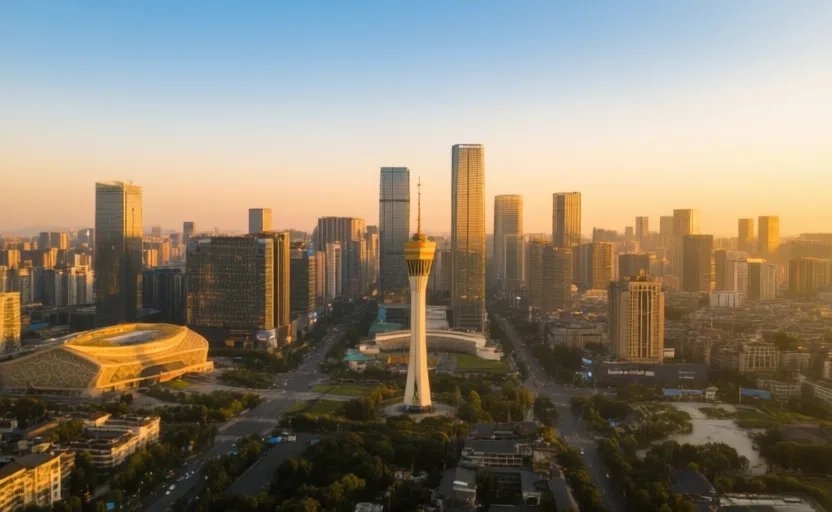 AI city illustration · Artistic impression
What people learn after moving
≈21 million in the municipality — capital of Sichuan and the largest city in western China
Mandarin, in the Sichuanese dialect — tones shift and retroflex sounds soften, but standard Mandarin is universally understood. English is limited outside the consular and high-tech districts
Renminbi / Chinese yuan (CNY, ¥)
CST (GMT+8) — all of China runs on Beijing time, so Chengdu's sunrise and sunset are noticeably later than the clock suggests
AI city illustration · Artistic impressionCost of living in Chengdu
Check your eligibility
Pick your passport to see entry rules and the long-stay routes we have researched.
Pick your passport to see whether you can enter China — and what it takes to stay.
The national sequence applies: Notification Letter of Foreigner's Work Permit obtained by your employer, Z visa at a Chinese mission abroad, entry, work permit card, then a residence permit within 30 days of entry — plus police registration within 24 hours of moving into a private flat. What differs in Chengdu is the arithmetic. The national points table awards additional points for employment in western China and calibrates salary points against the local average wage, and Sichuan's average wage is far below Shanghai's. The same person scores better here, and that can be the difference between Category B and Category A.
A foreign licence is not valid in mainland China and the International Driving Permit is not recognised. Conversion means a translation, a medical and the hundred-question written theory test, with practical tests waived for ordinary car categories. Unlike Beijing, Shanghai, Shenzhen, Guangzhou and Hangzhou, Chengdu has not imposed a plate quota — you can simply buy a car and register it. What it does impose is a rotating weekday restriction by plate-ending digit inside the ring roads, and this is the mainland city where a car is most obviously worth having, because the mountains are close.
Alipay and WeChat Pay accept foreign Visa and Mastercard up to USD 5,000 per transaction and USD 50,000 a year after verification, which covers a visit. Living here needs a local account, and the account needs a Chinese mobile number registered against your passport. The Chengdu-specific reality is that far fewer branches have onboarded a foreign resident than in Shanghai, so which branch you walk into matters more here than anywhere else — and the consular district branches in Wuhou are the ones that have.
Chengdu is unusually well provided for a second-tier city because West China Hospital of Sichuan University is one of the largest and most highly regarded hospitals in the country — people fly here from across western China for treatment. Ordinary outpatient departments are cheap and conducted in Mandarin; the international wing costs more and is far easier. The genuinely local health variable is the Sichuan basin's topography, which produces very low sunshine, persistent humidity and winter inversions that trap pollution over the city.
A SIM takes twenty minutes and a passport and should be your first errand, because the number gates the bank account and the payment apps. The blocked-services position is identical to the rest of mainland China — Google, Meta, WhatsApp, X and most Western news are unreachable on an ordinary connection — and unlike Shenzhen there is no Hong Kong SIM roaming a short journey away. Sort out your arrangement before you fly, and expect WeChat to become your primary channel with everyone here.
The national rules apply exactly as elsewhere: monthly withholding, an annual reconciliation between March and June, a 183-day residence test, and a six-year rule on worldwide income that resets with a single absence of more than thirty consecutive days. Foreign nationals also elect annually between the expatriate fringe-benefit exemptions and the standard itemised deductions. Chengdu has no local subsidy of the kind the Greater Bay Area offers — but the social insurance contribution base is set against Sichuan's local average wage, which is materially lower, so the same salary carries a smaller deduction here.
Each guide has verified costs, timelines, required documents, and the non-obvious gotchas — sourced from official government pages. Last verified August 2026.
Reading a list isn’t learning it. Globe Quest turns these into a trainer — hear each phrase spoken, drill them with spaced repetition, and get scored as you say them out loud.
The national A/B/C points system scores salary, education, experience, Chinese ability, age and, crucially, where in China the job is. Employment in western and north-eastern regions attracts additional points, and salary points are calibrated against the local average wage — which is far lower here than in Shanghai or Beijing. The practical result is that the same person, on the same salary, scores meaningfully better in Chengdu. Someone sitting marginally in Category B in Shanghai can clear Category A here, which means a longer permit, no quota or age constraint and a much lighter process. It is one of the few genuine structural advantages of a second-tier Chinese city and almost nobody weighs it when choosing between offers.
Article 39 of the Exit and Entry Administration Law requires anyone staying outside a hotel to register with the local public security organ within 24 hours of arrival. Hotels file it invisibly; private landlords do not. Take passport, visa, lease and landlord to the neighbourhood station and keep the slip, because it is requested again at your residence permit application and every renewal. The fine is up to RMB 2,000 and the real cost is being blocked at a counter when you cannot produce it.
The U.S. consulate general in Chengdu was closed in July 2020 and has not reopened. Sichuan, along with Chongqing, Tibet and several other western provinces, now falls under U.S. Embassy Beijing for American citizen services, which means passport renewals, notarials and emergency assistance involve a flight or a long train journey rather than a taxi. Chengdu still hosts one of the largest concentrations of foreign consulates in China — France, Germany, South Korea, Singapore, Australia, Israel, Switzerland, Poland, Thailand and others all maintain missions here — so for most nationalities the local consular position is unusually good for a second-tier city. For Americans specifically it is not, and it is worth knowing before you need a passport replaced.
A central one-bed here runs a fraction of the Shanghai equivalent, eating out is cheap enough that many residents rarely cook, and a household budget that feels tight in Beijing is comfortable in Chengdu. The trade-off is a smaller international job market, fewer direct long-haul flights despite two international airports, and a much thinner English-language service layer outside the consular districts. For anyone with location-flexible income or a China-focused role, the arithmetic is genuinely attractive.
Chengdu sits in the Sichuan basin, ringed by mountains, and the air barely moves. The consequences are consistent: very low sunshine hours by Chinese standards, persistent high humidity, grey overcast skies for large parts of the year, mild winters that feel colder than the thermometer says because of damp and no central heating, and winter temperature inversions that trap pollution over the city. Air quality has improved substantially in line with the national trend, but the topography means bad episodes still happen and they clear slowly. Locals joke that dogs bark at the sun; buy a purifier and take the Vitamin D question seriously.
Chengdu's self-image is 'bāshì' and 'ānyì' — comfortable, at ease — and it is not marketing. Teahouses in People's Park are full on a Tuesday afternoon, mahjong is played outdoors, dinner takes three hours, and the city has a well-earned national reputation for prioritising life over work. Newcomers from Shenzhen or Shanghai often describe the adjustment as the largest single difference in living in China's west. It cuts both ways: the same culture that makes evenings pleasant makes some business processes slower than an eastern colleague will expect.
Intel, Texas Instruments, Foxconn, Dell, Lenovo
Chengdu's high-tech zone hosts major assembly and test operations, and a very large share of the world's laptops and tablets has passed through the Foxconn and Dell plants here.
Tencent's Chengdu studios, Perfect World, numerous independent studios
Chengdu is one of China's two largest games development centres, and TiMi's Chengdu studio produced Honor of Kings — among the highest-grossing mobile games ever made.
Chengdu Aircraft Industry Group, Sichuan Airlines, COMAC operations
Chengdu is a centre of Chinese aviation manufacturing and engineering, with a substantial supply chain and a large pool of aerospace graduates from local universities.
China Railway Express to Europe, Chengdu Shuangliu and Tianfu airports
Chengdu is a principal origin for the China–Europe freight rail corridors, and one of only three mainland cities with two international airports — Beijing, Shanghai and Chengdu.
Kelun Pharmaceutical, Tianfu International Bio-town tenants
The Tianfu bio-town in the southern high-tech zone is western China's principal life sciences cluster, supported by Sichuan University's medical faculty.
Sichuan cuisine groups, Chengdu Research Base of Giant Panda Breeding, teahouse and hospitality sector
Chengdu was named a UNESCO City of Gastronomy in 2010, and food and tourism are genuine economic sectors here rather than an afterthought.
Culture · Qingyang, central
The city's public living room — a lake, a covered outdoor teahouse, mahjong tables, and ear-cleaners working the crowd.
Local tip: Sit down, pay for a lidded bowl of tea, and stay for three hours. Nobody will hurry you and the refills keep coming. This single act explains more about Chengdu than any museum, and the ear-cleaning is a genuine Sichuan tradition rather than a tourist gimmick.
Neighborhood · Qingyang, central
Three restored Qing-era lanes of courtyard architecture, now full of restaurants, tea houses and shops.
Local tip: It is polished and busy, and worth an hour rather than an afternoon. The genuinely interesting version is Shaocheng and the streets immediately west, where the same architecture is still ordinary housing.
Nature · Chenghua, northern outskirts
The main giant panda conservation and breeding centre, with a large forested site and a serious research programme behind it.
Local tip: Arrive at opening. Pandas are active in the early morning and asleep by ten, and by eleven the site is very crowded. The sun bear and red panda enclosures at the far end are almost always empty and the red pandas are, quietly, better value.
Nightlife · Wuhou, south of the centre
The bar and live music district — small venues, craft beer, late-night noodle shops and the city's independent music scene.
Local tip: Chengdu has produced a disproportionate share of Chinese indie and hip-hop, and Yulin is where it is heard. Little Bar and its successors have been the anchor for two decades. Go late; nothing here starts before ten.
Landmark · Wuhou, near the consulate district
A temple complex dedicated to the Three Kingdoms figures Liu Bei and Zhuge Liang, with a reconstructed commercial street attached.
Local tip: The shrine itself is the good part and most visitors give it fifteen minutes on the way to the food street. The Three Kingdoms story is genuinely load-bearing in Sichuanese identity — Chengdu was the capital of Shu Han — and understanding it makes a great deal of local conversation legible.
Nature · ≈60 km north-west, reachable by fast train in under an hour
A birthplace of religious Daoism on a forested mountain, next to a 2,200-year-old irrigation system still in working use.
Local tip: Dujiangyan is the extraordinary one and almost every visitor skips it for the mountain. Built around 256 BC without a dam, it still irrigates the Chengdu plain today and is the reason this basin has been agriculturally rich for two millennia. It is a UNESCO site, an hour from the city, and usually near empty on a weekday.
Side-by-side cost of living, language, climate and careers — to help you choose.