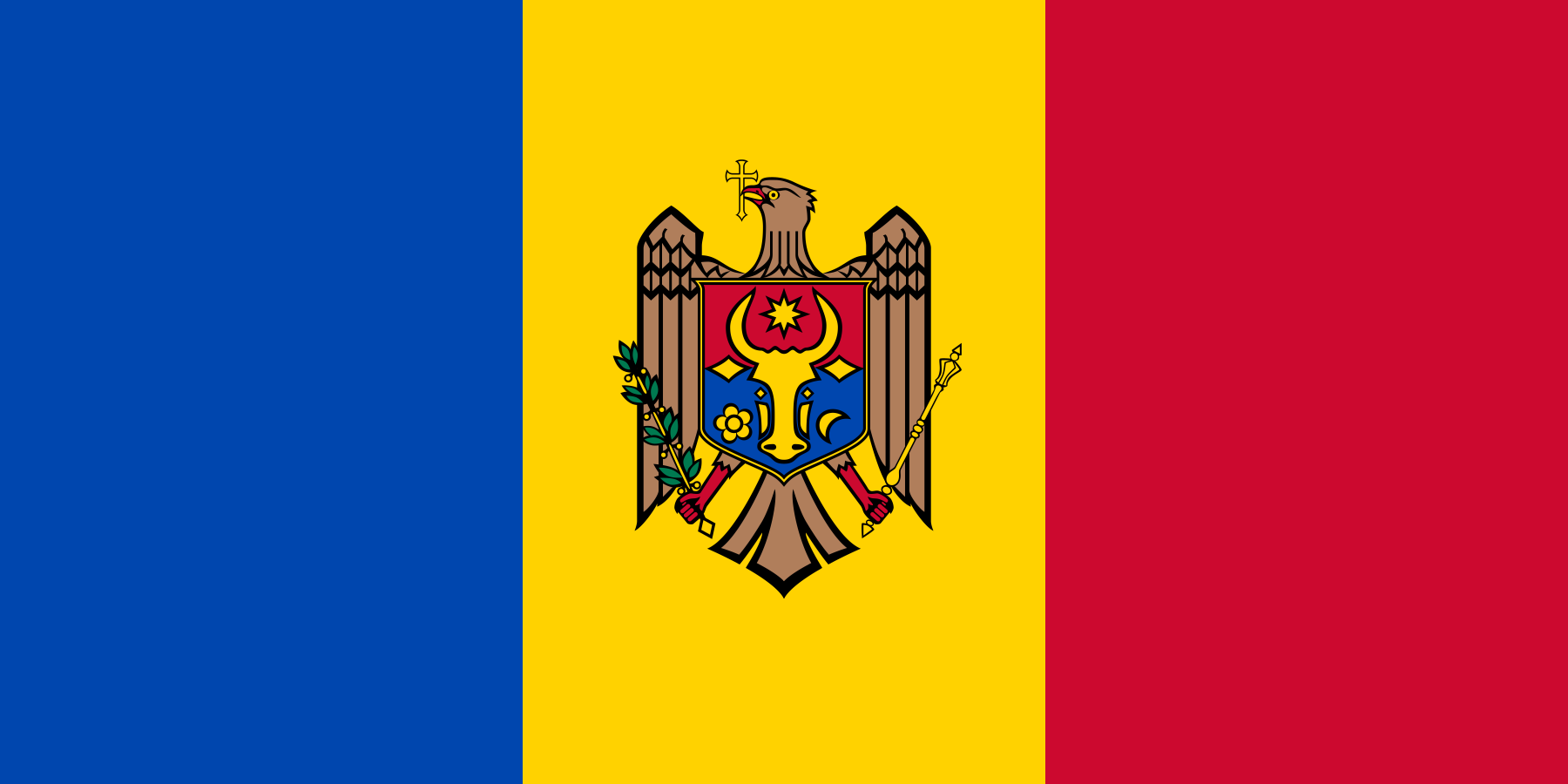
Population
567,000 in the city and 720,100 in Chișinău municipality at the 2024 census — 29.9% of everyone in the country the government administers
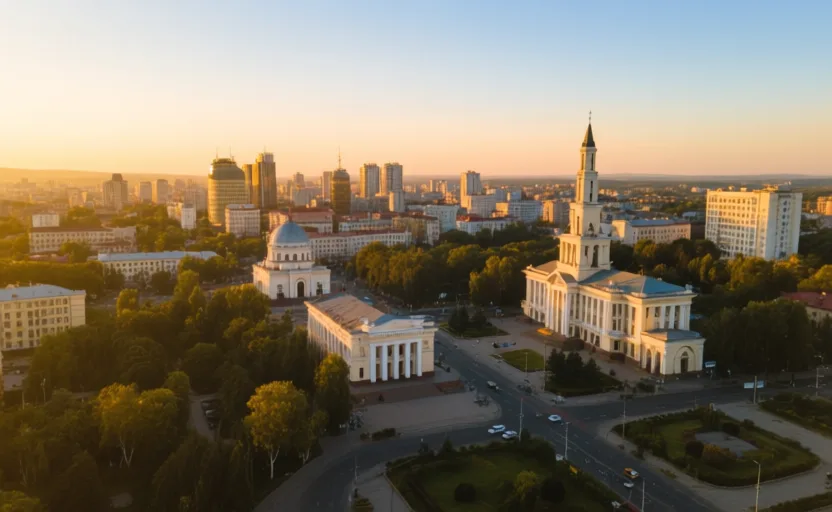 AI city illustration · Artistic impression
What people learn after moving
567,000 in the city and 720,100 in Chișinău municipality at the 2024 census — 29.9% of everyone in the country the government administers
Romanian is the state language (the Constitution was amended in 2023 to say so). About four in five give Romanian or Moldovan as their native tongue; Russian is the language usually spoken by around 16% and is normal in daily life
Moldovan leu (MDL). Not pegged to the euro and no adoption date — the National Bank fixes an official rate each business day
EET (GMT+2), EEST (GMT+3) in summer
AI city illustration · Artistic impressionCost of living in Chișinău
Check your eligibility
Pick your passport to see entry rules and the long-stay routes we have researched.
Pick your passport to see whether you can enter Moldova — and what it takes to stay.
Moldova admits most Western passport holders visa-free for 90 days in any six months, and that is a visit, not a basis to live here. Living here means a provisional residence right (drept de ședere provizorie) from IGM, granted for a stated purpose — work, digital nomad, investment, study, family — and renewed while the purpose holds. If your work is software, the IT Visa route through the Moldova Innovation Technology Park is faster, free to assess and longer-dated than the ordinary work permit, and most people who qualify for it should not be using anything else.
Whether you can swap your licence without an exam depends entirely on whether your country has an agreement with Moldova. There are six mutual-recognition treaties — with Israel, Türkiye, Lithuania, France, Albania and Italy — plus a declaration of intent with Germany. Everyone else takes the Moldovan theory examination, and in some cases the practical too. The cost of the licence itself is a ladder: MDL 440 for a 20-working-day turnaround up to MDL 2,640 for same-day, and the top of that ladder is available in the capital only.
Retail banking here is modern and app-first, card acceptance in Chișinău is near-universal, and a resident account is a same-day job once you hold a residence permit and an IDNP. What is different from Western Europe is the compliance temperature: after the 2014 bank fraud that removed roughly an eighth of GDP from three Moldovan banks, supervision was rebuilt hard, and questions about the origin of incoming foreign money are asked earlier and more literally than newcomers expect. Answer them fully the first time.
If you are employed in Moldova, 9% of your gross salary goes to mandatory health insurance and you are in the system automatically. If you are not on a Moldovan payroll — a digital nomad, a founder taking dividends, a spouse — you buy the fixed-sum policy instead, and here is the fact almost no guide carries: foreign citizens holding provisional or permanent residence are one of the categories entitled to the 80% reduction, so the 2026 policy costs MDL 2,527 rather than MDL 12,636, provided you pay in the first three months of the year. Most professionals also hold private clinic cover on top, because the state system's outpatient capacity is thin.
Moldova has some of the cheapest and fastest fixed broadband in the world — average fixed broadband pricing puts it among the most affordable in Europe, and the leading operators average well over 200 Mbps in Chișinău. Mobile is similarly cheap, 5G reached the central city in 2024 and 2025, and the practical sequence is a prepaid SIM on day one, postpaid once the permit and account exist, and fibre in a matter of days in most blocks. For anyone whose income depends on a connection, this is the single most concrete argument for the city.
Moldova charges a flat 12% personal income tax with a personal exemption of MDL 29,700 a year for anyone whose annual taxable income is under MDL 360,000. The employee also pays 9% mandatory health insurance; the 24% social insurance contribution is the employer's and never appears on your payslip. The net effect is that an employee keeps roughly 80% of gross — a much lighter own-burden than anywhere in the EU. Sitting above all of that is the Moldova Innovation Technology Park, where a resident company pays 7% of turnover and nothing else, guaranteed by the state to 2035.
Each guide has verified costs, timelines, required documents, and the non-obvious gotchas — sourced from official government pages. Last verified August 2026.
Reading a list isn’t learning it. Globe Quest turns these into a trainer — hear each phrase spoken, drill them with spaced repetition, and get scored as you say them out loud.
Romania treats most Moldovans as eligible for restoration of Romanian citizenship, and roughly 850,000 people have taken it up since 1991. The 2024 census counted 389,300 Moldovan citizens — 16.3% of them — also holding the citizenship of another state, against 5.6% a decade earlier. In practice that means the colleague across the desk may hold a Romanian passport, be free to work anywhere in the EU, and be weighing Chișinău against Bucharest, Milan or Munich every year. Salaries in tech and professional services are set with that in mind, senior people are genuinely scarce, and the flats that get renovated to Western standard are the ones owned by families with income coming back from abroad. Do not read Chișinău as a closed local market — it is a market whose best people have an exit.
A company that is a resident of the Moldova Innovation Technology Park pays a single 7% of turnover in place of corporate income tax, employees' personal income tax, social and health contributions, local taxes, property tax and road tax. Parliament extended the state guarantee on that rate to 2035. What the marketing understates is the floor: the amount payable cannot be less than 30% of the forecast average monthly salary per employee, which at 2026's forecast of MDL 17,400 is MDL 5,220 a month for each person who worked even one day under an employment contract. For a well-paid team of engineers the 7% is a very large saving; for a low-revenue company with several employees the floor bites first. Model both.
Moldova charges a flat 12% personal income tax and a 9% mandatory health contribution (AOAM) to the employee, with a personal exemption of MDL 29,700 a year for anyone whose annual taxable income is under MDL 360,000. The 24% social insurance contribution is paid by the employer on top of gross and never appears on your payslip. On a gross of MDL 20,000 a month that means about MDL 16,300 in hand — roughly 82% — and even above the exemption threshold the deduction is only 9% plus 12%, so you keep close to 80% either way. The comparable Romanian figure is somewhere in the high fifties, because there the employee carries a 25% pension and a 10% health contribution before income tax is applied at all. This is the single most under-reported thing about working here.
Moldova became a candidate in June 2022, opened accession negotiations on 25 June 2024, and opened its first negotiating cluster on 15 June 2026 and cluster 6 on 14 July 2026. That is real progress and it is not membership. Moldova is outside the EU, outside Schengen and outside the single market, the leu is not pegged to the euro, and no Moldovan residence permit carries any right to live or work in the Union. Time spent here counts toward Moldovan permanent residence at three years, not toward EU long-term resident status. Anyone selling you a Moldovan permit as a back door into Europe is selling you something that does not exist.
Since 1992 the territory on the left bank of the Nistru, plus Bender and a handful of villages on the right bank, has been administered by an unrecognised authority that Moldova calls the Administrative-Territorial Units of the Left Bank of the Nistru. Two practical consequences. First, Moldovan national statistics exclude it: the 2024 census could not be conducted in 157 localities, so 'Moldova has 2.4 million people' means the part Chișinău governs. Second, Moldova does not control that stretch of its border with Ukraine, so a foreigner who enters through it has no Moldovan entry record and must report to a documentation office within 72 hours — a failure that surfaces when you try to leave, not when you arrive. Day trips east are common and generally uneventful; just do not assume Moldovan police, courts or consular help operate there.
Article 13 of the Constitution said 'Moldovan' until the Constitutional Court held in 2013 that the Declaration of Independence prevails, and Parliament replaced the phrase throughout the statute book and the Constitution in March 2023. So the state language is Romanian, official forms, the tax portal and the courts run in Romanian, and permanent residence requires a Romanian language certificate. Meanwhile about 16% of the population say Russian is the language they usually speak, it is normal in Chișinău shops, offices and taxis, and older officials often reach for it first. Learn Romanian — it is the one the paperwork is in and the one you are eventually examined on — but do not be surprised when the answer comes back in Russian.
Endava, Pentalog (Globant), Amdaris, Cedacri International, Allied Testing, Simpals
The Moldova Innovation Technology Park had 2,981 resident companies and more than 26,000 employees by 2026, with forecast revenue around MDL 20 billion and 416 of the residents foreign-owned. It is a virtual park — residency is a tax and legal status, not an address — so a resident company can operate from anywhere in the country.
Cricova, Mileștii Mici, Purcari, Château Vartely, Asconi, Castel Mimi
Mileștii Mici holds the Guinness record for the world's largest wine collection and Cricova's tunnels run to well over a hundred kilometres — both are inside or beside Chișinău municipality. Wine is also a diplomatic instrument here: the sector's reorientation away from the Russian market after the 2006 and 2013 embargoes is the clearest single example of Moldova's economic turn westward.
maib, Moldindconbank, Victoriabank, OTP Bank Moldova, Comerțbank
The National Bank of Moldova and every bank headquarters are in Chișinău. The sector was rebuilt after the 2014 'billion-dollar theft' that removed roughly an eighth of GDP from three banks, and the resulting supervision is unusually strict about the source of foreign funds.
Trans-Oil, Orhei-Vit, Natur Bravo, Südzucker Moldova, Franzeluța
Sunflower oil, walnuts, apples, cereals and preserved fruit dominate exports, and the EU's tariff-rate quotas for Moldovan produce are a live political subject rather than a technicality. Chișinău is where the trading, financing and export paperwork sits, not where the growing happens.
Dräxlmaier, Sumitomo Electric, Fujikura, Gebauer & Griller, Coficab
German and Japanese wiring-harness plants in the free economic zones at Bălți, Strășeni and Ungheni employ tens of thousands and are Moldova's largest industrial exporter. The engineering, HR and logistics functions recruit out of Chișinău.
EU Delegation, UNDP, UNICEF, IOM, UNHCR, World Bank, EBRD, GIZ
Chișinău carries an unusually heavy donor presence for a city of its size, sharply increased since 2022 by the Ukrainian refugee response. It is one of the few places here that hires in English by default and pays on international scales.
Nature · Centru, west of the university district
A 114-hectare park wrapped around a 34-hectare lake, built in the 1950s and the city's default place to be outdoors.
Local tip: Come up the Cascade — the 218-step staircase from the lake to the Green Theatre, which is longer than Odesa's Potemkin Stairs and about a tenth as famous. Do the loop of the lake anticlockwise in the evening and you will pass every demographic in Chișinău in forty minutes.
Food · Centru, behind the bus station
The Central Market — the covered produce, cheese, honey, pickle and meat halls that set the city's real prices.
Local tip: Go for brânză de oi (sheep's cheese) and the pickle rows, and let someone give you a taste before you buy — refusing is the wrong move. It is cash and Romanian or Russian; the supermarkets on the ring road are cheaper for packaged goods and worse at everything else.
Culture · Cricova town, Râșcani sector — 15 km north of the centre
Over a hundred kilometres of limestone galleries with street signs, tasting halls and a national wine collection, all inside Chișinău municipality.
Local tip: You tour it in an electric train because walking it is not realistic. Book ahead and take a passport; the collection rooms include bottles seized and re-seized across several regimes. Mileștii Mici, 20 km the other way, is larger still and holds the Guinness record for the world's biggest wine collection.
Landmark · Centru, on Bulevardul Ștefan cel Mare
The government square, the 1830s Cathedral of Christ's Nativity, its detached bell tower and the Triumphal Arch — the ceremonial centre of the country.
Local tip: The bell tower you see is a 1998 reconstruction: the original was demolished in the 1960s. The park behind holds Chișinău's book market, a permanent row of second-hand stalls where the political temperature of the city is easier to read than in any newspaper.
Nightlife · Centru, off Bulevardul Ștefan cel Mare
The pedestrianised street that became the city's terrace strip, plus the bars and wine rooms in the grid around it.
Local tip: Chișinău drinks late and cheap and almost entirely outdoors from May to September. Order local — a glass of Fetească Neagră or Rara Neagră costs less than an imported beer and is the better drink. The wine bars off Bulevardul Constantin Negruzzi are where the trade itself drinks.
Culture · Buiucani, north-west of the centre
An eleven-hectare park laid out in 1958 on top of a Jewish cemetery, with a 1993 memorial complex to the victims of the 1903 Chișinău pogrom.
Local tip: Almost no visitor goes, and it is the most important place in the city for understanding what Chișinău was before the twentieth century emptied it. The 1903 pogrom made the city's name a byword worldwide and reshaped Jewish emigration to America and Palestine; the park it happened around was landscaped over the cemetery fifty-five years later. Go, read the plaques, and then look at how ordinary the park is.
Side-by-side cost of living, language, climate and careers — to help you choose.