
Population
371,179 at the 2022 census; ZIMSTAT projects 382,641 for 2026
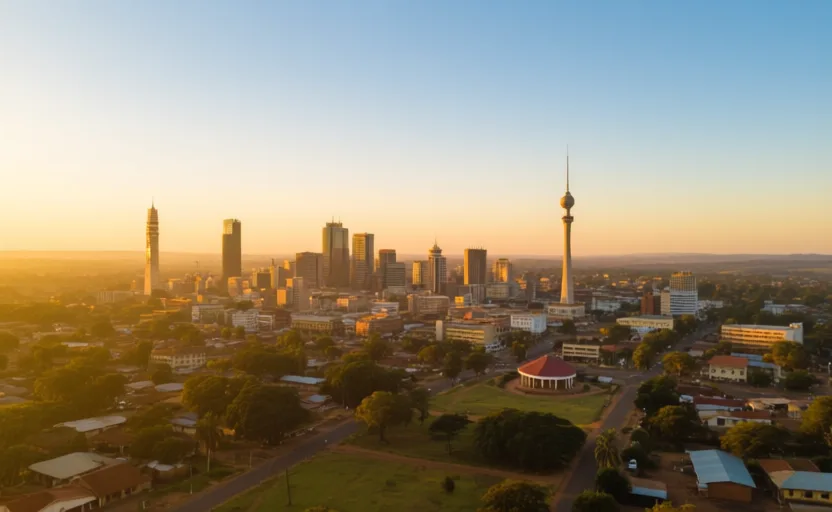 AI city illustration · Artistic impression
What people learn after moving
371,179 at the 2022 census; ZIMSTAT projects 382,641 for 2026
English for government and business; Shona is the everyday language, as in Harare
ZiG (ZWG) is the local unit; the US dollar is what rent, fees and wages are quoted in
CAT (GMT+2); no daylight saving
AI city illustration · Artistic impressionCost of living in Chitungwiza
Check your eligibility
Pick your passport to see entry rules and the long-stay routes we have researched.
Pick your passport to see whether you can enter Zimbabwe — and what it takes to stay.
The Temporary Employment Permit is the route: form I.F.5 in duplicate, a letter to the Chief Director of Immigration, the post advertised in a local newspaper with the shortlisted local candidates' CVs, police clearance under six months, a radiological certificate, and US$500 plus US$300 per dependant. The Department's head office is in Harare, which from Chitungwiza is a 25 km trip rather than a journey — the one real advantage this city has over anywhere else outside the capital.
The Vehicle Inspectorate Department tests drivers; the Central Vehicle Registry registers vehicles and produces the licence card, and its head office is at 29 Robson Manyika Avenue in Harare — about 25 km up the Seke Road. For most Chitungwiza residents the more relevant question is not the licence at all but the commute: whether to drive the Seke Road daily, take a kombi, or accept a mushika-shika.
Zimbabwean banks run local-currency accounts and foreign currency accounts side by side, and the Reserve Bank's guidelines recognise an individual FCA funded with salaries and diaspora remittances. Opening one will most likely mean a trip into Harare or a branch at Makoni. Day to day, EcoCash and cash do the work — and the shortage of small US dollar notes is felt more acutely here than anywhere.
Chitungwiza Central Hospital is one of Zimbabwe's central hospitals and is the single most important institution physically located in this city. It means an emergency here does not automatically mean a drive to Harare. Private specialist care still does. The other half of the health picture is water: Chitungwiza has no source of its own and buys treated bulk water from Harare, so supply interruptions and sewer strain are recurring public health facts rather than occasional events.
Three networks operate: Econet on 077 and 078, NetOne on 071 and Telecel on 073. Econet's reach and EcoCash make it the default, and in a city where bank branches are scarce and agents are not, mobile money is the more important half of the purchase. POTRAZ assigns Chitungwiza its own landline code — national destination code 70, dialled 0270 — separate from Harare's 0242.
PAYE runs to 40% with a 3% AIDS levy on the tax due, and ZIMRA publishes a ZWG table alongside a separate foreign-currency table, directing employers with mixed-currency payrolls to the USD one. On top sits the Intermediated Money Transfer Tax on electronic transfers. None of it varies between Chitungwiza and Harare — the difference is that your municipal rates are billed by Chitungwiza Municipality and are considerably lower.
Each guide has verified costs, timelines, required documents, and the non-obvious gotchas — sourced from official government pages. Last verified August 2026.
Reading a list isn’t learning it. Globe Quest turns these into a trainer — hear each phrase spoken, drill them with spaced repetition, and get scored as you say them out loud.
Most working residents travel into Harare, roughly 25 km north on the Seke Road. Kombis run from Makoni, Zengeza, Chikwanha and Huruyadzo and the peak-hour queues start before dawn. Two or three dollars a day each way is real money against Chitungwiza wages, and two to three hours of your day is real time. Ride the route at 6am on a weekday before you sign a lease — not at 11am, when it looks fine.
Chitungwiza has no water source of its own; it buys treated bulk water from Harare's system. That means supply here is downstream of somebody else's treatment works, pumping and finances, and interruptions are frequent. The sewer network is under long-standing strain. A property with a borehole or a well-maintained tank is a materially different proposition, and it is the first thing to ask about.
The Ministry of Health lists it among Zimbabwe's central hospitals, alongside Parirenyatwa and Sally Mugabe in Harare and the three in Bulawayo. For a dormitory city that is unusual and genuinely valuable — it means an emergency does not automatically mean a drive to the capital. Private specialist care still does.
Chitungwiza has a long history of disputes over unapproved structures and land allocated by people who had no authority to allocate it, and demolition exercises have targeted St Mary's, Zengeza, Seke and Nyatsime. Ask to see the stand's paperwork and the municipality's approval before you pay a deposit, particularly for anything recently built.
Immigration files go to the Chief Director in Harare. The Central Vehicle Registry is in Harare. Embassies, the main ZIMRA offices, most bank branches and every specialist clinic are in Harare. Living here means budgeting a trip north for each of those, which is fine if you plan for it and infuriating if you do not.
Rent is a fraction of Harare's, but groceries, electricity and school fees are national and quoted in US dollars. A household that earns in Chitungwiza and buys at national prices is the ordinary situation here, and it is why so much of the local economy is informal trading rather than employment.
Harare's employers, across every sector
This is the honest first entry. Chitungwiza's working population is largely employed in Harare — offices, factories, retail, domestic and construction work — and the city functions as a residential district of the capital rather than as a labour market of its own.
Chikwanha, Huruyadzo and Makoni markets; roadside vendors; home workshops
The largest visible economy in Chitungwiza and the one that absorbs most people who cannot commute. Markets here undercut Harare's on produce and secondhand goods, and supply traders in the capital.
Chitungwiza Central Hospital, Chitungwiza Municipality, schools and clinics
The most reliable formal employment in the city. The central hospital in particular is a substantial employer of nurses, technicians and administrators.
Chitungwiza Arts Centre and its resident sculptors
One of the country's most significant concentrations of Shona stone sculptors works here, carving and selling on site. It is a genuine export trade and the thing Chitungwiza is best known for outside Zimbabwe.
Kombi operators, mushika-shika drivers, cross-border haulage on the Masvingo road
The commuter fleet is itself a large employer — drivers, conductors, rank marshals and mechanics — and the Harare–Masvingo–Beitbridge corridor runs past the city.
Small workshops, brickmaking, building trades
Modest and mostly informal. Chitungwiza's growth is residential, and building it is the closest thing the city has to an industry of its own.
Culture · Off Chitungwiza Road
A working co-operative of Shona stone sculptors, carving serpentine and springstone in the open and selling straight from the yard.
Local tip: Go on a weekday when people are actually working, and talk to the sculptor rather than the front-of-house seller. Prices are a fraction of a Harare gallery's and you are buying from the person who made it.
Landmark · Zengeza
The Olympic-size pool complex built for the 1995 All-Africa Games, and still the best swimming facility outside Harare's private clubs.
Local tip: It is a genuine piece of national sporting infrastructure sitting in a high-density suburb, which tells you something about what Chitungwiza was meant to become. Check opening times locally — they change.
Landmark · Zengeza
Chitungwiza's football ground, and the home of a support culture that is out of all proportion to the city's size.
Local tip: A Sunday league match here is the cheapest and most enjoyable way to understand the town. Go with someone local, take small notes and nothing you mind losing.
Food · Seke and St Mary's
The city's produce and goods markets, where a large share of the household economy actually happens.
Local tip: Cheaper than anything in Harare on vegetables, and the traders here supply the capital's markets. Go early, bring small denominations, and learn 'marii?' before you arrive.
Neighborhood · Central Chitungwiza
One of the three original townships amalgamated into Chitungwiza in 1978, and still the city's most established residential area.
Local tip: Walk it on a Saturday. Zengeza, St Mary's and Seke were three separate places before they became one city, and the seams are still visible if you look.
Neighborhood · North towards Harare
The artery that defines Chitungwiza — kombi ranks, roadside trade and the daily tide of commuters running to and from the capital.
Local tip: Ride it northbound at 6am once, just to understand what you are signing up for. It is the single most informative hour you can spend in this city.
Side-by-side cost of living, language, climate and careers — to help you choose.