
Population
≈830,000 in the municipality on DANE's projections; about 1.1 million across the metropolitan area with Villa del Rosario, Los Patios, El Zulia, San Cayetano and Puerto Santander
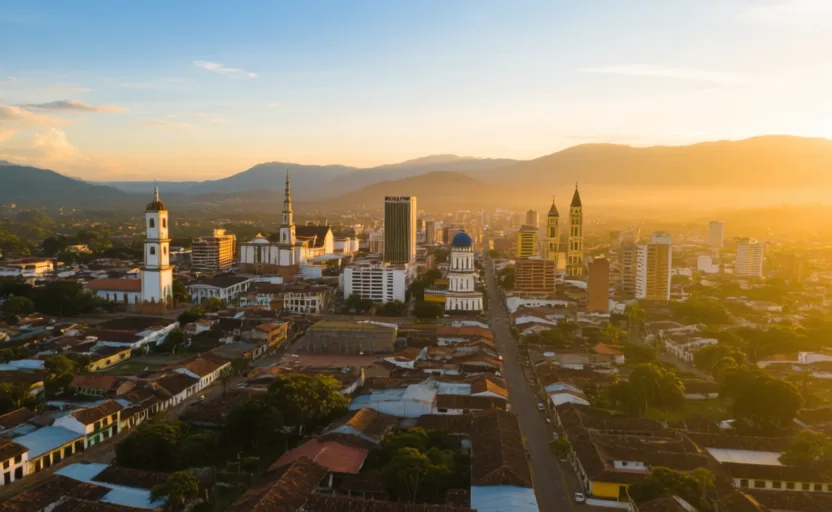 AI city illustration · Artistic impression
What people learn after moving
≈830,000 in the municipality on DANE's projections; about 1.1 million across the metropolitan area with Villa del Rosario, Los Patios, El Zulia, San Cayetano and Puerto Santander
Spanish, in an accent that sits between Colombian and Venezuelan — Venezuelan usage is completely normalised here
Colombian peso (COP); Venezuelan bolívares circulate informally near the bridges but are not legal tender
COT (GMT−5), no daylight saving — Venezuela is on GMT−4, so San Antonio del Táchira is an hour ahead across the bridge
AI city illustration · Artistic impressionCost of living in Cúcuta
Check your eligibility
Pick your passport to see entry rules and the long-stay routes we have researched.
Pick your passport to see whether you can enter Colombia — and what it takes to stay.
Colombia sorts long stays into three classes: V (Visitante, including the digital-nomad visa), M (Migrante — work, marriage, pensionado, investment) and R (Residente). You apply online through the Cancillería portal, with a published thirty-day decision window. Any visa valid more than three months must be registered with Migración Colombia within fifteen calendar days, producing the cédula de extranjería that unlocks banking, EPS affiliation, leases and utility contracts. A tourist stamp gives 90 days, extendable to 180 days maximum per calendar year. Cúcuta adds two things nowhere else in Colombia does. First, the Estatuto Temporal de Protección para Migrantes Venezolanos is a permanent part of the local landscape — but pre-registration in its Registro Único de Migrantes Venezolanos is now open exclusively to children and adolescents in the national education system or in ICBF programmes, so the PPT is not a route for an adult arriving today. Second, the frontier itself: three international bridges whose opening status has changed repeatedly and recently, and where the only correct crossing is a staffed post with a stamp.
Cúcuta has no mass-transit system: public transport is conventional busetas and colectivos, run by private operators on routes agreed across the metropolitan area, plus a large taxi fleet and the ride apps. The Área Metropolitana de Cúcuta raised the buseta fare on the urban routes linking Cúcuta, Los Patios and Villa del Rosario from COP 3,000 to COP 3,400 from 20 March 2026, with the taxi minimum at COP 8,000, a COP 4,500 flagfall and a COP 2,000 surcharge between 7:01pm and 4:59am. Pico y placa applies to private vehicles inside a delimited central perimeter and is unusual in shape — three windows across the day rather than two peaks — with the daily digits published by the Alcaldía. Two things distinguish driving here from anywhere else in Colombia: the frontier fuel regime, which means the pump price is set for border municipalities rather than nationally, and the fact that taking a vehicle across to Venezuela is a customs and insurance question rather than a driving one.
The cédula de extranjería is the gate: with one you can open an account at Bancolombia, Davivienda, BBVA, Banco de Bogotá or Banco Agrario, and without one you generally cannot, because anti-money-laundering rules key on it. Until then you run on a foreign card, cash and Wise. Two national things matter more than the choice of bank. Bre-B, the Banco de la República's interoperable instant-payments scheme, has been live since 2025 and lets you pay any participating bank or wallet using a registered llave. And the 4x1000 (GMF) takes 0.4% of most withdrawals and transfers unless you nominate one account as exempt — which you have to ask for. Cúcuta's own layer is the frontier: exchange houses along the central avenues quote bolívares and dollars, informal money-changing is everywhere, and Colombian banks apply enhanced scrutiny to accounts in border departments precisely because of it. Keep your affairs boringly documented and formal, and expect more questions than you would get in Medellín.
Colombia's contributory system runs through EPS insurers. Employees contribute 4% of salary with employers adding 8.5%; the self-employed pay the full 12.5% of a declared income base that cannot fall below one minimum wage — roughly COP 219,000 a month in 2026. Affiliation needs a cédula, and some visa classes, notably M-Pensionado and several V categories, cannot affiliate at all. The usual foreign setup is EPS plus a medicina prepagada plan for fast specialist access. The sector is mid-reform with several large insurers under Superintendencia intervention and 2026 rules restricting an EPS from operating where it holds too small a share of a department's members, so verify your insurer is functioning in Norte de Santander. Cúcuta's specific reality is that its hospitals absorb cross-border demand and the Catatumbo displacement caseload on top of the resident population, and that genuinely complex care is generally referred to Bucaramanga's Floridablanca cluster, two and a half hours south. If you have a serious chronic condition, know that before you move rather than after.
A prepaid (prepago) SIM takes fifteen minutes, costs almost nothing and needs only your passport, which the clerk registers because the law requires the line to be in a name. The trap is the handset, not the line: Colombia runs a national IMEI database against phone theft, and a device bought abroad that is never registered gets cut off after roughly three to four weeks. Claro has the broadest coverage, Movistar and Tigo sit between, WOM is cheapest and thinner outside the built-up area. Home fibre is available across the central and eastern barrios from Claro, Tigo and Movistar, though the network is thinner than in Colombia's larger cities and installation can take longer. The specifically Cúcuta problem is the frontier: Venezuelan mobile networks are strong enough near the river and the bridges that a Colombian handset will cheerfully register on one and bill you international roaming while you are standing in Colombia. Lock your network selection to manual before you go near the border.
Colombia taxes residents on worldwide income, and residency is a day count: 183 days or more within any rolling 365-day period. A digital-nomad visa does not exempt you and neither does being paid abroad. Rates are progressive to 39% and every threshold is expressed in UVT, a peso unit DIAN republishes each December. You register a free RUT with DIAN, then file the declaración de renta between August and October on a date fixed by the last two digits of your NIT. Cúcuta adds the municipal Impuesto de Industria y Comercio on business and independent professional activity carried on here, filed with the municipality rather than DIAN, and a frontier layer that has no equivalent in the interior: Ley 191 de 1995 provides special regimes for border zones, Ley 1430 de 2010 lets the Ministerio de Minas y Energía set fuel distribution and tariff schemes for border municipalities, and there is a permanent free-trade zone with its own customs treatment. If any part of your activity touches goods crossing the bridge, that is a customs matter and you need a Colombian professional, not a guide.
Each guide has verified costs, timelines, required documents, and the non-obvious gotchas — sourced from official government pages. Last verified August 2026.
Reading a list isn’t learning it. Globe Quest turns these into a trainer — hear each phrase spoken, drill them with spaced repetition, and get scored as you say them out loud.
Venezuela closed this frontier in 2015 and then completely in February 2019. Pedestrian crossing came back in stages from 2021, cargo resumed in September 2022, the Atanasio Girardot bridge opened to vehicles on 1 January 2023, and the Simón Bolívar and Francisco de Paula Santander bridges reopened to private cars on 17 February 2023 after more than seven years. Since then it has kept moving: on 3 January 2026 Colombia closed the Paraguachón crossing in La Guajira while the three Norte de Santander bridges stayed open under reinforced controls; on 2 May 2026 the Francisco de Paula Santander bridge closed when the Táchira river scoured a pier, and it reopened to light vehicles, motorcycles and collective transport on 5 August 2026, operating 6am to 9pm Venezuelan time, with heavy cargo still routed over the Atanasio Girardot. That is the position on 6 August 2026 and it is a snapshot, not a rule. Check Migración Colombia and the Cancillería the week you need to cross.
The informal paths across the Táchira river are cheaper and faster and they are controlled by armed groups. Beyond the robbery and extortion risk, an unstamped exit or entry breaks your Colombian immigration record, which matters enormously if you are counting days for a tourist stamp or building continuity toward a visa. Migración Colombia posts and staffs the bridges; use them, keep the stamp, and accept the queue.
DANE figures for February to April 2026 put informality in Cúcuta and its metropolitan area at 62.6% — about 276,000 people — with unemployment at 10.9%, and roughly four in five of the new jobs created in that window were informal. That is not an abstraction: it means most of the people you will deal with have no contract, no EPS through an employer and no pension contributions, that written quotes and receipts are the exception, and that anything you hire — a builder, a driver, a cleaner — comes with a genuine decision about whether to formalise it. Budget for doing things properly, because the market price you are quoted usually assumes you will not.
Since the ELN launched an offensive against FARC dissidents on 16 January 2025, the Catatumbo region north of Cúcuta has been through one of the worst displacement crises in Colombia's recent history — the UN puts cumulative displacement at around 100,000 people, roughly half the region's population, with about 20,000 newly affected in 2026 alone. Cúcuta and Ocaña are the principal receiving cities. Cúcuta itself is not a war zone and daily life goes on normally, but this shapes the city: pressure on housing and services, a large vulnerable population, and a security picture in the department that is genuinely bad even where the city's own streets are not.
Cúcuta is a legally recognised zona de frontera, and that carries real regulatory consequences — most visibly in fuel, where Ley 191 de 1995 and Ley 1430 de 2010 let the Ministerio de Minas y Energía set distribution and tariff schemes specifically for border municipalities, so the pump price here is not the national one. There is also a permanent free-trade zone and a customs environment shaped by cross-border trade. None of this is a loophole you should improvise around: check the current MinMinas resolution and, for anything commercial, get Colombian advice before you assume the national rule applies.
At around 320 m, Cúcuta runs at a mean near 27–28°C with regular highs in the mid-thirties, and it is dry rather than humid. Air conditioning is a real monthly cost, the middle of the day genuinely empties, and the shade from those wide avenues is the reason the grid was laid out that way. Plan your working day around an early start, and price a flat on rent plus the CENS bill rather than on rent alone.
Customs agencies, freight forwarders, casas de cambio, the Zona Franca de Cúcuta
The city's original and defining business. It expands and contracts with the frontier's opening status, which is why Cúcuta's economy is more volatile than any other Colombian city's — and why so much of it is unrecorded.
Brick, tile and gres works across Cúcuta, El Zulia and Los Patios
Norte de Santander is Colombia's principal producer of clay-based construction materials, and the kilns around the city are one of the few genuinely industrial employers here — energy-intensive, heavily exposed to gas prices, and the reason the horizon smokes.
Centro Comercial Ventura Plaza, Unicentro, the centre's wholesale streets
Retail here has always run on the exchange rate: when the bolívar is strong, Venezuelan shoppers fill the centre; when it is not, the same shops empty. It is the most visible barometer of the border's health.
UNHCR, IOM, ICRC, WFP, Defensoría del Pueblo, Unidad de Víctimas, ICBF
The migration and Catatumbo crises have made Cúcuta one of the largest humanitarian operations in South America, and for many foreigners it is the actual reason they are here — with the professional Spanish and security training that implies.
Universidad Francisco de Paula Santander (UFPS), Universidad de Pamplona, Universidad Simón Bolívar
The UFPS is the region's main public university and the source of most of the local engineering and health graduates who do not leave for Bucaramanga or Bogotá.
Rice, cacao and palm in the Zulia valley; Ecopetrol operations in the Catatumbo
The department's oil sits in the Catatumbo, which is precisely where the conflict is — an accurate summary of Norte de Santander's economic problem in a single sentence.
Landmark · Villa del Rosario, 12 km south-east
The busiest land crossing between Colombia and Venezuela — a short, unglamorous bridge over the Táchira river carrying an extraordinary daily volume of people, trolleys and goods.
Local tip: Go with someone who knows it, in the morning, and keep your documents and phone secure. This is a working border, not a viewpoint, and the Migración Colombia post is the only correct way across.
Culture · Villa del Rosario
The birthplace of Francisco de Paula Santander and the ruined church where the Congress of Cúcuta drafted the constitution of Gran Colombia in 1821 — the founding documents of Colombia, Venezuela and Ecuador were written here.
Local tip: Go early on a weekday when the park is empty and the tamarind tree Bolívar reputedly rested under has some shade under it. It is a fifteen-minute drive from the centre and almost nobody visits.
Neighborhood · Central Cúcuta
The spine of the rebuilt city — wide avenues under mature trees, the cathedral, the banks and the exchange houses, and the shaded benches everyone actually uses at midday.
Local tip: Sit under the trees in the Parque Santander with a cold tinto around four o'clock, when the heat breaks and the square fills. It is the single most Cúcuta hour of the day.
Nature · Along the river through the city
The riverside park strip that runs through Cúcuta, with walking and cycle paths, sports courts and the shade the rest of the city needs.
Local tip: Use it before seven in the morning. By ten it is unusable and by noon it is empty for a reason.
Nature · South, climbing toward the Andes
The metropolitan municipality on the road up into the mountains, and the beginning of the climb that takes you from 320 m to the cool colonial town of Pamplona in two hours.
Local tip: Drive up to Pamplona for a weekend when the heat becomes intolerable — it sits above 2,200 m and it is the standard local escape. Check road conditions in the rainy season first.
Food · North-east of the centre
The vast wholesale market where the whole region's produce arrives, and where the cross-border trade in food is at its most visible and least polished.
Local tip: Go very early with a local, carry nothing you mind losing, and eat a caldo at one of the stalls. It tells you more about the border economy than any amount of reading.
Side-by-side cost of living, language, climate and careers — to help you choose.