Population
≈596,000 in the canton at the 2022 census — Ecuador's third city, and roughly a fifth the size of Guayaquil
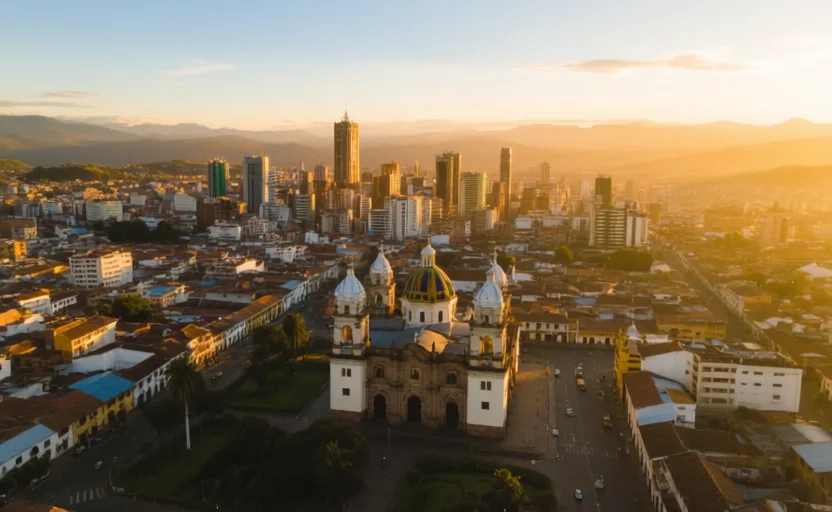 AI city illustration · Artistic impression
What people learn after moving
≈596,000 in the canton at the 2022 census — Ecuador's third city, and roughly a fifth the size of Guayaquil
Spanish in a distinctive southern-sierra accent, with Kichwa co-official in intercultural contexts. English is unusually easy to find here because of the retiree community
US dollar — Ecuador has been dollarised since 2000. US notes and coins circulate alongside Ecuadorian centavo coins
ECT (GMT−5) — no daylight saving, and near the equator the day is twelve hours long all year
AI city illustration · Artistic impressionCost of living in Cuenca
Check your eligibility
Pick your passport to see entry rules and the long-stay routes we have researched.
Pick your passport to see whether you can enter Ecuador — and what it takes to stay.
Ecuador grants temporary residence for two years, renewable, and permanent residence after 21 months of continuous temporary residence. Thresholds are multiples of the salario básico unificado, USD 482 for 2026 — so the pensioner and rentista routes that bring most people to Cuenca need three SBU, USD 1,446 a month of permanent income. Cuenca's particular hazard is not the application. It is that a city built around retirees is full of people who plan to spend a large part of each year somewhere else, and Ecuadorian residence does not permit that.
Two governments touch your car. The licence is an ANT matter, national and identical everywhere, needing a medical and psychosensometric assessment and — for most nationalities — a course and examination rather than a straight exchange. Everything to do with the vehicle is EMOV EP's: matriculación, the revisión técnica vehicular, parking and enforcement. Against that, Cuenca is one of the few Ecuadorian cities where a car is genuinely optional: the tram runs 10.5 km and 27 stops for USD 0.35, and the historic centre is small enough to cross on foot in twenty minutes.
Ecuador uses the US dollar, which removes exchange risk, spreads and the whole apparatus of currency management. What it adds instead is the Impuesto a la Salida de Divisas on money leaving the country, and a banking culture conservative about opening accounts for people without a cédula. Cuenca's distinctive feature is the cooperative sector: JEP, founded in a rural parish of this city in 1971 and headquartered here, is the largest savings and credit cooperative in Ecuador, and cooperatives hold a share of southern-sierra household savings that has no parallel in Guayaquil.
Employees are enrolled in the IESS by their employer from the first day of work. Everyone else can affiliate voluntarily by declaring a contribution base and paying 17.60% of it, from USD 84.83 a month at the 2026 floor — the single most useful fact for a retiree in this city, and one many never hear. Cuenca's health environment is otherwise defined by two things: a private hospital market that has grown specifically around the foreign community, and an altitude of about 2,538 metres that is easier than Quito's but is still altitude.
The mobile market is the same as everywhere in Ecuador and SIM registration against an identity document is mandatory. Fixed-line is not. ETAPA EP, owned by the municipality of Cuenca, has run the city's telephone network for decades and now sells its fibre alongside the water and sewerage it also supplies — an arrangement that exists in no other Ecuadorian city. It is generally well regarded in the urban core; the national operators and independents compete against it, and coverage thins together with the water network in the outlying parishes.
Ecuador taxes its residents on worldwide income. For a working expatriate that is a technicality; for the several thousand foreign pensioners in this city it is the central fact of their financial life, because a foreign pension is foreign-source income of a person tax-resident in Ecuador. Residence turns principally on days present. Ecuador also levies the Impuesto a la Salida de Divisas on money leaving the country, and the municipality levies its own charges on property and on business activity in the canton.
Each guide has verified costs, timelines, required documents, and the non-obvious gotchas — sourced from official government pages. Last verified August 2026.
Reading a list isn’t learning it. Globe Quest turns these into a trainer — hear each phrase spoken, drill them with spaced repetition, and get scored as you say them out loud.
Azuay province recorded 1.56 homicides per 100,000 inhabitants in the first half of 2025, against 47.81 in Guayas and 42.1 in El Oro, and it was one of only three provinces in the country where the figure fell rather than rose. Among Ecuador's cantons with more than 100,000 inhabitants, Cuenca had the lowest rate of any of them. That is not a marginal difference from Guayaquil or Manta; it is a different country's worth of difference, and it is the single largest reason foreign residents concentrate here. What Cuenca does have is ordinary urban property crime — bag-snatching on the Barranco path, phones taken on buses, opportunistic theft around the markets and the bus terminal — which is a real nuisance and an entirely different order of problem. Do not import coastal habits, and do not import complacency either.
A temporary resident may be outside Ecuador for no more than ninety days in a year, counted cumulatively across the visa's validity rather than resetting on renewal. Permanent residents have historically faced a 180-day annual limit during their first two years. This is the rule that catches Cuenca's retiree population harder than any other group in the country, because the whole point of the plan for many is to spend part of the year with grandchildren somewhere else. Two long visits home and a summer away is ninety days. There is no warning letter. The reforming law published on 24 October 2025 rewrote the article on losing permanent residence, so check the current wording before you book anything, and keep a spreadsheet of every entry and exit from the day you land.
Somewhere between four and six thousand foreign residents, mostly North American retirees, live here — enough to sustain English-speaking doctors, lawyers, accountants and social life, and enough that a newcomer can be functional in a week. That is a real head start and there is no point pretending otherwise. The costs are equally real: a parallel 'gringo price' for rentals, furniture and services that runs well above what a cuencano pays for the same thing; a social bubble it takes deliberate effort to leave; and a body of advice circulating in expatriate groups that is confidently out of date about visas, taxes and the health system. Use the community for landings and for company. Do not use it as a source on anything a government publishes.
Cuenca's annual mean is about 16.3°C, and a typical day runs from around 11°C at dawn to 22°C at noon and straight back down. That average conceals everything: it is genuinely cold in the evening, essentially no residential building here has heating, and interior walls of stone and adobe hold the cold. Bring or buy proper bedding and a decent jumper, and ask which way a flat faces before you rent it — sun matters more than temperature. Then treat the ultraviolet as a daily medical issue, because near the equator at this altitude the levels are among the highest anywhere and people burn on cool, overcast days when nothing feels dangerous.
ETAPA EP is owned by the municipality and supplies Cuenca's drinking water, its sanitation and its fixed telephone and internet. No other Ecuadorian city does it this way. In practice it means one relationship rather than three, a genuinely well-regarded network in the urban core, and — the point most often made about Cuenca and rarely believed by newcomers — mains water that is treated to a standard people here actually drink from the tap, which is not true in Guayaquil, Manta or Machala. It also means that in the outlying parishes where ETAPA's network thins, both your water and your internet get worse at the same time and for the same reason.
Cuenca has real industry — ceramics, tyres, domestic appliances, hat finishing — and two good universities, but it is a city of roughly 600,000 people at the southern end of the country, and the professional job market is a fraction of Quito's or Guayaquil's. Salaries are lower, English-language work is scarce outside the expatriate service economy, and the international corporate layer that exists in the two big cities barely exists here. That is precisely why it suits pensioners and remote workers so well and why it suits mid-career job-seekers so badly. Be honest with yourself about which of those you are before you commit.
Graiman, Cerámica Andina, Italpisos, Hormicreto
Cuenca is Ecuador's tile and sanitaryware capital and Graiman is the country's dominant producer. The clays of the Azuay basin and a long craft tradition turned into a genuinely export-scale industry — one of the few in Ecuador that is neither extractive nor agricultural.
Continental Tire Andina, Indurama, Fibro Acero, Vanderbilt
The Continental tyre plant — the former Ecuadorian Rubber Company — has made tyres here for decades with several hundred people on the production line, though it has been running well below capacity and cut to a five-day week in 2025. Indurama makes cookers and refrigerators for the Andean market from Cuenca. The Parque Industrial in the east is where most of this sits, and where the tram line begins.
Homero Ortega, K. Dorfzaun, and the workshops of Sígsig, Chordeleg and Gualaceo
The hat the world calls Panamanian is woven in Azuay and Manabí and finished in Cuenca, and the weaving is inscribed on UNESCO's list of intangible cultural heritage. Chordeleg's silver and Gualaceo's textiles sit in the same craft economy an hour outside the city.
Hospital del Río, Monte Sinaí, Santa Inés, plus English-speaking clinics, insurers, lawyers and relocation agents
Several thousand foreign retirees have produced a real service sector: private hospitals that market to them, bilingual professionals, and an entire relocation-services trade. It is one of the few places in Ecuador where being an English speaker is commercially useful.
Universidad de Cuenca, Universidad del Azuay, Universidad Politécnica Salesiana
The Universidad de Cuenca dates from 1867 and, with the other two, makes the city a genuine student town — which is why the bars, bookshops and cheap lunch places outnumber what a city this size would otherwise carry.
Fundación Municipal Turismo para Cuenca, hotels in the historic centre, tour operators for Cajas and the Inca ruins
The historic centre has been a UNESCO World Heritage site since 1999, and the Cajas national park half an hour west and the Ingapirca ruins to the north anchor a steady, mid-scale tourism economy rather than a mass-market one.
Landmark · The colonial grid between the Tomebamba and the Machángara
A UNESCO World Heritage site since 1999 — a compact grid of colonial and republican façades under three enormous blue-tiled domes.
Local tip: The domes were built too heavy for the planned bell towers, which is why the cathedral is famously unfinished at the top. Climb to the roof terrace for the view over the tiles, then walk down to the flower market beside the Carmen de la Asunción — it has run in the same small square for centuries and is the single best photograph in the city.
Nature · The cliff edge where the old city drops to the river
The colonial city ends in a wall of hanging houses above the Tomebamba, with a riverside path running the length of it.
Local tip: The path is how residents actually move around — walk it west towards Puente del Vado in the late afternoon when the light hits the façades. It is also where opportunistic bag-snatching happens after dark, so it is a daytime pleasure. In the wet months the river runs loud and fast enough to drown out the city.
Culture · At the eastern end of the Barranco, beside the Banco Central museum
The excavated remains of Tomebamba, the Inca city the Spanish found here — terraces, foundations and an ethnographic museum above them.
Local tip: This was intended as a second Cusco and was largely dismantled to build the colonial city on top, which is the single most interesting fact about Cuenca and is not on most itineraries. The museum is free and its ethnographic floor — including the shrunken heads — is better than the ruins. Go on a weekday morning.
Food · Centro Histórico, a few blocks south of the cathedral
Three floors of produce, juice counters and the hornado stalls where roast pork is carved to order with mote and potato cake.
Local tip: Go upstairs and eat where the people who work in the market eat, before eleven. Downstairs on the ground floor you will also find the limpias — traditional cleansings with herbs, eggs and a good deal of theatre — carried out in the open for anyone who asks, at a couple of dollars. It is not staged for visitors.
Nature · Half an hour west on the road to Guayaquil
Nearly three hundred glacial lakes on a high páramo plateau above 3,000 metres, with polylepis cloud forest in the folds between them.
Local tip: It is genuinely high — up to around 4,400 metres — so acclimatise in Cuenca first and do not treat it as a stroll. The weather turns in minutes and people get lost in fog on the marked trails every season. Take waterproofs whatever the sky in the city is doing, and register at the ranger station. The buses to Guayaquil will drop you at the entrance.
Neighborhood · On the ridge above the city, about ten minutes south
A viewpoint church on the hill with the entire city, its rivers and the mountains behind it laid out below.
Local tip: Everyone comes for the postcard view and then leaves. The reason to stay is the ceramics: the workshops around Turi, including some of the region's best-known artisan potters, are a few minutes from the mirador and almost nobody who takes the photograph walks over to them. Go late afternoon, do the workshops first and the view at dusk.
Side-by-side cost of living, language, climate and careers — to help you choose.