
Population
≈1.8 million in the city; ≈3.7 million across the metropolitan region
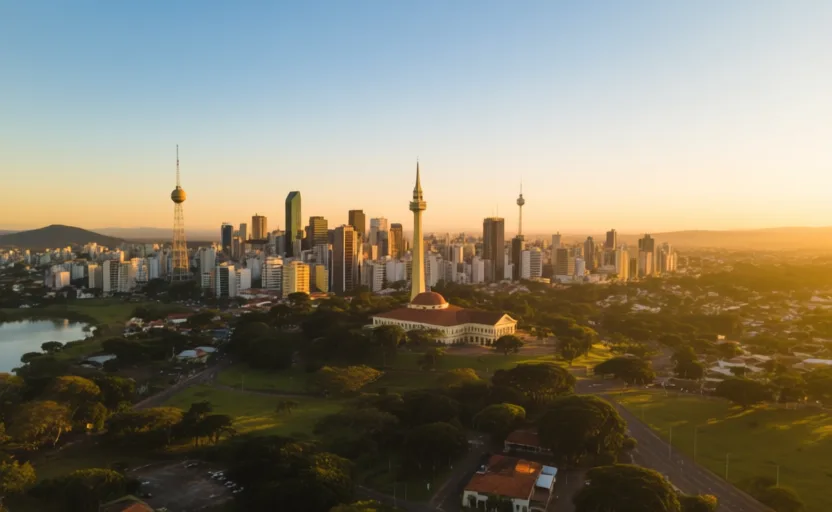 AI city illustration · Artistic impression
What people learn after moving
≈1.8 million in the city; ≈3.7 million across the metropolitan region
Portuguese. The city was settled by Polish, Ukrainian, Italian, German and Japanese immigrants and the surnames, food and churches still show it
Brazilian real (BRL)
BRT (GMT−3) — no daylight saving since 2019
AI city illustration · Artistic impressionCost of living in Curitiba
Check your eligibility
Pick your passport to see entry rules and the long-stay routes we have researched.
Pick your passport to see whether you can enter Brazil — and what it takes to stay.
Register with the Polícia Federal and collect your CRNM within 90 days of entering Brazil on that visa — or within 30 days of publication in the Diário Oficial where residence was authorised from inside the country. The CPF comes before everything and has no immigration prerequisite. Two things are locally relevant: the Paraná superintendency in Curitiba serves the whole state, so appointment supply is tighter than the city's size suggests, and a large share of people who end up living here arrive on another basis entirely and then apply for residence from inside Brazil — which is possible in more categories than most newcomers realise.
A foreign licence is good for a maximum of 180 days of regular stay, on the basis of the road traffic conventions Brazil has ratified and of reciprocity, in practice carried with an International Driving Permit. Conversion through DETRAN-PR then requires a sworn translation, a medical fitness examination and a compulsory psychological assessment that nobody from Europe or North America expects. Curitiba itself is one of the few Brazilian cities where you can genuinely live without a car, because the structural axes put rapid transit at the door of most dense housing. When you do drive, two things are locally distinctive: the trinary road layout, which is genuinely confusing on first encounter, and the fog on the Serra do Mar descent to the coast.
The CPF is the hard gate. Past it, digital banks onboard foreigners in days where traditional branches want documents you will not have for months. Pix, the central bank's free instant transfer rail, is what you use daily. The other half of Brazilian payments is the boleto — a printed or digital payment slip with a barcode, still how rent, condominium fees, IPTU and many services are billed. Both are simple once you know they exist, and both are baffling for a fortnight if you do not.
Curitiba's municipal health service is among the better-organised in Brazil and has run a shared electronic patient record across its units for years, so your history follows you between clinics rather than living in a paper folder. SUS will treat you free whatever your paperwork says. Most professionals carry a private plano de saúde as well, and the thing that determines its value is which hospitals it admits you to. The distinctly local risk is seasonal: a cold, damp winter produces a real respiratory season here that tropical arrivals are not braced for.
Vivo, Claro, TIM and Algar all cover the city well and the choice is essentially a price decision. Where Curitiba differs from Rio or Florianópolis is fixed broadband: the south of Brazil has an unusually competitive regional ISP market, and the local fibre operators frequently beat the national carriers on both price and speed. As everywhere in Brazil, the CPF gates the chip and the condominium gates the fibre.
You become a Brazilian tax resident immediately on arrival with a permanent visa or a local employment contract, or — on a temporary visa — on the day you complete 184 days of presence, more than 183, inside a twelve-month period, and residence means worldwide income. Foreign-source income is paid monthly through carnê-leão, not settled at filing. The municipal layer is where cities diverge: Curitiba levies ITBI at 2.7%, below Rio's 3% but above Florianópolis's 2%, and runs a local invoice scheme that converts service-tax credits into a discount on your property tax.
Each guide has verified costs, timelines, required documents, and the non-obvious gotchas — sourced from official government pages. Last verified August 2026.
Reading a list isn’t learning it. Globe Quest turns these into a trainer — hear each phrase spoken, drill them with spaced repetition, and get scored as you say them out loud.
Receita Federal issues CPFs online and through consulates to people with no visa, no address and no presence in Brazil. Since 2023 it is the single identification number across every federal, state and municipal database. Bank account, phone chip, lease, health card, gym membership, a pharmacy discount: all gated. Landing in Curitiba without one converts your first fortnight from a checklist into a dependency chain where every item waits on the same queue.
The clock starts at your arrival stamp under that visa, not at issue, and a border hop is not a reliable way to buy a fresh window. The Paraná superintendency in Curitiba serves the entire state, so its appointment slots are competed for by applicants from Londrina, Maringá and Foz do Iguaçu as well as from the capital. Book in your first week and move the appointment later if your documents slip — the reverse order does not work, and without a CRNM there is nothing to renew when your first year expires.
This is the coldest state capital in Brazil. Winter nights fall to two or three degrees, frost happens, and the record is below zero. Almost no flat here has central heating, walls are uninsulated single-leaf masonry and windows are single-glazed, so indoor temperature tracks outdoor temperature with a delay. Combined with months of drizzle, the practical consequences are cold bedrooms and mould in wardrobes. Ask what heating exists before you sign anything, and look for north-facing rooms.
Curitiba was planned in the 1960s around five linear corridors, each with a central exclusive busway flanked by one-way fast roads — the trinary system. High-density building was permitted along those corridors and restricted elsewhere, so the flats are where the buses are by design. A block on an eixo gives you a bi-articulated BRT service every few minutes into the centre. Two streets off it, you are waiting on a feeder route. This is the single most useful thing to know before you choose a neighbourhood.
The integrated network lets you change between as many routes as you like without paying again, provided you make the change inside a terminal or a tube station rather than stepping onto the street. Newcomers walk out of a terminal, realise they wanted a different line and pay a second fare. The transport card is worth getting for the fare cap and for not fumbling for coins at a tube turnstile in the rain.
Curitiba has rain distributed across all twelve months and a genuinely grey winter — weeks of low cloud and garoa rather than dramatic storms. People arriving from the north-east of Brazil or from anywhere tropical routinely underestimate what this does to mood and energy in July and August. Locals compensate with the cafés, the covered markets and a serious cultural programme. Plan for it rather than being surprised by it.
Renault, Nissan, Volvo Trucks, Audi/Volkswagen, Bosch, Denso
The metropolitan region, especially São José dos Pinhais, is one of Brazil's three main automotive clusters. Volvo builds trucks and buses here, and the supplier network around the assembly plants employs tens of thousands.
EBANX, Olist, MadeiraMadeira, Contabilizei, Positivo Tecnologia
Curitiba has produced several Brazilian unicorns — EBANX in cross-border payments and Olist and MadeiraMadeira in e-commerce — which makes it the country's most credible tech city outside the São Paulo axis.
Copel, Sanepar, Petrobras REPAR, Klabin
Paraná's state utilities are headquartered here, and the REPAR refinery at Araucária on the city's edge is one of Petrobras's largest — a substantial engineering employer that has nothing to do with the startup scene.
Grupo Boticário, Condor, Positivo, Cacau Show franchisees
Grupo Boticário, based in São José dos Pinhais, is one of the largest cosmetics groups in Latin America and runs a franchise network across the whole country from the Curitiba region.
Cooperatives, grain traders, Port of Paranaguá operators
Paraná is one of Brazil's leading grain states and Paranaguá, ninety minutes down the mountain, is among the country's largest grain export ports. The trading, financing and logistics functions sit in Curitiba.
UFPR, PUCPR, UTFPR, Government of Paraná, TJPR
UFPR dates its foundation to 1912 and claims the title of Brazil's oldest university — disputed, but it anchors a large research and teaching sector alongside the state government. Those posts are filled by concurso, and Brazilian nationality is a statutory requirement for the civil service, with a narrow exception for teaching and research staff at federal universities and research institutes.
Landmark · Jardim Botânico district, east of the centre
The art nouveau glasshouse and formal French gardens that became the city's postcard, built on a reclaimed rubbish tip in 1991.
Local tip: Everyone photographs the greenhouse and turns round. The trail into the native forest behind it, and the boardwalk over the wetland, are where the park actually is — and both are empty on a weekday morning.
Nightlife · Historic centre
Cobbled streets around the eighteenth-century church, with the city's oldest bars and a large Sunday antiques and crafts fair.
Local tip: The Sunday feira is the famous part but the Wednesday and Thursday nights are the local one — the bars on Rua São Francisco are where Curitiba actually drinks. The area is quiet on Monday and Tuesday to the point of being closed.
Food · Next to the bus station, central
A 1958 covered market with an entire organic hall, a serious cheese and charcuterie section, and the city's best casual lunch counters.
Local tip: Go before eleven on a Saturday. The upstairs restaurants do a proper Paraná barreado and the deli aisles carry Polish, Ukrainian, Italian and German products that reflect who actually settled this city.
Neighborhood · North-west of the centre
The Italian colony founded by Veneto immigrants in the 1870s, now a boulevard of enormous family restaurants and wine cellars.
Local tip: The set menus are galeto, polenta and pasta served until you surrender, and they are a Sunday institution rather than a tourist trap. Go with more people than you think you need and skip breakfast.
Culture · Northern quarries
A tubular steel opera house standing in a flooded granite quarry, and a second quarry turned into a park with a waterfall and a tunnel walk.
Local tip: The two are minutes apart and best done together in the late afternoon. Tanguá's viewpoint at sunset over the quarry lake is the single best free view in Curitiba and almost no visitor knows to go.
Nature · Departs Curitiba central station
An 1880s mountain railway dropping 900 metres through Atlantic rainforest to the coastal plain, across viaducts cut into the escarpment.
Local tip: One of the great train journeys anywhere and Curitibanos treat it as an ordinary day out. Take the train down, eat barreado in Morretes, and come back by road — the return leg by rail is the same view in worse light. Sit on the left going down.
Side-by-side cost of living, language, climate and careers — to help you choose.