
Population
≈2.35 million and slowly declining, the fourth-largest Korean city
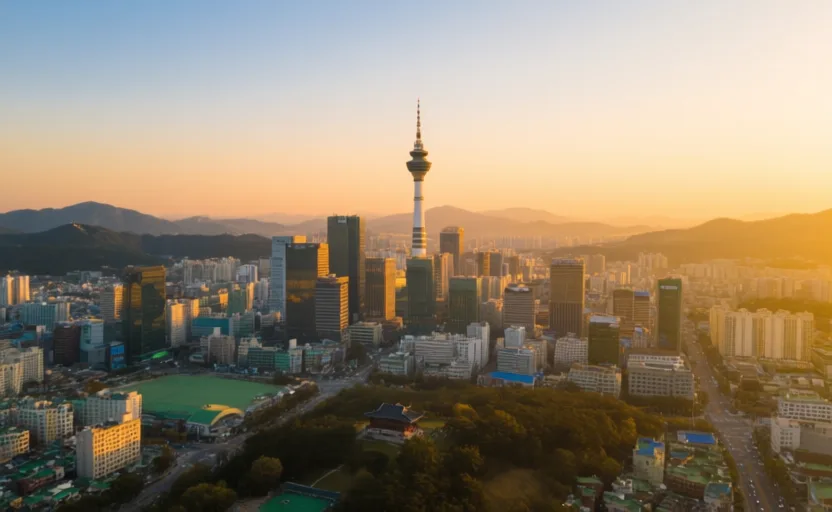 AI city illustration · Artistic impression
What people learn after moving
≈2.35 million and slowly declining, the fourth-largest Korean city
Korean, in the Gyeongsang dialect — pitch-accented, with -나 and -노 question endings that instantly mark the region
South Korean won (KRW, ₩)
KST (GMT+9) — Korea does not observe daylight saving
AI city illustration · Artistic impressionCost of living in Daegu
Check your eligibility
Pick your passport to see entry rules and the long-stay routes we have researched.
Pick your passport to see whether you can enter South Korea — and what it takes to stay.
Korea separates entry from residence completely. Visa-free entry or a K-ETA lets you visit and nothing else. The long-stay category — E-7 skilled work, E-2 teaching, D-8 startup, D-10 job search, D-2 study, F-6 spouse, F-1-D remote work — is normally issued by a Korean consulate before you fly, and several cannot be switched into from inside Korea. Once here you have ninety days to register and obtain the Alien Registration Card, and its thirteen-digit number is what every Korean system authenticates you against. Daegu adds a route the capital does not have: three of its districts are designated population-decline areas with their own residence visa.
You may drive on your home licence plus a Geneva Convention International Driving Permit for one year from entry, and the permit must be issued at home before you fly. Once you hold an ARC, KoROAD will exchange your foreign licence — an eyesight and aptitude check for reciprocity countries, a 40-question written test in English for everyone else. Daegu is flat, gridded and by some distance the cheapest big Korean city to park in, so a car is a reasonable default rather than an extravagance here. The three metro lines are good but do not reach the Innovation City or the outer industrial complexes conveniently.
A Korean account belongs to a verified identity, and for a foreigner that identity is the ARC. Before it arrives some banks will open a deposit-and-withdraw-only account on a passport — no transfers, no app banking, no outward remittance. A full account needs the ARC plus a Korean mobile number registered in exactly the same name. Even then, anti-fraud rules open every new account as a limited-transaction account capped around ₩1 million a day until you document its purpose. Daegu's own iM Bank, which converted from a regional to a nationwide commercial bank in 2024, is unusually well set up for this and is among the banks accepting the mobile ARC.
National Health Insurance enrolment is compulsory once you pass six months of residence and cannot be declined because you hold private cover. With an employer the premium is split and payroll-deducted; without one you become a local subscriber billed a premium benchmarked to the national average rather than to your Korean income. Arrears can block a visa extension. Pension contributions are equally compulsory and reclaimable on departure only depending on your nationality. Daegu's own layer is a hospital cluster larger than the city's size suggests, a medical innovation complex, and a summer that generates genuine heat-related admissions every August.
The point of a Korean number is identity, not calls. Korean real-name verification binds your name, birth date, registration number and phone line together, and only a line registered to you personally passes it — which gates banking apps, delivery, government portals and most of the useful internet. A data eSIM or a passport-bought prepaid SIM gives connectivity and a number but not verification. The sequence is eSIM or prepaid as a bridge, then the ARC, then a postpaid or MVNO line in your own name. Home fibre is fast and cheap, and Daegu's enormous stock of recent apartments means fibre to the unit is the norm rather than the exception.
You become a Korean tax resident by having a settled life here or by 183 days of presence in a tax year. Residents are taxed on worldwide income at progressive rates plus a 10% local surtax. Two national reliefs matter to foreigners: resident five years or fewer of the last ten and your foreign-source income is taxed only when a Korean payer pays it or you remit it; and foreign employees may elect a flat 19% on Korean employment income, forfeiting all deductions. The one that matters most in a low-rent city like Daegu is smaller and far more widely missed: a tax credit on monthly rent, available to employees below an income threshold and unlocked by the move-in report you should already have filed.
Each guide has verified costs, timelines, required documents, and the non-obvious gotchas — sourced from official government pages. Last verified August 2026.
Reading a list isn’t learning it. Globe Quest turns these into a trainer — hear each phrase spoken, drill them with spaced repetition, and get scored as you say them out loud.
Daegu has led the country in completed-but-unsold new apartments for years, to the point where the city froze approvals for new housing construction projects outright in January 2023 — with 13,445 unsold homes on its books at the time — and has kept the hold in place since, to let the market absorb what exists. For a tenant that means unusually good stock at unusually low rents and genuine room to negotiate the deposit-to-rent split. The flip side is 역전세: where deposits agreed at the 2021 peak now exceed what a new tenant would pay, a landlord may simply be unable to fund your refund. Check the property register, compare your deposit against current asking deposits in the same building, and price HUG guarantee cover.
Your deposit is protected only once you have actually moved in and registered your residence, and that opposing power takes effect from 00:00 the following day. A landlord who registers a mortgage on the same day you pay therefore outranks you. This one-day gap is the mechanism behind a large share of Korea's deposit-fraud cases. File the move-in report and get the fixed-date stamp immediately, and pull the property register again the following morning.
Employees below an income threshold can claim a tax credit on rent paid, worth a meaningful percentage of it up to an annual cap, through the year-end settlement. Two things people get wrong: your resident registration must be at the rented address, which is exactly what the move-in report does, and you do not need the landlord's consent to claim it. The rates, income threshold and cap are revised most years, so check the current figures on Hometax rather than a dated summary. In a city with rents as low as Daegu's, a much larger share of arrivals falls under the threshold than they assume.
The Ministry of Justice runs a regional-specialised visa programme for officially designated population-decline areas. Three parts of Daegu are on the Ministry of the Interior's designated list — Nam-gu, Seo-gu and Gunwi-gun, which joined the city from North Gyeongsang in 2023 already designated — and a local-government recommendation there can open the F-2-R residence visa at thresholds below the ordinary points route in exchange for living and working in the region. Quotas, criteria and the district list are reissued annually, so read the current year's plan.
Daegu sits in a basin ringed by mountains, which traps heat and stops the sea breeze that moderates Busan. It held Korea's national temperature record — 40.0°C, set in 1942 — until Hongcheon finally broke it in 2018. Practically: ask what air conditioning a flat has and whether it is in every room, prefer buildings with cross-ventilation, and expect August electricity bills to be your largest of the year. The city runs a network of designated cool refuges in public buildings during heatwaves.
Daegu and North Gyeongsang form the most reliably conservative region in Korea, and the identity is regional as much as party-political — it runs through business networks, university ties and family history. Nobody expects a foreign resident to have a view. What does land badly is arriving with Seoul or Gwangju assumptions and voicing them casually at work. Listen first; the regional history behind it is genuinely interesting and people will explain it if you ask rather than assert.
Korea Textile Development Institute, DYETEC, the Seongseo and dyeing industrial complexes
Daegu built modern Korea's textile industry and still runs its research and dyeing infrastructure. The sector has moved from cheap cloth to technical and industrial fibres — carbon, aramid and medical textiles — though the Seo-gu dyeing complex remains a real air-quality consideration for the districts around it.
Daegu-Gyeongbuk Medical Innovation Foundation, Korea Brain Research Institute, DGIST, five university hospital groups
The national medical innovation complex at Sinseo is one of only two in the country, pairing device and drug development facilities with an unusually dense hospital cluster for a city this size.
Korea Institute for Robot Industry Advancement, HD Hyundai Robotics, the machine-tool cluster
The national robot industry promotion agency is headquartered here and HD Hyundai Robotics built its plant in the city, which has anchored a supplier base around industrial automation and machine tools.
SL Corporation, Pyeonghwa Industrial, IRAY AMS and a deep tier-two supplier belt
Daegu is one of Korea's main automotive parts clusters — lighting, chassis, seals and driveline — supplying the assembly plants in Ulsan, Gwangmyeong and Bupyeong rather than assembling cars itself.
Korea Gas Corporation, Korea Credit Guarantee Fund, Korea Student Aid Foundation, iM Bank
The Innovation City at Sinseo in Dong-gu received a cluster of relocated national agencies, and the local bank converted from a regional to a nationwide commercial bank in 2024 — the first such conversion in over three decades.
Kyungpook National University, DGIST, Keimyung University, Yeungnam University
Kyungpook National is one of Korea's former national flagship universities and its medical school anchors the hospital cluster; DGIST is one of the four national science and technology institutes, with a graduate-heavy, English-language research culture.
Food · Jung-gu
One of Korea's great historic markets, trading since the Joseon era, with a night market that takes over the aisles after dark.
Local tip: The daytime market is textiles and dried goods and is the more interesting half. The night market from around seven is where everyone actually goes — go hungry, bring cash for the smaller stalls, and try the kalguksu alley rather than the photogenic skewers.
Culture · Jung-gu
A street of traditional medicine merchants trading continuously since 1658, with a museum in the middle of it.
Local tip: The whole street smells of dried roots and it is worth walking simply for that. The museum is small, free and explains what the shops are selling, which makes the shops themselves far more interesting afterwards.
Landmark · Jung-gu
Missionary houses, a 1900s church and the stone stairway used by student demonstrators in 1919, all within a few hundred metres downtown.
Local tip: The city runs a marked walking route through it that most visitors never notice starts right behind Dongseongno. Do it in the morning before the heat, and detour to the Kim Kwang-seok mural street by Bangcheon Market afterwards.
Nightlife · Jung-gu
The downtown pedestrian grid — shopping by day, and after dark the densest concentration of bars and makchang restaurants in the region.
Local tip: The main street is chains. One block east or west is where the small bars and the intestine grills are, and prices drop by a third the moment you leave the pedestrianised spine.
Nature · Dong-gu and Gunwi-gun
The mountain range on the city's northern edge, promoted from provincial to national park at the end of 2023 as Korea's twenty-third.
Local tip: The Gatbawi stone Buddha at the eastern end is a hard hour of steps and is where people come to pray before exams — go on a weekday. The cable car from the southern side is the lazy route to the ridge and perfectly respectable in August.
Neighborhood · Dong-gu
A walled clan village of roughly 400-year-old hanok houses with an ancient zelkova grove, entirely inside the modern city.
Local tip: Descendants of the founding family still live here, which is why it has none of the polish of the tourist hanok villages. Walk in quietly, keep to the lanes, and sit in the grove at the entrance — it is twenty minutes from downtown and most Daegu residents have never been.
Side-by-side cost of living, language, climate and careers — to help you choose.