
Population
About 970,000 before 2022 and Ukraine's fourth city; the wartime figure is inflated by arrivals from further east and no reliable current count exists
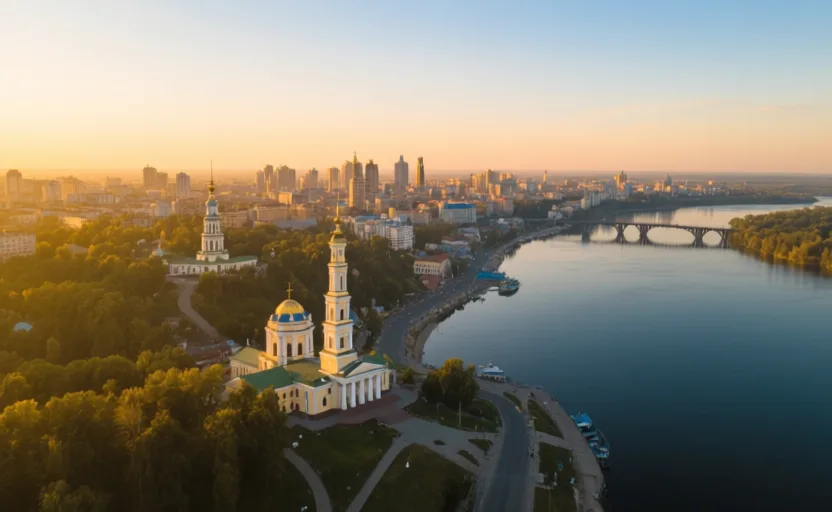 AI city illustration · Artistic impression
What people learn after moving
About 970,000 before 2022 and Ukraine's fourth city; the wartime figure is inflated by arrivals from further east and no reliable current count exists
Ukrainian is the sole state language and dominates public life; Dnipro was a Russian-speaking industrial city and both are heard daily
Ukrainian hryvnia (UAH, ₴) — about ₴44.8 to the US dollar at the NBU official rate, August 2026
EET (GMT+2), EEST (GMT+3) from late March to late October
AI city illustration · Artistic impressionCost of living in Dnipro
Check your eligibility
Pick your passport to see entry rules and the long-stay routes we have researched.
Pick your passport to see whether you can enter Ukraine — and what it takes to stay.
The law is national and identical to Kyiv's: a TEMPORARY residence permit (посвідка на тимчасове проживання) issued by the State Migration Service on a ground in Article 4 of the Law on the Legal Status of Foreigners, and a separate PERMANENT residence instrument reached only through a prior immigration permit granted by category. Time on a temporary permit accumulates towards nothing. What is different about Dnipro is the shape of the population applying. A large share of foreign nationals here are on international technical assistance projects, NGO employment or medical secondments rather than ordinary corporate contracts — which matters, because the salary floor for a work permit drops from 10 minimum wages to 5 for public associations, charities and educational institutions, and because the international technical assistance ground is a distinct route with its own paperwork. Get the ground right first; everything else follows from it.
Exchange happens in person at a сервісний центр МВС and the head service centre states explicitly that it cannot be done online. You need your identity document, your РНОКПП tax number, the foreign licence with a certified Ukrainian translation, a driver's medical examination, and a confirmation from the issuing country's competent authority — or its diplomatic mission in Ukraine — that the licence was issued and that you have not been disqualified. Exams are NOT required where the licence was issued by a party to the 1968 Vienna Convention and the document conforms; a theory and a practical exam ARE required where it was not. Exchange is available at ANY territorial service centre regardless of where you are registered. The Dnipro-specific point is not about the licence at all: driving is genuinely useful here because so much work involves moving things, and it is genuinely consequential, because parts of Dnipropetrovsk oblast are designated combat or possible-combat areas with their own curfews and access rules.
Ukraine has one of the most advanced retail banking sectors in Europe, and Dnipro has a specific claim on that: PrivatBank, the country's largest retail bank, was founded here in 1992 and the city retains a substantial financial-services employment base. For a foreign resident the practical path is a passport plus a residence permit plus a РНОКПП tax number; a non-resident individual with no РНОКПП is recorded with nine zeros in its place. The National Bank has also permitted account opening with the digital passport in Diia. Before you move money, learn the wartime FX regime: purchases of foreign currency, cash withdrawals abroad and cross-border card transfers are all capped and the caps change. The most useful recent change for a foreign employee is the April 2026 easing that lets non-resident individuals buy and transfer abroad the foreign-currency equivalent of salary and civil-law-contract payments received into their Ukrainian hryvnia accounts on or after 1 May 2026. If you are here on an international project or with an NGO, add one more item: grant and project funds have their own reporting expectations and your finance officer, not your bank, is the right first call.
Ukraine funds healthcare through the Programme of Medical Guarantees, administered by the National Health Service of Ukraine (НСЗУ), which pays contracted providers directly at national tariffs. Access is defined by the Law on State Financial Guarantees of Medical Services (No. 2168-VIII), and the insured population is citizens, foreigners and stateless persons PERMANENTLY RESIDING in Ukraine, and recognised refugees and persons needing complementary protection. A temporary residence permit is not permanent residence — which is why ДМС makes medical insurance a listed condition of that permit. Dnipro's particular situation is that the state sector here is unusually strong at the acute end: the Mechnikov regional hospital is one of the busiest trauma centres in Europe, expanded its intensive care from roughly 60 to about 200 beds, and continued operating after a mass attack damaged its buildings on 18 May 2026. For routine care the private clinics are the practical answer for most foreign residents, as elsewhere. For anything serious, the ambulance takes you where the expertise is, and that is a good outcome here.
Three operators cover the country: Kyivstar, Vodafone Ukraine and lifecell. You can buy a prepaid SIM at a kiosk, a supermarket or an operator shop and use it immediately without producing a document. What the operators offer instead is voluntary REGISTRATION or 'personification' — linking the number to your identity document through the shop, the app, Diia or BankID. Register, because an unregistered number cannot be recovered if the phone is lost or stolen, cannot be ported, and is not accepted for identity-linked services. Kyivstar caps registrations at ten numbers per document. Coverage in Dnipro city is good and data is cheap; the constraints are power outages draining base-station batteries, and — if your work takes you towards Nikopol or Synelnykove districts — much thinner and less reliable coverage, plus positioning interference. Two SIMs on different networks is standard for anyone who travels in this oblast.
Two things to get right. First, the РНОКПП — the taxpayer registration number, still universally called the identification code — is the single most load-bearing number in Ukrainian life after your permit. Foreigners apply to the regional State Tax Service; a foreigner holding a temporary or permanent residence permit registers at the tax inspection covering the address on that permit, which here means the Dnipropetrovsk oblast head office and its taxpayer service centres — note the oblast keeps the pre-2016 name even though the city does not. Second, the rates: employment income is taxed at 18% personal income tax plus a 5% military levy. The levy was 1.5% until Law No. 4015-IX of 10 October 2024 raised it to 5% with effect from 1 December 2024 — still routinely misreported, and the difference between a 19.5% and a 23% deduction. Employers withhold both. Ukraine also runs the simplified ФОП regime and the separate Diia City regime for registered IT companies. Dnipro's local wrinkle is the humanitarian sector: staff on international technical assistance projects have a treatment of their own, and it is not something to work out from a general summary.
Each guide has verified costs, timelines, required documents, and the non-obvious gotchas — sourced from official government pages. Last verified August 2026.
Reading a list isn’t learning it. Globe Quest turns these into a trainer — hear each phrase spoken, drill them with spaced repetition, and get scored as you say them out loud.
This is the fact that explains the city. The Mechnikov regional hospital receives the most seriously wounded from the east and is one of the busiest trauma centres in Europe; it expanded intensive care from roughly 60 beds to about 200 to carry the load, and it kept working through a mass attack on 18 May 2026 that blew out its windows and damaged its buildings. Around that sits an entire economy: rehabilitation and prosthetics, medical supply, volunteer logistics moving vehicles and equipment east, and the reception of people evacuating. If you are coming to work in health, humanitarian logistics or reconstruction, Dnipro is where that work is, and the city's social life is organised around it to a degree that surprises newcomers.
Dnipro city has no front line in it. Dnipropetrovsk oblast does. As of mid-2026 Nikopol district (Nikopol, Marhanets, Chervonohryhorivka, Myrove) is designated an active combat area and is shelled almost daily from across the reservoir, where Enerhodar and the occupied Zaporizhzhia nuclear plant sit; communities in Synelnykove district and on the eastern edge of Kryvyi Rih district are designated possible combat areas, and the Synelnykove risk zone expanded in June 2026. Mandatory evacuation applies in parts of the oblast — in Synelnykove district roughly one resident in four has already left. A weekend drive that would be unremarkable from Lviv is a serious decision here. Check the current designation for your destination, not for 'the region'.
Accurate for 2026. Dnipro city runs midnight to 05:00, in line with Kyiv and Odesa. Elsewhere in Dnipropetrovsk oblast the hours are set district by district according to the security situation — shorter evenings in Nikopol district and earlier starts in parts of Synelnykove — and they change. This is the most common way visitors get caught out: they assume an oblast-wide rule, drive out for the afternoon and find the destination's curfew began two hours before the one they planned around.
Dnipro's metro is a single line of six stations — one of the shortest systems in the world — running from the railway station towards the industrial west. It is cheap, clean and takes contactless bank cards at every station, and it is nearly useless as an air-raid shelter for most of the city, because most of the city is nowhere near it. That makes Dnipro structurally different from Kharkiv and Kyiv, where 'get to the metro' is a real instruction. Here the shelter is a marked basement, an underpass or a purpose-built room, and you need to know where the one nearest your flat and your office is on the day you arrive.
Dnipro's fares are unusually lopsided. As of May 2026 a metro ride costs ₴10, the cheapest fare of any Ukrainian city that charges at all, while trams and trolleybuses cost ₴25 and buses and marshrutkas ₴23. Compare Odesa at ₴15 for a tram, or Kharkiv, which charges nothing at all. The metro's price is a legacy of a six-station line built to serve factories rather than a city, so it is cheap and it goes almost nowhere useful; the surface network is what you will actually ride, and it is priced accordingly. Every metro station takes a contactless bank card, phone or watch, so there is nothing to buy in advance.
LUN put Dnipro's median one-bed at about ₴12,000 a month in August 2026, essentially unchanged year on year and up about 9% over six months. That makes it the steadiest of Ukraine's big rental markets: cheaper than Kyiv, Lviv and Odesa, well above Kharkiv, and without Odesa's seasonal swings. The variable that will actually shape your quality of life is the same one everywhere in Ukraine — the power. Ask which черга the building is in, whether there is a generator or an inverter and what it powers, and how high the flat is, because a fifth floor with no lift during an outage is a different flat from the one you viewed.
Mechnikov Dnipropetrovsk Regional Clinical Hospital, the city's rehabilitation and prosthetics providers, international medical NGOs
The largest concentration of acute trauma and reconstructive expertise in eastern Ukraine, built around a hospital that expanded its intensive care from roughly 60 to about 200 beds. It is also the sector with the most international clinical partnership and the most demand for experienced staff.
Freight and warehousing operators, international humanitarian agencies, and a very large volunteer logistics sector
Dnipro is the staging point for almost everything moving east — medical supplies, vehicles, generators, humanitarian cargo. The volunteer networks here are large, organised and effectively professional, and they are how most newcomers meet people.
Interpipe, Pivdenmash (Yuzhmash), mining and metallurgical machinery plants
The industrial base the city was built on. Interpipe runs one of the newest electric-arc steelworks in Europe; Pivdenmash is the rocket and space plant that Russia targeted with a new intermediate-range ballistic missile in November 2024. Both remain significant employers and both are strategic targets.
PrivatBank, which was founded in Dnipro in 1992, plus the regional presence of the other large banks
Ukraine's largest retail bank started here, and the city retains a real financial-services employment base — operations, compliance and technology rather than trading floors.
Grain and oilseed traders, elevator operators, agricultural machinery dealers
Dnipropetrovsk is one of Ukraine's largest agricultural oblasts and the trading, storage and machinery businesses run from the city. With the sea route disrupted, the rail and road logistics around this sector have become considerably more complicated and considerably better paid.
Outsourcing and product firms across the city, with a strong fintech and enterprise-software bent
Ukraine's fourth technology city, smaller than Kyiv, Lviv or Kharkiv but with a distinct financial-services heritage from the PrivatBank ecosystem. Diia City (Law No. 1667-IX) and the ФОП simplified regime apply here as everywhere.
Nature · Shevchenko Park, Sobornyi district
A wooded island in the Dnipro linked to Shevchenko Park by a footbridge, with paths, beaches, a chairlift and views up and down one of the longest urban river frontages in Europe.
Local tip: Walk the island and then the embankment north towards the centre at the end of the day. It is the single best hour in the city, and it is also where you will notice how much of Dnipro's social life happens outdoors and early, because of the curfew.
Landmark · Sholem Aleichem Street, city centre
Seven linked towers arranged as a menorah, opened in 2012 and among the largest Jewish community centres in the world, housing the Museum of Jewish Memory and the Holocaust in Ukraine alongside the Golden Rose synagogue.
Local tip: Go for the museum rather than the building. Dnipro's Jewish history is central to understanding the city and the museum tells it without softening either the Holocaust or what came after; allow two hours.
Culture · Yavornytskoho Avenue, city centre
The regional history museum founded in the nineteenth century, with a Cossack collection, a famous line of stone steppe idols outside, and a hall dedicated to the war that began in 2014 and the people from this region who fought in it.
Local tip: The stone babas outside are free to look at any time and are a thousand years older than anything else in the city. Inside, go to the war hall last, and give it time — it is the museum locals bring visitors to.
Neighborhood · Between Yavornytskoho Avenue and the river
The short, dense, tree-lined boulevard that is the centre of the city's café and restaurant life — pedestrianised, low-rise, and busiest in the early evening because everything winds down well before midnight.
Local tip: Eat here early. Dnipro's food scene was among the best in Ukraine before 2022 and much of it survived; the boulevard and the streets off it are where to find it, and the tables fill from six.
Food · Ozerna Square, near Vokzalna metro
The city's central market — a large covered and open complex selling produce, meat, dairy, pickles and everything else, and the cheapest place in Dnipro to buy food by a wide margin.
Local tip: Go before ten with cash and small notes. The dairy and pickle rows are the reason to come; the imported fruit is not. Prices are negotiable at volume and nobody minds being asked.
Landmark · One line, six stations, from the railway station westwards
One of the shortest metro systems in the world — a single 7.8-kilometre line of six deep stations opened in 1995, built to serve factories that no longer employ what they did, and taking contactless bank cards at every turnstile.
Local tip: Ride it once for the curiosity and then stop planning around it. Unlike Kharkiv's or Kyiv's, this metro serves a corridor rather than a city, and it is not the shelter network — knowing that early saves you a bad assumption.
Side-by-side cost of living, language, climate and careers — to help you choose.