
Population
≈600,000 (city); ≈1.5 million (greater Dublin)
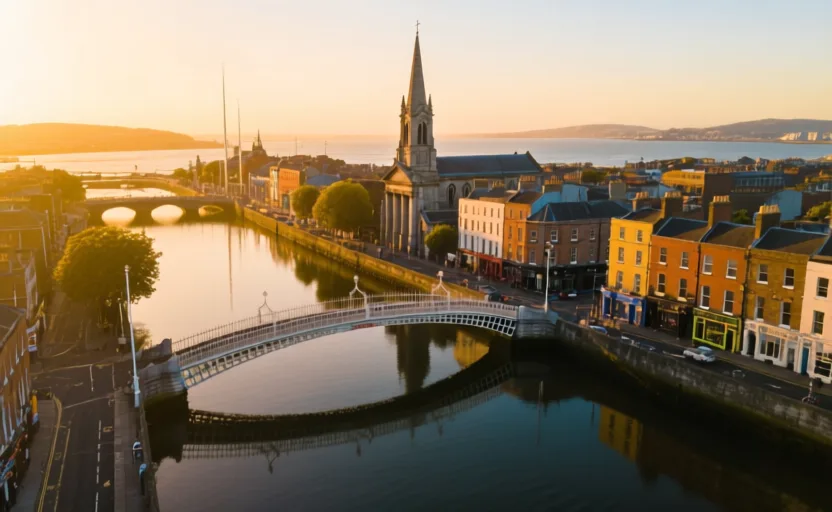 AI city illustration · Artistic impression
What people learn after moving
≈600,000 (city); ≈1.5 million (greater Dublin)
English; Irish is an official language and taught in schools
Euro (EUR)
GMT (UTC+0); IST (UTC+1) in summer
AI city illustration · Artistic impressionCost of living in Dublin
Check your eligibility
Pick your passport to see entry rules and the long-stay routes we have researched.
Pick your passport to see whether you can enter Ireland — and what it takes to stay.
The Critical Skills Employment Permit is Ireland's premium route: two years, no labour-market test for listed occupations, immediate family reunification, and a path to Stamp 4 (unrestricted work) after two years. Ireland raised every permit salary threshold on 1 March 2026, so any figure from an older guide will get an application refused.
Ireland exchanges licences from EU/EEA states and from a specific list of recognised countries. If your licence isn't on that list you must go through the full learner process — theory test, twelve mandatory lessons and a driving test — which takes months. Ireland drives on the left.
Irish retail banking consolidated sharply after KBC and Ulster Bank exited, leaving AIB, Bank of Ireland and PTSB plus digital challengers. Traditional banks demand proof of Irish address; digital banks generally don't, which is why most newcomers open a Revolut or N26 account first and a pillar-bank account later.
Ireland has public healthcare through the HSE, but unlike most of Western Europe, ordinary GP visits are not free for most working adults — you pay per visit. Medical cards for free care are means-tested and set at a low threshold. Most professionals therefore hold private health insurance, and many employers provide it.
Three networks — Vodafone, Three and Eir — plus resellers running on them. Prepaid SIMs are sold in supermarkets and phone shops and can be set up on the spot. Because Ireland is in the EU, roaming from another EU SIM is free at no extra cost, which buys you time before committing.
A Personal Public Service number is free and issued by the Department of Social Protection. Until you have one and have registered the job with Revenue, your employer must operate emergency tax, which withholds far more than you owe. Getting this right in week one is worth real money.
Each guide has verified costs, timelines, required documents, and the non-obvious gotchas — sourced from official government pages. Last verified July 2026.
Reading a list isn’t learning it. Globe Quest turns these into a trainer — hear each phrase spoken, drill them with spaced repetition, and get scored as you say them out loud.
Dublin's rental market is the hardest part of moving here by a wide margin. Viewings draw queues, good listings vanish within hours, and landlords pick from dozens of applicants. Budget more than you expect, arrive with a deposit ready, and treat the first month as a full-time search.
The Personal Public Service number gates employment, tax, banking and health services. Without it you're taxed on an emergency basis, which takes a large bite of your first pay packets until it's sorted and reconciled.
In a group at the pub, everyone buys a round in turn. Skipping yours is noticed. If you don't want that much to drink, say so early rather than quietly dropping out of the rotation.
Non-EEA nationals must register in person and get an IRP card. Appointment slots are the bottleneck, not the paperwork — book the moment you land, not when the deadline approaches.
It rarely pours but it's often drizzling, and the wind off the Irish Sea makes umbrellas useless. A hooded waterproof is the single most useful thing you can own here.
'Not too bad' is high praise. 'It's grand' can mean anything from delighted to quietly furious. Enthusiasm is fine but oversell lands poorly, and slagging — mutual mockery — is a sign of acceptance.
Google, Meta, Microsoft, Stripe, Intercom, Workday
Nearly every US tech firm runs its EMEA headquarters here, clustered around Grand Canal Dock — 'Silicon Docks'.
Pfizer, Johnson & Johnson, MSD, Medtronic
Ireland is one of the world's largest pharmaceutical exporters, with heavy manufacturing and regulatory-affairs demand.
Citi, JPMorgan, BNY, Bank of Ireland, AIB
The IFSC concentrates fund administration, aircraft leasing and post-Brexit EU banking operations.
Deloitte, PwC, EY, KPMG, Accenture
All the big firms are here at scale, feeding off the multinational base.
AerCap, Avolon, SMBC Aviation Capital
A genuine world-leading niche — a large share of the world's leased commercial aircraft is managed from Dublin.
Trinity College, UCD, DCU, government departments
Stable employment and a research base that feeds the tech and pharma clusters.
Nature · North-west of the centre
One of Europe's largest enclosed city parks, with a free-roaming herd of fallow deer and the President's residence inside it.
Local tip: The deer congregate near the Papal Cross in the mornings. Rent a bike at the Parkgate Street entrance — the park is far too big to cover on foot.
Neighborhood · North inner city
Red-brick terraces, small bars and independent coffee, a short walk from the centre and much less touristed.
Local tip: Manor Street and Stoneybatter proper are where locals drink. It's the neighbourhood people move to when Temple Bar has worn them out.
Nature · North coastal, end of the DART
A looped clifftop path around a fishing village headland, thirty minutes from the city on the DART.
Local tip: Do the purple route for the full loop and eat at the harbour afterwards. Go on a weekday — weekend DARTs to Howth are packed.
Culture · South inner city
Dublin's oldest quarter — the Guinness Storehouse, Teeling Distillery and St Patrick's Cathedral within a few streets.
Local tip: Skip the Storehouse queue and do Teeling or Roe & Co instead; smaller, cheaper, and you'll actually talk to someone who works there.
Neighborhood · South of the canal
Leafy Victorian suburbs full of restaurants, a twenty-minute walk or short Luas ride from town.
Local tip: Ranelagh village has the best concentration of good restaurants in Dublin outside the centre, and you can actually get a table midweek.
Nature · South coastal
A rocky sea-bathing spot where Dubliners swim year-round, including Christmas morning.
Local tip: Locals swim here in January without wetsuits. Go in summer first, bring a flask, and don't underestimate how cold the Irish Sea is.
Side-by-side cost of living, language, climate and careers — to help you choose.