
Population
≈367,000 in the comune; ≈700,000 across the contiguous Florence–Sesto–Scandicci–Prato conurbation
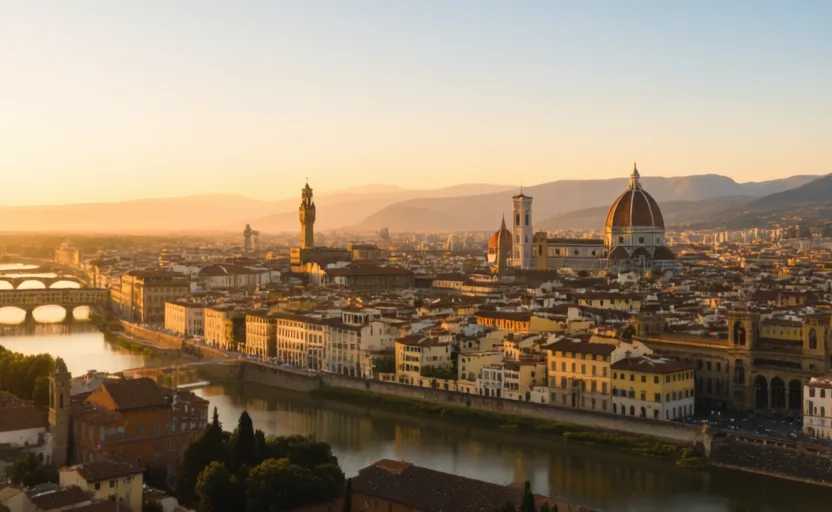 AI city illustration · Artistic impression
What people learn after moving
≈367,000 in the comune; ≈700,000 across the contiguous Florence–Sesto–Scandicci–Prato conurbation
Italian. English is widely spoken in tourism and the university sector and rarely in public offices
Euro (EUR)
CET (GMT+1), CEST (GMT+2) with daylight saving from late March to late October
AI city illustration · Artistic impressionCost of living in Florence
Check your eligibility
Pick your passport to see entry rules and the long-stay routes we have researched.
Pick your passport to see whether you can enter Italy — and what it takes to stay.
The chain is national — nulla osta, type-D visa, entry, then a permesso di soggiorno application filed on paper within eight working days at a post office — and Florence's version of it is dominated by students. The Questura's autumn caseload is enormous because thousands of enrolments land in the same fortnight, so early filing matters more here than the deadline alone suggests. Residence registration runs separately through the comune and includes a municipal police visit to the address.
EU licences are valid indefinitely. Licences from countries with a reciprocity agreement convert administratively; the rest means the Italian theory and practical exams, in Italian, within twelve months of registering residence. Florence then places almost the entire historic centre inside a camera-enforced ZTL with additional night-time restrictions in the entertainment areas, and adds a tramvia network that has made a car unnecessary for a growing share of the city.
You need a codice fiscale for any account, and banks distinguish between resident and non-resident accounts with the latter costing more. The fastest route to a working Italian IBAN is a digital bank. The more consequential piece of setup is SPID, the national digital identity, without which the tax portal, the health booking system and the comune's services all mean queueing in person.
SSN registration is compulsory and free for employees, the self-employed and their families, and voluntary for students, elective residents and some permit holders — who since 1 January 2024 pay an income-based contribution with statutory minimums of €700 for students, €1,200 for au pairs and €2,000 for most other adults. Registration assigns you a medico di base, the gatekeeper for every referral. Tuscany's system performs well by Italian standards and Careggi is one of the country's larger teaching hospitals.
Italian mobile is cheap and every SIM, prepaid included, must be registered against an identity document and a codice fiscale. Fixed connectivity is good in the outer districts and along the tramvia corridors, and much less predictable inside the historic centre, where listed façades, protected interiors and condominium consent all bear on whether fibre can reach a specific flat. Ask before you sign, not after.
Residence for tax follows anagrafe registration or having your habitual abode or centre of interests in Italy for more than 183 days in the calendar year, and residents are taxed on worldwide income. The impatriate regime was substantially rewritten for anyone moving from 2024. Florence's other distinctive tax question is property: this is a city where a great many foreign residents own something and let it, and both the national short-let rules and the comune's own authorisation regime now apply.
Each guide has verified costs, timelines, required documents, and the non-obvious gotchas — sourced from official government pages. Last verified August 2026.
Reading a list isn’t learning it. Globe Quest turns these into a trainer — hear each phrase spoken, drill them with spaced repetition, and get scored as you say them out loud.
Since 2025 the comune has blocked new short tourist lets in the UNESCO historic core, grandfathering only properties already regularly let in 2024. In May 2026 the Tuscan administrative court rejected the nineteen challenges brought against the regulation, and in June 2026 the council extended the block to nine further zones in the belt around the centre. Short lets now need a five-year authorisation tied to both owner and property, units must be at least 28 square metres, and keyboxes on façades have been banned since 2025. The practical effect for you is that stock is slowly returning to long lets — but also that a landlord offering you an informal short-term arrangement in the centre may be doing something the comune now polices.
The tax code is free, issued the same day at an Agenzia delle Entrate office with a passport, and required before a lease, a bank account, a SIM contract or SSN registration. Non-EU nationals arriving on a sponsored work or family visa are usually assigned one at the Sportello Unico. Florence's student population makes this the single most common bottleneck in September, when several thousand people need one in the same fortnight — go in the first week, not the third.
Non-EU arrivals on a long-stay visa collect a yellow kit at a Poste Italiane counter marked 'Sportello Amico', complete it, attach a €16 revenue stamp bought at a tobacconist, and hand it back with roughly €30 in postal and permit fees. The postal receipt is your proof of lawful stay while the Questura di Firenze processes it. The clock runs from the day you cross the border, not from finding a flat — and you can file using a hospitality declaration if you have not yet signed a lease.
Idealista put Florence at €22.3 per square metre a month in the second quarter of 2026 — behind Milan, ahead of Venice and well ahead of Rome — in a comune of under 370,000 people. Two decades of short-let conversion plus a very large student and study-abroad population did that. A one-bed in or near the centre is €1,000–1,500; rooms in shared flats, which is how most people here actually live, run €500–800. Look north and east — Rifredi, Novoli, Campo di Marte — where the tramvia and the regional trains make the difference in cost far larger than the difference in journey time.
Nearly the whole historic centre is a limited-traffic zone with camera gates, and there are additional night-time restrictions in the entertainment areas on weekend evenings in the warmer months. A single wrong turn produces a fine per gate crossed. Hotels can register a guest's plate for a short window; residents obtain a permit tied to a specific sector. Foreign plates are pursued months later through international recovery agents. If you are moving in with a van, arrange the temporary authorisation with the comune in advance — retroactive appeals almost never succeed.
Under D.Lgs. 209/2023, 50% of qualifying employment or professional income is exempt up to €600,000 a year for five tax periods, conditional on a high qualification or specialisation, three prior years of non-residence and a commitment to remain tax resident four years. The old regime exempted 70%, and 90% in the southern regions — Tuscany never had the southern rate, but plenty of guidance aimed at Florence still quotes the 70%. Anyone moving now should model on 50%.
Gucci, Salvatore Ferragamo, Roberto Cavalli, Emilio Pucci, Prada and LVMH Tuscan operations
Gucci's operational headquarters is at Scandicci on the city's edge and Ferragamo has been headquartered on Via Tornabuoni since 1938. The leather workshops of the Oltrarno and Santa Croce still supply the maisons, and the Polimoda school feeds the whole cluster.
Baker Hughes (Nuovo Pignone), El.En., Targetti
Nuovo Pignone at Rifredi has built turbines and compressors in Florence since the nineteenth century and is now the core of Baker Hughes' turbomachinery business — the city's largest industrial employer and its main engineering career path.
Menarini, Eli Lilly Sesto Fiorentino, Kedrion, Abiogen
Menarini is headquartered in Florence and is Italy's largest privately held pharmaceutical group, and the Sesto Fiorentino belt hosts significant manufacturing and research operations.
Università di Firenze, European University Institute, Polimoda, Scuola Normale Pisa campus, dozens of US study-abroad programmes
The European University Institute at Fiesole is an EU-funded postgraduate and research institution with its own international legal status, and Florence hosts one of the largest concentrations of American university programmes anywhere outside the United States.
Uffizi, Palazzo Pitti, Opera del Duomo, hotel groups and tour operators
Around ten million visitors a year in a city of under 370,000 residents. It is the dominant employer and also the force that reshaped the housing market — which is why the comune's short-let regulation matters so much locally.
Opificio delle Pietre Dure, Oltrarno workshops, goldsmiths on the Ponte Vecchio
The Opificio is one of the world's leading restoration institutes and trains conservators internationally. The Oltrarno's artisan trades — gilding, bookbinding, marbled paper, cabinetmaking — remain a real if small labour market.
Landmark · Centro storico
The cathedral and the octagonal dome raised without centring in the 1420s, still the largest masonry dome ever built.
Local tip: The dome climb is timed, sells out days ahead and involves 463 steps between the two shells. The nearby Campanile has no reservation queue and gives you the better photograph, because it includes the dome.
Neighborhood · South bank
The artisan half of the city — workshops, a plain-fronted Brunelleschi church, and the square where Florentines actually spend their evenings.
Local tip: The morning market in Piazza Santo Spirito and the workshops along Via Toscanella and Via de' Serragli are the real neighbourhood. Cross at the Ponte Santa Trinita rather than the Ponte Vecchio and you will see almost no one.
Food · Santa Croce, east of the centre
The neighbourhood food market Florentines use, as opposed to the tourist-facing one at San Lorenzo.
Local tip: Go before one o'clock, when the covered hall and the outdoor produce stalls are both working. The trattoria inside serves a two-course lunch to market traders at market-trader prices and does not advertise.
Nature · Above San Niccolò, south bank
A terraced hillside garden with a wisteria tunnel, a baroque staircase and the best framed view of the city.
Local tip: It shares a ticket with the Boboli but takes a fraction of the visitors, and the wisteria in late April is the single best week in the Florentine calendar. Enter from Via de' Bardi and walk down through it rather than up.
Nature · West, along the Arno
A 160-hectare former Medici hunting estate along the river — the city's only large park and its running, cycling and market ground.
Local tip: The Tuesday morning market is the biggest in the city and where residents buy clothes and household goods. The tramvia T1 runs along the edge, so it is easy to reach from Rifredi or Scandicci.
Culture · San Marco, north of the centre
Andrea del Castagno's 1440s Last Supper, in a former convent refectory, restored and almost always empty.
Local tip: Free, open most mornings, and typically holding fewer than a dozen people. It is a five-minute walk from the Accademia queue and the contrast is the whole point. Check the opening days, which are limited and change seasonally.
Side-by-side cost of living, language, climate and careers — to help you choose.