
Population
537,000 in the municipality at the 2022 census; ≈1.3 million across the metropolitan region including São José, Palhoça and Biguaçu
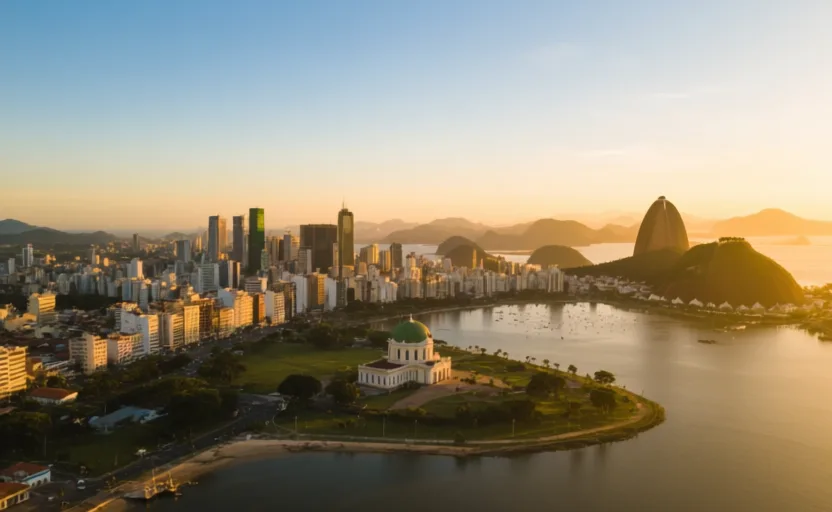 AI city illustration · Artistic impression
What people learn after moving
537,000 in the municipality at the 2022 census; ≈1.3 million across the metropolitan region including São José, Palhoça and Biguaçu
Portuguese, in the fast Azorean-descended manezês of the island. Spanish is widely heard in summer; English is common in tech and rare elsewhere
Brazilian real (BRL)
BRT (GMT−3) — no daylight saving since 2019
AI city illustration · Artistic impressionCost of living in Florianópolis
Check your eligibility
Pick your passport to see entry rules and the long-stay routes we have researched.
Pick your passport to see whether you can enter Brazil — and what it takes to stay.
Register with the Polícia Federal and collect your CRNM within 90 days of entering Brazil on that visa, whatever route brought you — or within 30 days of publication in the Diário Oficial if your residence was authorised from inside the country. The CPF comes first and can be obtained before you leave home. Florianópolis has become Brazil's densest concentration of digital nomad visa holders, which makes two things locally acute: proving a Brazilian address when you are living in a short-let, and the fact that VITEM XIV caps at two years and is not a road to permanence.
Your foreign licence is valid for a maximum of 180 days of regular stay in Brazil, on the strength of the road traffic conventions Brazil has ratified and of reciprocity — in practice, carried alongside an International Driving Permit. After that, conversion through DETRAN-SC requires a sworn translation, a medical fitness examination and a psychological assessment — the last of which no European or North American driver expects. Unlike São Paulo or Rio, Florianópolis gives you almost no way to live without a car once you leave the central district: there is no rail of any kind, the bus network radiates through terminals rather than connecting places directly, and the island's two arterial roads are the only routes north and south.
The CPF is the hard gate; nothing opens without it. Past that, Brazil's digital banks onboard foreigners through an app in days. Pix — the central bank's free instant transfer rail — is what you actually use every day. The genuinely local question is how money reaches you: if you are paid abroad, the combination of IOF on conversion, the FX spread and the Brazilian dollar-account fintechs determines what you keep, and the differences across a year are large enough to be worth a serious afternoon.
Florianópolis runs one of the better-regarded municipal primary care networks in Brazil, with family health teams covering the whole island through neighbourhood Centros de Saúde. SUS will treat you free whatever your immigration status. The gaps are at the top end — genuinely high-complexity oncology and cardiac work is sometimes referred off the island — and at the beach, where the Corpo de Bombeiros lifeguard service is seasonal and the rip currents are not.
Vivo, Claro, TIM and Algar all serve the island, and the central districts are well covered. Florianópolis is one of Brazil's better-connected cities and home fibre is fast and cheap by international standards, which is a large part of why the tech cluster and the nomads are here. The two local caveats are seasonal: mobile capacity in the north and south of the island degrades noticeably when the summer population triples, and fixed connections in the outer beach villages can still be radio rather than fibre.
Brazilian tax residence begins immediately on arrival with a permanent visa or a local employment contract, or — on a temporary visa — on the day you complete 184 days of presence, more than 183, within a twelve-month period, and residence means worldwide income. Foreign-source earnings are paid monthly through carnê-leão rather than settled at filing. Locally, the thing that shapes take-home pay most is that Florianópolis's technology sector hires overwhelmingly on PJ contracts rather than as employees, which changes your tax, your benefits and your legal rights all at once.
Each guide has verified costs, timelines, required documents, and the non-obvious gotchas — sourced from official government pages. Last verified August 2026.
Reading a list isn’t learning it. Globe Quest turns these into a trainer — hear each phrase spoken, drill them with spaced repetition, and get scored as you say them out loud.
From roughly mid-November the island's landlords switch inventory to short-let temporada pricing, where four months of summer can earn what a year of residential rent would. Annual listings thin out, agencies stop returning calls, and what remains is priced as if you were a tourist. If you can control your arrival date, come in April or May when the season has ended, the owners want twelve months of certainty and you have actual bargaining power. Arriving in December and hunting for a lease is the single most avoidable mistake here.
Receita Federal will issue a CPF to someone with no Brazilian visa, no address and no presence in the country, online or through a consulate. Since 2023 it is the one number every public database keys off, and the bank account, the phone chip, the lease and the health card all sit behind it. Florianópolis has a whole cottage industry of concierges charging nomads to solve this after arrival; doing it yourself before departure takes an afternoon and costs nothing.
The deadline runs from your arrival stamp, not from visa issue, and you should not plan on a weekend in Buenos Aires buying you a fresh window — the obligation attaches to your admission on that visa. The Santa Catarina superintendency handles registration and is less oversubscribed than Rio or São Paulo, but the address proof is the sticking point for nomads: you need a lease or a signed declaração de residência, which is difficult if you are living in a short-let. Sort the address before you book the appointment.
Florianópolis sits at 27° south with the cold Atlantic on three sides. Between June and September daytime highs are often 14–18 °C, the wind off the sea is relentless, and it rains for days. Brazilian construction has no insulation and virtually no home here has heating, so indoor temperatures track outdoor ones. People arrive in February, sign a summer-appropriate flat and spend August in three jumpers. Look at how a place faces the sun and whether it has any heating at all.
All road traffic between the island and the mainland crosses the Colombo Salles or Pedro Ivo Campos bridges — the historic Hercílio Luz reopened in 2019 but carries only light traffic. Everything funnels through that pair, and the SC-401 north-island corridor and SC-405 to the south are single arteries with no alternative. A commute from the north of the island to the mainland can be twenty minutes at ten in the morning and eighty at six in the evening. Choose your side of the bottleneck deliberately.
The Corpo de Bombeiros posts guards on the open Atlantic beaches during the summer season and largely withdraws for the rest of the year. Praia Mole, Joaquina, Moçambique and the Campeche have powerful rip currents that locals identify by sight and call valas. Drowning is the leading cause of accidental death on these beaches and most victims are people who could swim perfectly well in a pool. Learn what a rip looks like before you go in during April, and never swim an empty beach alone.
Softplan, RD Station, Conta Azul, Involves, Neoway, ACATE members
The city counts technology firms in the thousands, clustered around the ACATE association — which alone has more than a thousand member companies — and the Sapiens Parque campus in the north. That density is why Florianópolis is routinely called Brazil's silicon island rather than a beach town with wifi.
Coworking operators, relocation concierges, language schools
There is no official register of digital nomads, but the published local estimates put the figure in the low thousands and rising fast — roughly a tripling across the six years to 2025 — and an entire service layer of coworking, concierge and visa support has grown around it.
UFSC, UDESC, IFSC, Certi Foundation
UFSC is consistently ranked in Brazil's top three for computing and produces several hundred software engineers a year — the supply that made the tech cluster possible in the first place.
Government of Santa Catarina, TJSC, ALESC, Celesc, Eletrosul
Florianópolis is the state capital, and the state government, courts and utilities remain the largest single block of stable employment on the island. These jobs are filled by concurso and are effectively closed to foreign nationals.
Hotels, pousadas, beach clubs, short-let operators
Over two million visitors a year, heavily concentrated between December and Carnival and heavily Argentine and Uruguayan — which is why the island's economy, and its rental market, have a pronounced four-month peak.
Ribeirão da Ilha oyster farms, Santa Catarina co-operatives
Santa Catarina produces the overwhelming majority of Brazil's farmed oysters and mussels, and most of it comes out of the sheltered bays on the island's western side. The oyster farms at Ribeirão da Ilha are a working industry, not a tourist attraction.
Neighborhood · Centre of the island
A saltwater lagoon ringed by bars, restaurants and the densest concentration of foreign residents on the island.
Local tip: The Centrinho is where everyone eats and drinks, and it is also where the summer traffic jams. The dunes on the far side, between the Lagoa and Joaquina, are the good part — walk across them in the late afternoon and sandboard down the seaward face.
Food · Downtown, island side
The 1898 market hall and the streets around it — the working, administrative city most visitors never see.
Local tip: Box 32 upstairs is the institution: prawns and cold beer from midday, packed with civil servants on a Friday. The market is the one place in Florianópolis where the city feels like a city rather than a collection of beach villages.
Culture · South-west coast
An Azorean colonial village of whitewashed houses and a 1806 church, facing calm water lined with oyster farms.
Local tip: This is where Brazil's oysters actually come from, and the restaurants along the waterfront serve them a couple of hours out of the sea. Go on a weekday, eat at whichever place has the fishermen's vans outside, and stay for the sunset over the mainland mountains.
Nature · North end of the Lagoa da Conceição
A village with no road access at all, reachable only by a lagoon boat or a two-hour trail along the shore.
Local tip: The scheduled boat leaves from the Centrinho and costs almost nothing — it is public transport, not a tour. Walk one way along the old trail and take the boat back. There are perhaps a dozen restaurants at the end and no cars anywhere, which on this island is a genuinely strange and lovely sensation.
Nightlife · East coast
The island's surf and party stretch — beach bars on the sand at Mole, a fishing village turned nightlife strip at Barra.
Local tip: Mole is spectacular and has a genuinely dangerous rip; swim between the flags in season and stay out of the water when the guards have gone. Barra da Lagoa has the better and cheaper seafood, and a canal walkway out to a natural swimming pool in the rocks.
Landmark · Between the island and the mainland
A 1926 eyebar suspension bridge, the largest of its kind in Brazil, closed for twenty-eight years and reopened in 2019.
Local tip: It carries only light traffic and pedestrians now, which is the point — walk it at sunset for the view back at the island. The two modern bridges either side of it carry the entire island's traffic, which explains a great deal about how this city works.
Side-by-side cost of living, language, climate and careers — to help you choose.