
Population
≈1.65 million in the city — Japan's fastest-growing major city, and the youngest by average age
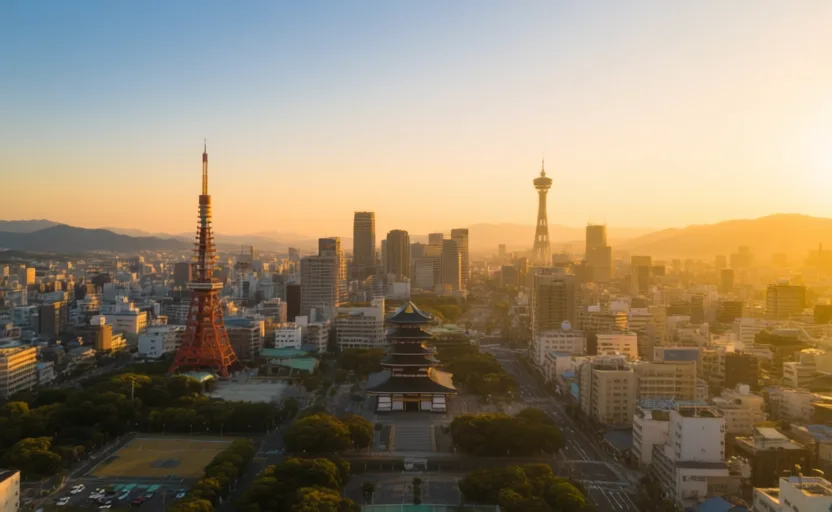 AI city illustration · Artistic impression
What people learn after moving
≈1.65 million in the city — Japan's fastest-growing major city, and the youngest by average age
Japanese, in the Hakata dialect. English support is better than the city's size suggests, particularly around the startup ecosystem
Japanese yen (JPY)
JST (GMT+9) — Japan does not observe daylight saving
AI city illustration · Artistic impressionCost of living in Fukuoka
Check your eligibility
Pick your passport to see entry rules and the long-stay routes we have researched.
Pick your passport to see whether you can enter Japan — and what it takes to stay.
Japan issues your residence card at the airport, but the card alone is not enough — you must register your address at your ward office within fourteen days, and that registration unlocks health insurance, banking and phone contracts. Fukuoka pioneered Japan's startup route: it can certify a business preparation plan that buys a founder up to two years of 'Designated Activities' status before the ordinary Business Manager thresholds bite. Since 1 January 2025 that route runs nationwide rather than only in special zones, so what Fukuoka offers now is the deepest English-language support for it rather than exclusivity.
Converting a foreign licence — gaimen kirikae — requires a knowledge check and, for most countries, a practical test on a closed course that is notoriously exacting. A defined list of countries is exempt. The rules tightened nationally on 1 October 2025: a jūminhyō is now compulsory for every applicant, so short-stay visitors are shut out of the route entirely, and the knowledge check went from ten questions at 70% to fifty questions at 90%. An International Driving Permit is valid for one year only. Fukuoka is compact and flat enough that most residents manage without a car, and registering one requires proving you have somewhere to park it first.
Japanese banks vary enormously in how they treat new foreign residents, and several major banks effectively require six months of residence before opening a full account. Japan Post Bank and the online banks are the usual first stop because they do not. You need ward registration first. Fukuoka Bank, the dominant regional institution, is worth knowing about because local employers and landlords often expect it.
Enrolment is a legal obligation, not a choice. Once enrolled you pay 30% of the cost of most treatment at the point of care and the scheme pays the rest, with a monthly ceiling that caps catastrophic costs. Pension enrolment is equally compulsory — and if you leave Japan you can claim a lump-sum withdrawal of part of what you paid, which a great many departing residents never do.
Japanese mobile has historically been expensive, dominated by three carriers with long contracts and heavy handset subsidies. Government pressure changed that, and the low-cost sub-brands and MVNOs now offer genuinely cheap plans on the same networks. You need a residence card and usually a Japanese bank account or credit card. Home fibre is fast and cheap, but what reaches your actual flat depends on the building.
Most employees never file a return — the employer's year-end adjustment handles it. The two things that catch foreign residents are residence tax, calculated on last year's income and billed from the following June, and the distinction between non-permanent and permanent tax residence, which determines whether Japan taxes your foreign income at all. Founders on the startup route have a third problem: nobody is running a year-end adjustment for them.
Each guide has verified costs, timelines, required documents, and the non-obvious gotchas — sourced from official government pages. Last verified August 2026.
Reading a list isn’t learning it. Globe Quest turns these into a trainer — hear each phrase spoken, drill them with spaced repetition, and get scored as you say them out loud.
Fukuoka City can certify a business preparation plan that gets you a 'Designated Activities' status of up to two years to incorporate before you have to meet the ordinary Business Manager requirements — the capital threshold and the physical office that normally block anyone starting from scratch. Fukuoka was the first city to do this, under its 2014 National Strategic Special Zone designation, and the free English-capable support at Startup Café Fukuoka is genuinely better than most. But the route is no longer unique: the special-zone scheme was merged into METI's nationwide Foreign Entrepreneurship Promotion programme on 1 January 2025, and around seventeen municipalities — including Tokyo, Shibuya, Yokohama, Osaka, Kyoto and Sendai — now certify plans too. Choose Fukuoka for the support and the cost of living, not because it is the only door.
Japanese law requires you to register your address at the ward office covering it within fourteen days of moving in. Fukuoka has seven wards — Hakata, Chūō, Higashi, Nishi, Minami, Jōnan and Sawara — and it must be the one your address sits in. The registration produces the jūminhyō certificate and triggers your My Number, and without it you cannot enrol in health insurance, open most bank accounts, or complete a phone contract.
Deposit, key money, agency fee, guarantor company fee, fire insurance and the first month. Key money in particular is a gift to the landlord you never see again. Fukuoka is the gentlest of Japan's big cities on this — the large student population keeps a lot of zero-reikin stock in the market — but budget for the full package rather than the best case.
Jūminzei is calculated on your previous calendar year's income and billed from the following June. Your first year feels cheap and your second is expensive, and if you leave Japan you can still owe a full year's residence tax on income already spent. Anyone planning a departure should appoint a tax representative or settle it before going.
Fukuoka Airport is two subway stops from Hakata Station and five from Tenjin — the shortest airport-to-centre journey of any major city in Japan. The flip side is a strict height limit on buildings under the flight path, which is why central Fukuoka is low-rise where Osaka and Tokyo are not, and why the Tenjin Big Bang redevelopment needed a special relaxation of those rules to proceed at all.
Busan is roughly an hour by air or three by high-speed ferry from Hakata port; Seoul is a short flight. Tokyo is over 1,000 km away. Fukuoka's orientation is genuinely toward the continent rather than toward eastern Japan, which shows up in the food, the trade and how people spend long weekends.
Nulab, Skydisc, Fusic, QPS Research Institute, Mirrativ
Fukuoka was designated Japan's Global Startup and Job Creation Special Zone in 2014 and has run an explicit startup policy ever since, including the city-backed startup visa and a free support centre operating in English.
Nishitetsu, Fukuya, Zensho, Piolax, TRIAL Holdings
Nishitetsu runs the private railway, the bus network and a department store from the same terminal, which is why Tenjin functions as the city's commercial centre rather than the JR station does.
TDK, Sony Semiconductor Kyushu, Mitsubishi Electric, Rohm
Kyushu is nicknamed 'Silicon Island' for its concentration of semiconductor fabrication, and the TSMC investment in neighbouring Kumamoto has pulled significant supply-chain activity into the region.
Hakata Port, Kyushu Electric Power, Nishinippon Railroad, Yamaha Motor Kyushu
Hakata is Japan's closest major port to the Asian mainland and handles both container freight and the passenger ferries to Busan.
Ajinomoto Kyushu, Yakult Honsha Kyushu, Kubara Honke, Marutai
Tonkotsu ramen, mentaiko and Hakata udon all originate here, and the regional food industry is a genuine employer rather than a tourist line.
Kyushu University, Fukuoka University, Kyushu Institute of Technology, RIKEN Kyushu
Kyushu University is one of Japan's former imperial universities, and its move to the new Ito campus in the west reshaped where students and young researchers live.
Food · Nakasu island, central
Open-air stalls that assemble along the riverbank at dusk and are gone by morning — the largest surviving concentration in Japan.
Local tip: Licences are allocated by public tender and the stalls are genuinely regulated, so quality is more even than it looks. Sit at the ones with locals rather than the ones with the biggest signs, expect to pay a small premium over a restaurant, and know that space is tight and turnover is expected.
Nature · Chūō ward, west of Tenjin
A large pond that was once the castle moat, with a two-kilometre path around it and the ruins of Fukuoka Castle alongside.
Local tip: The loop is exactly two kilometres and is the city's default run. The Japanese garden in the southern corner charges a small entry and is almost always empty — the best quiet half-hour in central Fukuoka.
Neighborhood · Central
The commercial heart — department stores and underground arcades above ground, and a grid of small bars and independent shops behind it in Daimyō.
Local tip: Tenjin Chikagai, the underground shopping street, is how you cross the district in bad weather and connects far more than the maps suggest. Daimyō is where the interesting eating is; the main Tenjin drag is chains.
Landmark · Sawara ward, northwest
A reclaimed waterfront district of wide streets, a beach, the baseball dome and Japan's tallest seaside tower.
Local tip: It is a planned district and feels like one, but the beach is genuinely usable and the sunset over the bay from the seawall is free where the tower observation deck is not.
Food · Between Hakata and Tenjin
A short covered market known as 'Hakata's kitchen', where the city's restaurants buy fish, mentaiko and pickles.
Local tip: Much smaller than Kuromon in Osaka and far less touristed, which is the point. Go in the morning, buy mentaiko from a stall rather than a department store, and expect the difference in price to be substantial.
Nature · 40 minutes west by train or car
A coastal peninsula of beaches, a torii gate standing in the sea, and a string of cafés and craft studios along the shore road.
Local tip: The Sakurai Futamigaura torii is the photograph everyone takes, but the peninsula's real appeal is that a genuinely rural coastline sits forty minutes from a city centre. It is the standard Fukuoka weekend and the reason a lot of people here never miss Tokyo.
Side-by-side cost of living, language, climate and careers — to help you choose.