
Population
Around 250,000 in the city proper and roughly double that across the Greater Gaborone area including Mogoditshane and Tlokweng
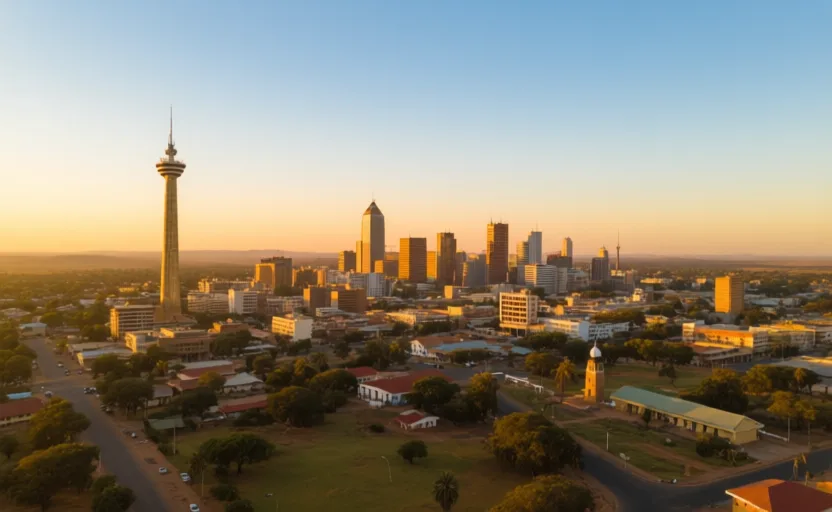 AI city illustration · Artistic impression
What people learn after moving
Around 250,000 in the city proper and roughly double that across the Greater Gaborone area including Mogoditshane and Tlokweng
English is the official language of government and business; Setswana is the national language and what people actually speak to each other
Botswana pula (BWP) — managed against a basket of the SDR and the South African rand under a crawling band, and NOT part of the rand Common Monetary Area
CAT (GMT+2) — no daylight saving, and the same clock as South Africa year-round
AI city illustration · Artistic impressionCost of living in Gaborone
Check your eligibility
Pick your passport to see entry rules and the long-stay routes we have researched.
Pick your passport to see whether you can enter Botswana — and what it takes to stay.
Botswana splits the job across two ministries and you need both halves. The work permit application is made at a Labour Office with a copy of the job advertisement showing the post was offered to citizens; the residence permit is a separate application on Forms 15 and 3 to Immigration. Published service standards are fourteen working days for a work permit and thirty for a residence permit, and renewals must be lodged six months before expiry. Localisation is the substantive constraint — Botswana genuinely expects a post to go to a citizen unless the employer can show it could not.
Foreign licence holders resident in Botswana may drive on their existing licence for 90 calendar days, after which they must convert — except that holders of licences issued within SADC states are expressly exempted, with conversion optional. Holders of a valid international driving permit may also continue driving without converting. Conversion requires a certified copy of the foreign licence, a letter from the issuing authority or the representative embassy confirming it is genuine, your passport and permits, and an eye screening valid for one year. Botswana drives on the left, and a car is close to essential.
Botswana's banking sector is small, conservative and well run, dominated by a handful of banks with South African and regional parentage. Account opening for a non-citizen turns on your permits: banks want the residence permit and usually the work permit, plus proof of address and an employer's letter. The important structural fact is monetary rather than procedural — Botswana is not part of the Common Monetary Area that ties Namibia, Lesotho and Eswatini to the rand. The pula is managed against a basket under a crawling band, rand is not legal tender here, and the exchange rate between them moves.
Botswana runs a public health system that is close to free for citizens and permanent residents and charges non-citizens a per-consultation fee plus service charges. Foreign professionals almost universally hold a private medical aid scheme — BOMAID and Pula are the main names — which buys access to private clinics in Gaborone and, importantly, referral to South Africa for anything the country cannot treat. That referral pathway is the part worth checking in the policy wording, because for serious or specialist care the answer here is frequently Johannesburg or Pretoria.
SIM registration is compulsory in Botswana and is carried out by the operators rather than by BOCRA — you go to Mascom, Orange or beMOBILE with an identity document. Citizens use the Omang; non-citizens use a passport with their permits. Coverage across Gaborone is good on all three networks and fixed broadband is available through Botswana Fibre Networks and the retail providers built on it. Data is more expensive than in Nigeria or Ghana but the service is more consistent.
Botswana's personal income tax is low by international standards and unusually low for the region: resident individuals pay nothing on the first BWP 48,000 a year and reach a top marginal rate of 25% above BWP 156,000. Non-residents pay from the first pula with no tax-free band, starting at 5% and reaching the same 25%. Taxation is source-based rather than worldwide for most purposes. VAT is 14% under the Value Added Tax Act, 2026, in force from 1 July 2026, with a defined list of zero-rated basic foodstuffs.
Each guide has verified costs, timelines, required documents, and the non-obvious gotchas — sourced from official government pages. Last verified August 2026.
Reading a list isn’t learning it. Globe Quest turns these into a trainer — hear each phrase spoken, drill them with spaced repetition, and get scored as you say them out loud.
The work permit comes from the Department of Labour and Social Security; the residence permit comes from the Department of Immigration and Citizenship. Both are required, they are applied for separately, and the National Immigrants Selection Board sets the validity on each. Holding a valid work permit while your residence permit has lapsed leaves you unlawfully resident even though your employment is lawful. Track both expiry dates independently.
The Government of Botswana's own guidance is that work permit renewal applications should be submitted six months before the current permit expires. That is much earlier than most countries and it is the single most common avoidable problem for foreign workers here. Put a reminder in at month six, not month eleven.
Botswana's policy is that a post goes to a citizen unless the employer can demonstrate otherwise, and the evidence required is concrete: a copy of the job advertisement, not more than six months old, showing the role was offered to citizens. Certain professions also need clearance from their regulatory body before a permit is issued — the government names drivers, farm workers, medical professionals, teachers, accountants, pilots, engineers and footballers among them. If a role could plausibly be filled locally, expect a refusal rather than a negotiation.
Botswana requires resident foreign licence holders to convert after 90 days — but holders of driving licences issued within SADC states are expressly exempted, with conversion optional. For anyone arriving from South Africa, Namibia, Zimbabwe or Zambia that removes an entire errand. Everyone else needs a certified copy of the licence plus a letter from the issuing authority or their embassy verifying it is genuine, which takes longer to obtain than the conversion itself.
Resident individuals pay nothing on the first BWP 48,000 a year and a top marginal rate of 25% above BWP 156,000 — one of the lower burdens in the region. Non-residents pay from the first pula with no free band, which is a real difference. VAT is 14% under the Value Added Tax Act 2026, in force from 1 July 2026, with a defined list of zero-rated basics: maize meal, sorghum, millet, wheat grain, rice, samp, brown bread and bread flour, sugar, cooking oil, and specified fresh fruit and vegetables — but only in their natural state, not prepared or mixed.
The Tlokweng border is about fifteen kilometres from central Gaborone and Johannesburg is a four-hour drive. A great deal of specialist shopping, medical referral and long-haul air travel runs through South Africa, and many residents drive to OR Tambo rather than connect through Sir Seretse Khama International. Budget for a car, check your medical scheme covers treatment in South Africa, and make sure your Botswana permits allow re-entry before you cross casually.
Debswana, De Beers Global Sightholder Sales, Okavango Diamond Company, Lucara
De Beers moved its rough diamond sales operation from London to Gaborone in 2013, which put the global sorting and selling of rough stones in this city. The sector's 2024–25 downturn was severe enough to contract the national economy.
Ministries, the Bank of Botswana, BURS, parastatals
Government is the largest employer in Gaborone by a wide margin, and the professional job market orbits it. This is a capital city economy in the fullest sense.
Bank of Botswana, First National Bank Botswana, Absa Botswana, Botswana Stock Exchange, BPOPF
The Botswana Public Officers Pension Fund is one of the largest institutional investors in southern Africa, and the country's macroeconomic stability has made Gaborone a plausible regional treasury location.
SADC Secretariat, Southern African Customs Union liaison, development agencies
The Southern African Development Community Secretariat is headquartered in Gaborone, which gives the city a diplomatic and technical community out of proportion to its size.
Botswana Meat Commission, commercial cattle ranching
Cattle are culturally and economically central in Botswana, and beef exports to the EU under long-standing preferential access have been a pillar of the rural economy for decades.
Wilderness, &Beyond, Chobe Holdings, Botswana Tourism Organisation
The Okavango Delta and Chobe underpin a high-value, low-volume tourism model that is deliberately expensive. The head offices, licensing and logistics run through Gaborone and Maun.
Nature · South-west of the city
The rocky hill overlooking Gaborone, with a well-used trail to the top and baboons on the way.
Local tip: Go early — it is exposed and hot by mid-morning. The summit gives you the whole city, the dam and, on a clear day, the South African border country. Do not leave anything in the car at the trailhead.
Nature · South of the city
The reservoir that supplies the capital, with sailing, birdlife and a shoreline that tells you how the rains have been.
Local tip: The water level is the city's most visible barometer — it has come close to empty in drought years and the North-South Carrier pipeline was built because of it. The sailing club is the main point of public access.
Nature · 15 km south, on the Lobatse road
A private reserve with white rhino, giraffe, and guided walks, twenty minutes from the office.
Local tip: The rhino tracking on foot is genuinely good and much cheaper than an equivalent experience further north. It is also the standard first outing for anyone visiting you from abroad.
Landmark · Central Business District
Bronze statues of the three chiefs who travelled to London in 1895 to keep Bechuanaland out of Rhodesian hands.
Local tip: Ten minutes and free, and it explains more about why Botswana turned out differently from its neighbours than any museum. Khama III, Sebele I and Bathoen I went to petition Queen Victoria directly — and it worked.
Neighborhood · Central Gaborone
The original pedestrian spine of the planned city, with government buildings at one end and traders' stalls down the middle.
Local tip: This is where the city actually meets. Come for the craft and fabric stalls at lunchtime and for the best street food; the shiny malls out at Kgale and Airport Junction have the shops but none of the life.
Culture · About 50 km south-west, near Ranaka
San rock paintings in red ochre on a granite outcrop, in a village setting with almost no infrastructure around them.
Local tip: There is no ticket office and no crowd — you ask in the village and someone will walk you up. An hour's drive from Gaborone and one of the oldest human artworks you will ever stand in front of, entirely unmediated.
Side-by-side cost of living, language, climate and careers — to help you choose.