
Population
≈560,000 in the comune, ≈810,000 in the metropolitan city — Italy's sixth-largest city, on a strip about 30km long and rarely more than a few kilometres deep
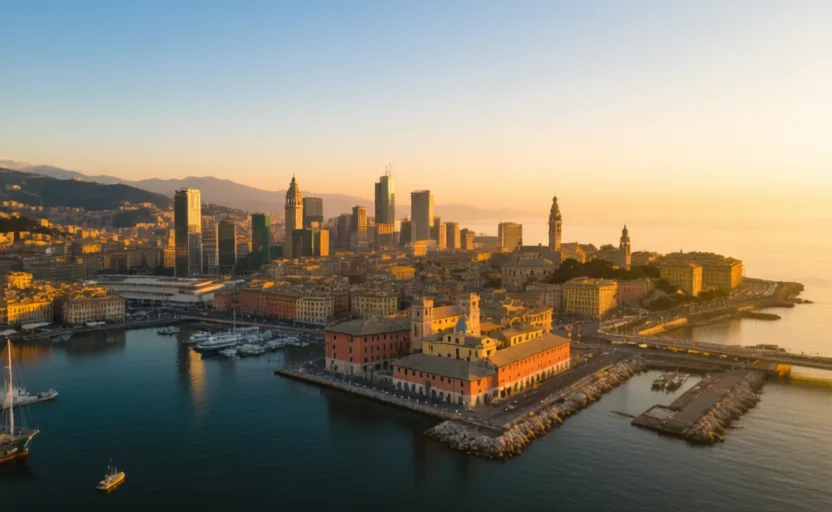 AI city illustration · Artistic impression
What people learn after moving
≈560,000 in the comune, ≈810,000 in the metropolitan city — Italy's sixth-largest city, on a strip about 30km long and rarely more than a few kilometres deep
Italian; Ligurian (Genoese) survives but is far less spoken than Sicilian or Neapolitan. English is used routinely in shipping, marine insurance and at the IIT
Euro (EUR)
CET (GMT+1), CEST (GMT+2) with daylight saving from late March to late October
AI city illustration · Artistic impressionCost of living in Genoa
Check your eligibility
Pick your passport to see entry rules and the long-stay routes we have researched.
Pick your passport to see whether you can enter Italy — and what it takes to stay.
The chain is the national one — nulla osta for sponsored work, a type-D visa, entry, then a permesso di soggiorno filed on paper at a post office within eight working days. Genoa's local colour is demographic and geographic rather than legal: the comune has been losing population for decades and processes residence registrations for a shrinking, ageing city, and the vigile's verification visit is complicated by an old town where buildings have several entrances, no lift and frequently no legible numbering.
EU licences work indefinitely. Licences from countries with a reciprocity agreement convert administratively; everyone else sits the Italian theory and practical exams, in Italian, within twelve months of registering residence. Genoa then makes an unusually strong case against owning a car at all: alleys too narrow to drive, no on-street parking in most central districts, a garage space bought or rented separately from the flat, and a transport network that answers the city's verticality with public lifts and funiculars carried on the ordinary ticket.
You need a codice fiscale for any account, and banks distinguish between resident and non-resident accounts with the latter costing more. A digital bank is the fastest route to a working Italian IBAN. Genoa's local wrinkles are practical: a lot of employment here is maritime, which means foreign-currency and cross-border payment questions ordinary branch staff answer badly, and residence registration carries transport and local concessions that make the anagrafe step worth doing before the banking one.
SSN registration is compulsory and free for employees, the self-employed and their families, and voluntary for students, elective residents and some permit holders — who since 1 January 2024 pay an income-based contribution with minimums of €700 for students, €1,200 for au pairs and €2,000 for most other adults. Liguria uses the ordinary ASL naming and numbers its authorities one to five; Genoa is ASL 3. The regional context that matters is demographic: Liguria has the oldest population in Italy, and a health service shaped around that has consequences for what is easy to access and what is not.
Italian mobile is cheap and every SIM, prepaid included, must be registered against an identity document and a codice fiscale. Fibre across the nineteenth- and twentieth-century districts is good. The old town is the exception, and so, for mobile, is the terrain: Genoa is a city of road and rail tunnels, hillsides that block signal, and alleys so narrow and deep that coverage varies within a few metres. Check the exact civic number for a fixed line, and check the phone signal inside the flat before you sign.
Residence for tax follows anagrafe registration or having your habitual abode or centre of interests in Italy for more than 183 days in the calendar year, and residents are taxed on worldwide income. Genoa's distinguishing feature is the municipal surcharge: where almost every Italian comune applies a single flat rate capped at 0.8%, Genoa exempts taxable income up to €14,000 and then charges 1.0%, 1.1% and 1.2% in brackets, under delibera 55 of 19 December 2024. Liguria's regional surcharge is set separately by the region and is applied in bands; check the current year's figures on the Dipartimento delle Finanze lookup before modelling a salary.
Each guide has verified costs, timelines, required documents, and the non-obvious gotchas — sourced from official government pages. Last verified August 2026.
Reading a list isn’t learning it. Globe Quest turns these into a trainer — hear each phrase spoken, drill them with spaced repetition, and get scored as you say them out loud.
The addizionale comunale IRPEF is normally capped at 0.8%, or 0.9% for a provincial capital, and almost every comune applies a single flat rate. Genoa does neither: it exempts taxable income up to €14,000 entirely and then charges 1.0% up to €28,000, 1.1% to €50,000 and 1.2% above, under delibera 55 of 19 December 2024. Very few Italian comuni have a genuinely progressive municipal surcharge at all, and fewer still are above the ordinary cap. For a lower earner it is generous; on a good salary it is the highest municipal rate of the four cities added here. Model it explicitly, because payroll and relocation calculators built from a national template will not.
Regione Liguria and its environmental agency ARPAL issue colour-coded hydrogeological alerts by basin zone; Genoa sits in Zone B, the central Ligurian maritime basins, whose torrents are small, steep and capable of going from nothing to dangerous within an hour. On an orange alert the comune can close schools of every level, parks, cemeteries and markets, and residents are told to stay away from underpasses and torrent embankments, avoid basements and ground floors, and not use lifts. Sign up to the comune's alert notifications in your first week, and find out where your address sits in the flood-risk mapping before you sign a lease rather than after your first November.
Genoa is thirty kilometres long, a few hundred metres wide in places, and vertical. The transport network reflects that: alongside the buses and the single metro line, AMT runs public lifts and funiculars that carry the ordinary €2.00 ticket, valid 110 minutes with changes. On top of that, AMT's urban services are reported to be free from 2026 for residents of the Città Metropolitana on Sundays and every night between 22:00 and 05:00, under a Sunday and Night Citypass scheme, with the region moving to account-based ticketing. Confirm the current terms with AMT directly, because these schemes change — but the underlying point is stable: registering residence here is worth money on transport in a way it is not in most Italian cities.
Istat puts Liguria's median age at around 49.6 years, the highest in Italy, with roughly 283 people over 65 for every 100 under 15 in 2025 against a national figure near 200, and a regional population of about 1.51 million at the start of 2026. Genoa province sits at the regional median. The consequences are concrete rather than abstract: a health service configured around geriatric demand, a lot of housing stock coming onto the market, low rents by northern Italian standards, quiet evenings in most districts, and a school-age population small enough that the international-school choice is thin. It is an excellent city for a certain kind of arrival and a slow one for another.
In the old town and on the hills, streets are frequently too narrow for a car and there is no on-street parking to be had. A garage space or box is bought or rented separately from the flat, often from a different owner, and in central districts the monthly cost is a meaningful fraction of the rent. Assume any listing that does not mention a posto auto does not have one. Combined with the ZTL over the centro storico and a public network that reaches the hills by lift and funicular, the honest advice is to arrive without a car, live here for six months, and only then decide whether you actually need one.
The Morandi viaduct on the A10 collapsed on 14 August 2018, killing 43 people and severing the motorway link between the west of the city and the rest of it. The replacement, the Ponte San Giorgio, opened in August 2020. A newcomer should know this not for the sake of the anecdote but because it explains something real: Genoa is a city built on viaducts, tunnels and retaining walls, infrastructure is a live political subject here, and the long-running works on the motorway network and the Terzo Valico rail tunnel are an ordinary part of journey planning. Check the state of the A7, A10 and A12 before any drive out of the city.
Autorità di Sistema Portuale del Mar Ligure Occidentale, terminal operators, Grimaldi, Costa Crociere, MSC's Italian operations
Genoa is Italy's leading port complex by tonnage and the country's centre of gravity for shipping, marine insurance and cruise operations — a genuinely international sector with English used routinely.
Fincantieri Sestri Ponente, Ansaldo Energia, Leonardo, Ansaldo Nucleare, marine equipment suppliers
Heavy engineering is the historic backbone of the western districts and remains a major skilled employer, from cruise-ship hulls to gas turbines.
Istituto Italiano di Tecnologia, Università di Genova, the Erzelli GREAT Campus, Ericsson and Siemens local operations
The IIT is one of Italy's best-funded research institutions and works substantially in English; Erzelli is the hilltop technology park where the university's engineering faculties and several technology employers are being concentrated.
Ospedale Policlinico San Martino, Istituto Giannina Gaslini, ASL 3 Genovese, Università di Genova
San Martino is one of Italy's largest hospital complexes and the Gaslini is a paediatric institute with a national referral role — a deep clinical employment base for a city this size.
Marine and cargo insurers, shipping law firms, average adjusters, customs and freight-forwarding practices
A specialised professional cluster grown around the port over centuries. Marine law and cargo insurance here are internationally connected niches rather than provincial ones.
Acquario di Genova, cruise terminals, the Cinque Terre and Portofino operators, basil and pesto producers at Prà
The aquarium is the largest in Italy and anchors a waterfront that Renzo Piano redesigned; the DOP basil terraces at Prà are a protected agricultural niche inside the city boundary.
Neighborhood · Centro storico
One of Europe's largest medieval old towns — a maze of alleys a metre or two wide, opening onto a street of sixteenth-century palaces inscribed by UNESCO.
Local tip: Via Garibaldi's Palazzi dei Rolli were private houses required to host visiting dignitaries; three of them are now the Musei di Strada Nuova on one ticket. Go into the courtyards even when the museums are shut — most of the gates are open in the daytime and nobody minds.
Food · East of the centre, on the Corso Italia
A fishing cove of ochre houses swallowed by the city but never rebuilt, at the end of the seafront promenade.
Local tip: It is genuinely lovely and genuinely crowded at weekends. Walk the Corso Italia from Foce and arrive on foot rather than trying to park; the gelato queue is the point, and the pebble beach is small enough that arriving early matters.
Landmark · Across the hillsides
A network of lifts and funicular railways that climb from the old town to the hill districts and count as ordinary public transport.
Local tip: The Castello d'Albertis–Montegalletto lift runs horizontally through the hill before it goes up, which is not a thing most cities have. The Zecca–Righi funicular takes you to the ring of nineteenth-century forts above the city and a walk along the walls with the whole gulf below.
Nature · 9km east, still inside the comune
A former resort village absorbed by the city, with a cliff-top promenade cut into the rock and a chain of villa parks running down to the sea.
Local tip: The Passeggiata Anita Garibaldi along the cliffs is the best two kilometres of walking in Genoa. The parks hold four separate museums, and the whole thing is twenty minutes from Brignole on the regional train.
Culture · Old harbour
Renzo Piano's reworking of the old port for 1992, with Italy's largest aquarium, the Bigo lift and an open waterfront where there had been fences.
Local tip: The aquarium is genuinely good and genuinely busy; go at opening or in the last two hours. The rest of the Porto Antico is free and is where Genoa spends its Sunday — the Biosfera and the panoramic Bigo are cheap add-ons rather than the main event.
Nature · The ridge above the city
A seventeenth-century wall system running along the ridge line, with a chain of forts on top and one of the longest defensive circuits in Europe.
Local tip: Take the Zecca–Righi funicular up and walk west along the walls towards Forte Sperone and Forte Begato. It is free, almost empty on a weekday, and the drop away to the port on one side and the Apennines on the other explains Genoa's geography better than any map.
Side-by-side cost of living, language, climate and careers — to help you choose.