
Population
≈272,000 in the municipality — Flanders' second city — with tens of thousands of university and college students on top of that during term
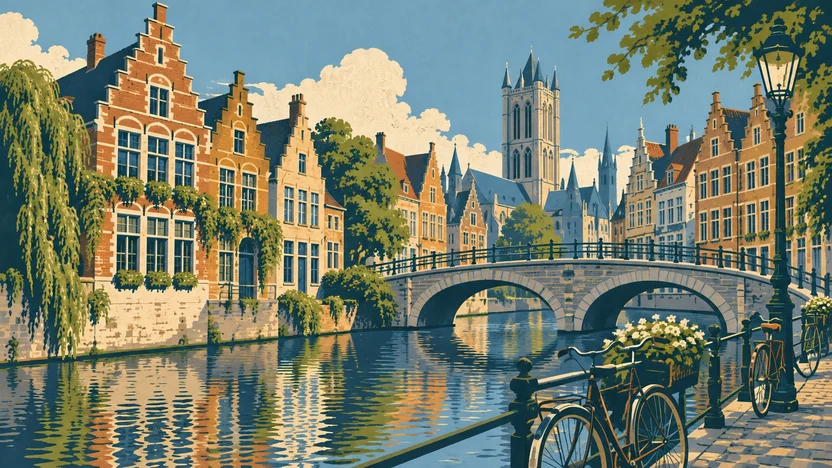 AI city illustration · Artistic impression
What people learn after moving
≈272,000 in the municipality — Flanders' second city — with tens of thousands of university and college students on top of that during term
Dutch, with a strong local accent. English is spoken almost universally in a city this student-heavy; French is understood but is not the administrative language
Euro (EUR)
CET (GMT+1), CEST (GMT+2) from late March to late October
AI city illustration · Artistic impressionCost of living in Ghent
Check your eligibility
Pick your passport to see entry rules and the long-stay routes we have researched.
Pick your passport to see whether you can enter Belgium — and what it takes to stay.
One permit, three levels of government. Your employer lodges a single permit with the Flemish government, which decides the work half against Flemish salary floors and a Flemish migration list, while the Immigration Office decides the residence half. On arrival you report to the city, receive a Bijlage 15, and wait for a neighbourhood police officer to verify you live at the address. Most non-EU newcomers then pick up a compulsory civic integration obligation — which in Ghent is delivered by the city's own agency, Amal, and which since September 2023 the newcomer part-pays for.
EU and EEA licences remain valid and can be exchanged at the city. A non-EU licence can only be exchanged if the issuing country is on the FPS Mobility recognition list, and you have roughly 185 days from registration to do it — after that, the Belgian theory and practical exams. Driving here then means two Ghent-specific regimes that stack: a low emission zone covering everything inside the R40 ring road, and a circulation plan that splits the centre into six sectors you cannot pass between.
Belgian banks want your national register number and an eID, which puts the city registration first in the queue. Most Belgian current accounts carry an annual fee, which surprises arrivals from free-banking markets. The thing that actually determines how painless your first months are is itsme, the national digital identity app that unlocks tax filing, government portals and bank logins — and which normally needs a Belgian eID or a Belgian bank card to activate.
Belgian healthcare is fast and good, and works by reimbursement rather than free-at-point-of-use: you pay the doctor and get most of it back, usually automatically within days. Cover is compulsory but enrolment is not automatic — you choose a ziekenfonds and join. Two decisions then set what you actually pay: registering a global medical file with one GP, and checking whether the doctors you see have signed the national fee agreement.
Every SIM in Belgium, prepaid included, must be registered to an identified person under the 2017 anti-terrorism rules. Mobile pricing is high by EU standards and the smaller operators reselling on the same networks are dramatically cheaper. For fixed internet, Ghent is largely served by the Flemish coax network alongside Proximus copper, with fibre arriving street by street — what your building actually has is a question to ask before you sign the lease, not after.
Belgium taxes employment income about as heavily as any country in the OECD: four brackets rising to 50%, employee social security of 13.07% off the top, and a communal surcharge on the tax you owe — 6.5% in Ghent for assessment year 2026, the lowest of the big Flemish cities. The two things that most change a newcomer's position are the inbound taxpayer regime, which replaced the pre-2022 expat status and was rewritten again for income from 2025, and the fact that most employees now receive a pre-filled proposal they still have to check.
Each guide has verified costs, timelines, required documents, and the non-obvious gotchas — sourced from official government pages. Last verified August 2026.
Reading a list isn’t learning it. Globe Quest turns these into a trainer — hear each phrase spoken, drill them with spaced repetition, and get scored as you say them out loud.
Belgium's single permit is decided by the region where the job sits, so a Ghent job is judged by Flanders — not by the federal state and not by Brussels. Flanders states its floors annually rather than monthly: €48,912 gross for a highly skilled worker, €39,129.60 for under-30s on a local contract, €78,259 for management, and €63,586 for an EU Blue Card, which is set at 130% of the average gross annual salary. From 1 January 2026 the rest tightened too: level-2 low-skilled roles no longer qualify at all, the mid-skilled migration list lost functions, level 3–4 roles need a VDAB vacancy published for nine weeks first, and the authorities can demand proof your diploma is genuine. On top of the federal contribution, Flanders charges its own non-refundable €180 retribution on applications lodged from 1 September 2026 and will not start processing until it is paid. Advice written for Brussels is wrong here in both directions.
Third-country nationals on a long-stay visa must report to the city within eight working days of arriving. You receive a Bijlage 15, and then a wijkagent calls at the address to confirm you live there. Until that report is positive there is no national register number, and without the number there is no eID, no bank account, no ziekenfonds and no phone contract. Put your name on the letterbox and the doorbell the day you get the keys, and tell your neighbours you have moved in. A failed check restarts the whole sequence and routinely costs people a month.
Non-EU newcomers aged eighteen or over with a permit of more than three months, registered in a Flemish municipality, must follow the inburgering path: social orientation, Dutch, individual guidance towards work, and diploma evaluation, with 80% attendance required across every part. Flanders and Brussels have only three delivery bodies between them and two of them are cities: Antwerp uses Atlas and Ghent uses Amal, so you will not be dealing with the regional agency here. The part that catches people is money. Since September 2023 the newcomer pays €180 for the social orientation classes and first test and €180 for the Dutch classes and first test — retakes cost more, and books are extra. The identical programme is free of charge in Brussels, twenty-five minutes away by train.
Belgium's additional communal tax is a percentage added to the income tax you already owe, voted by each municipality and published by FPS Finance every year. For assessment year 2026 Ghent charges 6.5%, against 7.0% in Antwerp, 6.9% in Bruges and 6.7% in Leuven — while the City of Brussels charges 4.9% and Liège 8.0%. Nationally the table runs from 0% in Knokke-Heist to 9.0% in Mesen. It is a real difference on identical income and it is your registered address on 1 January that fixes which rate you pay for that year, so a move between municipalities in December and in January are different financial decisions.
Since 1 October 2023 the city has required a conformiteitsattest before a new lease is signed on a dwelling more than thirty years old — which in Ghent means most of the rental stock. The certificate is issued by the mayor within sixty days of the request, confirms the home meets the Flemish standards on safety, health and basic comfort, and is valid for ten years. It is the landlord's obligation, not yours, and asking to see it costs nothing. If a landlord cannot produce one for an old house, that tells you something before you have handed over three months' deposit.
The 2017 circulation plan was introduced over a single weekend: around eighty streets changed and 2,500 signs went up. The city centre is now six sectors around a restricted-traffic core, and you cannot pass from one sector to another through the middle — you come back out to the R40 inner ring and go round. The car-free area grew 128% overnight and fourteen locations were closed to most motor traffic permanently. Separately, everything inside the ring road is a low emission zone with camera enforcement, so the two regimes stack. Ghent was named Cycling City 2024 for a reason: living here without a car is easier than living here with one.
Universiteit Gent, UZ Gent, HOGENT, Arteveldehogeschool
UGent is one of the two largest universities in Flanders and, with the colleges alongside it, makes Ghent the country's most student-dense big city — the population swells and shrinks with the academic calendar in a way Antwerp's does not.
argenx, VIB, Sanofi (the former Ablynx), Bio Base Europe Pilot Plant
argenx grew out of the Ghent research cluster into one of Belgium's most valuable listed companies, and VIB — the Flemish life-sciences institute — has its largest concentration of research groups on the Zwijnaarde technology campus south of the city.
North Sea Port, ArcelorMittal Belgium, Stora Enso, Christeyns
The Ghent docks merged with Terneuzen and Vlissingen in 2018 to form North Sea Port, a genuinely cross-border Belgian–Dutch authority — one of very few in Europe — and the steelworks on the Ghent–Terneuzen canal is among the largest single industrial sites in Belgium.
Volvo Car Gent, Volvo Group, Daikin Europe, Bekaert
Volvo has built cars in Ghent since 1965 and the plant is one of the group's main European assembly sites; the surrounding supplier network is a large part of why East Flanders' industrial employment held up better than Wallonia's.
Port cluster projects, Ghent University spin-offs, Capture, Bio Base Europe
The canal zone is one of the designated Flemish sites for hydrogen and carbon-capture projects, precisely because heavy industry, deep water and a research university sit within fifteen kilometres of each other.
Gentse Feesten, Film Fest Gent, Viernulvier, Historische Huizen Gent
The Gentse Feesten fills the whole medieval core for ten days every July and is one of Europe's largest city festivals; the year-round venue economy behind it employs a great many people in a city of this size.
Landmark · Centre, on the Leie
Two facing quays of guild houses on the medieval grain harbour — the most photographed stretch of water in Flanders.
Local tip: Sit on the Graslei steps in the evening with something from a shop rather than a terrace; half the city does. The better view is from the Korenlei side or from the top of the Sint-Michielsbrug, which most visitors walk across without stopping on.
Landmark · Centre
A twelfth-century moated castle sitting bluntly in the middle of a working city, complete with gatehouse, keep and armoury.
Local tip: The audio guide is famously, deliberately comic — written and voiced as a sketch rather than a history lesson — and it is the reason locals bring visiting friends. Go early; the spiral stairs jam solid by midday and there is no way past anyone.
Neighborhood · Behind the Gravensteen
A knot of narrow medieval lanes that was a slum within living memory and is now the city's densest restaurant quarter.
Local tip: The lanes are barely wide enough for a car, which is why the atmosphere survives. Book: the good places have a dozen tables and Ghent eats late. Walk two minutes further to the Vrijdagmarkt if you want a terrace rather than a table.
Culture · Sint-Baafsplein
Home of the Van Eyck brothers' Adoration of the Mystic Lamb — the most stolen artwork in history, and a panel of it is still missing.
Local tip: The restoration that ran through the 2010s stripped centuries of overpaint and revealed a startlingly different Lamb; the reaction was worldwide and not entirely polite. Book a slot rather than queueing, and give it an hour — the visitor centre's augmented-reality guide is the rare case where the gimmick genuinely earns its place.
Food · Centre
The city's political square since the fourteenth century, and the old vegetable market beside it where the cuberdon carts stand.
Local tip: Tierenteyn-Verlent on the Groentenmarkt has been scooping mustard out of a wooden barrel since 1790 and is a shop, not an attraction — bring a jar back and they refill it. The Vrijdagmarkt has run a market on Fridays for something close to seven centuries and it is still a real one.
Culture · Off the Hoogpoort, centre
A single alley where painting the walls is not merely tolerated but officially permitted, and the artwork changes weekly.
Local tip: It is signposted as the Graffitistraatje and it is genuinely legal — the city set it aside as a free wall, so what you see was almost certainly painted over something better within the fortnight. Photograph it the day you find it. Almost every visitor walks past the entrance without seeing it.
Side-by-side cost of living, language, climate and careers — to help you choose.