
Population
≈18.7 million in the municipality — the capital of Guangdong and the core of the Pearl River Delta
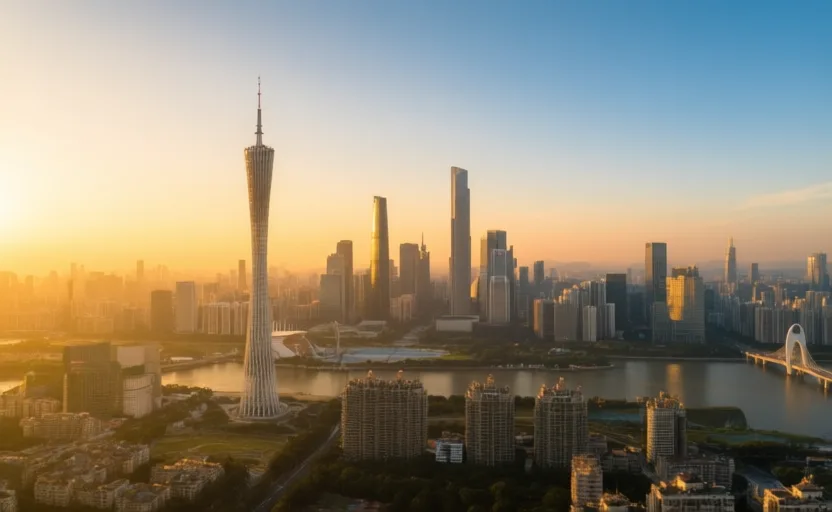 AI city illustration · Artistic impression
What people learn after moving
≈18.7 million in the municipality — the capital of Guangdong and the core of the Pearl River Delta
Cantonese is the street and family language; Mandarin is the official and business language and universally understood. English is limited outside trade and tech
Renminbi / Chinese yuan (CNY, ¥)
CST (GMT+8). No daylight saving
AI city illustration · Artistic impressionCost of living in Guangzhou
Check your eligibility
Pick your passport to see entry rules and the long-stay routes we have researched.
Pick your passport to see whether you can enter China — and what it takes to stay.
The national sequence is fixed: your employer obtains the Notification Letter of Foreigner's Work Permit, you convert it into a Z visa abroad, you enter, you collect the work permit card, and you apply for a residence permit within 30 days of entry — plus a police registration within 24 hours of moving into a private flat. Guangzhou's addition is the Greater Bay Area regime: relaxed age and experience tests, longer talent permits for some profiles, and mutual recognition across the nine mainland GBA cities, so a permit obtained in Shenzhen or Dongguan transfers here without resubmitting the whole file.
A foreign licence is not valid in mainland China and the International Driving Permit is not recognised. Conversion means a translation, a medical and the hundred-question written theory test, with practical tests waived for ordinary car categories. Guangzhou then rations plates through a quota allocated by a mix of free lottery and paid auction, and restricts vehicles with non-Guangzhou plates in the central zone under the 'drive four, stop four' rule — four consecutive days in, then four days out.
Alipay and WeChat Pay accept foreign Visa and Mastercard up to USD 5,000 per transaction and USD 50,000 a year after verification, which covers a visit. Living here needs a local account, which needs a Chinese mobile number registered against your passport. Guangzhou's particularity is that its banks handle a very large volume of trade-related cross-border activity, so counter staff are experienced — and compliance scrutiny of anything that resembles trading flow through a personal account is correspondingly high.
Guangzhou holds the strongest medical institutions in southern China — the Sun Yat-sen University affiliated hospitals in particular draw patients from across the region, including from Shenzhen. Ordinary outpatient care is cheap, excellent and conducted in Mandarin and Cantonese; the same hospitals run international wings with English support at several times the price. The subtropical climate adds a genuine seasonal health calendar that northern Chinese cities do not have, dengue in particular.
A SIM takes twenty minutes and a passport, and should be your first errand because the number gates the bank account and the payment apps. The harder half is the same everywhere in China: much of the Western internet is unreachable from an ordinary connection, and in a trading city where your suppliers and customers are abroad, that is an operational problem rather than an inconvenience. Ask what your employer provides, and note that a Hong Kong or Macau SIM roaming on mainland networks is a common local arrangement here as it is in Shenzhen.
National rules apply: monthly withholding, an annual reconciliation between March and June, a 183-day residence test, and a six-year rule on worldwide income that resets with a single absence of more than thirty consecutive days. Guangzhou then sits inside the Greater Bay Area preferential regime, which refunds individual income tax paid above a 15% effective rate for qualifying overseas talent and runs to 31 December 2027. Between that, the expatriate fringe-benefit exemptions and the six-year rule, most of the value here comes from things you have to actively claim.
Each guide has verified costs, timelines, required documents, and the non-obvious gotchas — sourced from official government pages. Last verified August 2026.
Reading a list isn’t learning it. Globe Quest turns these into a trainer — hear each phrase spoken, drill them with spaced repetition, and get scored as you say them out loud.
A Ministry of Finance circular continues a preferential individual income tax policy across all nine mainland Greater Bay Area cities, Guangzhou included, to 31 December 2027. Qualifying overseas high-end talent and talent in short supply have the individual income tax paid above a 15% effective rate refunded by the municipal government, and the refund is itself exempt from tax. Against a 45% top band this is the most valuable single fact about working here. It is not automatic: you apply through the municipal human resources bureau within an annual window, with employer support, and the definitions of 'high-end' and 'in short supply' are set locally and revised. Raise it with HR in month one.
Article 39 of the Exit and Entry Administration Law requires anyone staying somewhere other than a hotel to register with the local public security organ within 24 hours of arrival. Hotels file it for you invisibly, which is why people who move straight into a rented flat never learn the rule exists. Take passport, visa, lease and landlord to the neighbourhood station and keep the registration slip — it is asked for again at the residence permit application and every renewal. The fine is up to RMB 2,000; the real cost is being blocked at a counter when you need the slip and do not have it.
Guangzhou is a two-thousand-year-old city with a native population, and Cantonese is what people speak in markets, restaurants and among family — Mandarin is the official and business language and everyone under sixty is fluent in it, but it is the second language of the street. Shenzhen, an hour away, is Mandarin by default because almost nobody there is local. Practically: your Mandarin will work everywhere, and a hundred words of Cantonese will change how you are treated in a market or a dim sum hall more than a thousand words of Mandarin will.
The China Import and Export Fair has run at Pazhou each spring and autumn since 1957 and is the largest trade fair in China. During its phases hotel rates multiply, short-term rentals disappear, taxis become scarce and the metro lines to Pazhou are full. If you are arriving, moving flat, or hosting visitors, check the Fair dates first — and if you are in a trading business, the reverse is true and those weeks are the reason your company has a Guangzhou office at all.
The area around Xiaobei and Dengfeng, and the wholesale markets at Sanyuanli, have for two decades hosted the largest concentration of African traders in Asia, alongside a long-established Middle Eastern business community with mosques that predate almost everything else in the city — the Huaisheng Mosque is traditionally dated to the seventh century. Numbers fell substantially after 2020 and the community is smaller than at its peak, but this remains the most genuinely diverse Chinese city, and the trading infrastructure built around it — freight forwarders, translators, sample rooms, halal restaurants — is unmatched on the mainland.
Guangzhou sits just south of the Tropic of Cancer. Summer runs roughly from April to October, humidity is relentless, the typhoon season overlaps most of it, and the wet season delivers genuinely dramatic rain. Winter is short and mild enough that heating is unnecessary — which also means buildings have none, and the two or three genuinely cold weeks in January are spent in a flat with only an air conditioning unit for warmth. Budget for air conditioning running most of the year, and for the electricity bill that follows.
Canton Fair, Guangzhou Port, the Zhongda fabric and Baiyun leather markets
Guangzhou has been China's window on foreign trade since the eighteenth-century Canton System, and the wholesale markets — textiles, leather, tea, electronics, hardware — remain a genuine global sourcing hub rather than a historical curiosity.
GAC Group, Guangqi Honda, GAC Toyota, Xpeng
Guangzhou is one of China's largest car manufacturing bases, anchored by GAC's joint ventures with Honda and Toyota, and Xpeng's electric vehicle operations are headquartered here.
Tencent's Guangzhou R&D centre, NetEase, Huya
WeChat was designed and built by Tencent's Guangzhou research team rather than in Shenzhen — a fact most people find surprising, and a reason there is a real software labour market here.
Sinopec Guangzhou, Guangzhou Shipyard International
The Huangpu and Nansha industrial belts along the Pearl River carry refining, shipbuilding and chemicals at national scale.
Sun Yat-sen University and its hospitals, Guangzhou Medical University, the International Bio Island
Sun Yat-sen University's affiliated hospitals are among the strongest in southern China, and the Bio Island research park in Haizhu is the region's biotech cluster.
China Southern Airlines, Baiyun International Airport, Guangzhou Port Group
China Southern is one of Asia's largest carriers and Baiyun is among the world's busiest airports, giving Guangzhou better direct long-haul connectivity than Shenzhen.
Landmark · Liwan, on the Pearl River
A small sandbank that was the foreign concession from 1859 — colonial banks and consulates, banyan trees, and almost no traffic.
Local tip: Go early. By mid-morning it fills with wedding photographers, and the point of Shamian is that it is the one place in Guangzhou where you can hear birds. The old Anglican church and the riverside path on the south side are the good parts.
Neighborhood · Liwan, west of the old city
The historic Cantonese merchant quarter — arcaded qilou shophouses, Cantonese opera houses and the oldest food streets in the city.
Local tip: Enning Road has been restored and is busy; the interesting part is the lanes running off it, where the old Xiguan houses with their carved wooden folding doors are still lived in. This is where Cantonese food culture is at its densest and least performed.
Landmark · Tianhe, the modern CBD
The new central axis — the opera house, the library, the museum, and the tapering Canton Tower across the river.
Local tip: The axis is best walked at night from the library down to the river. Skip the tower's paid observation deck; the free view from the Haixinsha park at the base of the axis, looking across at the lit tower, is the better one.
Food · Liwan and Fangcun
Guangzhou's traditional medicine, dried goods and tea wholesale markets — enormous, working, and utterly unlike a tourist market.
Local tip: Fangcun is the largest tea wholesale market in China and the vendors will brew for you at length whether or not you buy. Go with a Cantonese-speaking friend, allow three hours, and expect to leave with more pu'er than you intended.
Neighborhood · Yuexiu, north of the centre
The trading district that has hosted Africa's and the Middle East's business communities in China for two decades.
Local tip: The restaurants here are the real reason to come — Nigerian, Ethiopian, Turkish, Uyghur and Yemeni cooking that exists nowhere else on the mainland at this quality. Numbers have fallen since 2020 but the food and the freight forwarders are still there.
Nature · Baiyun district, northern Guangzhou
A 380-metre wooded massif inside the city, laced with paved paths and used properly by locals rather than visitors.
Local tip: Go at six in the morning and you will find several thousand Guangzhou residents walking, singing opera, practising tai chi and drinking tea at the summit teahouses. It is the single best window into ordinary Cantonese life in the city, it is free before a certain hour, and almost no foreign resident ever goes.
Side-by-side cost of living, language, climate and careers — to help you choose.