
Population
≈1.9 million in the city; ≈5.4 million in the metropolitan region
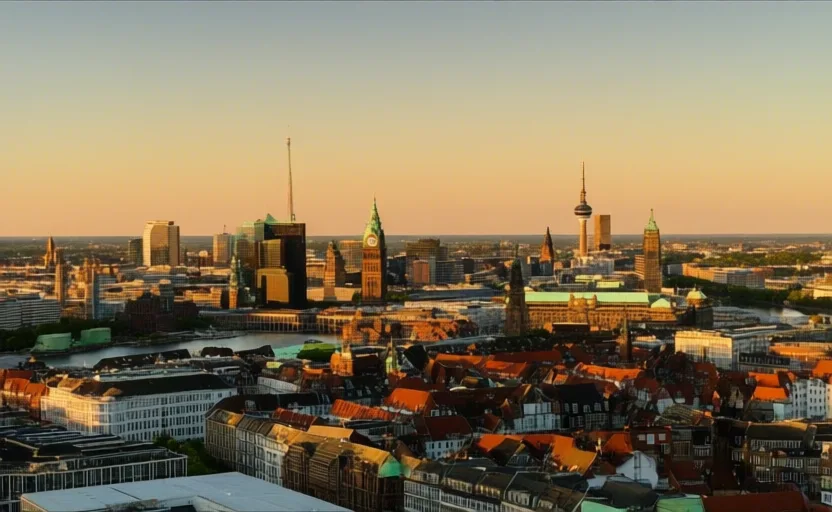 AI city illustration · Artistic impression
What people learn after moving
≈1.9 million in the city; ≈5.4 million in the metropolitan region
German, with Low German heritage audible in the accent; English widely spoken in the media, aviation and shipping sectors
Euro (EUR)
CET (GMT+1); CEST (GMT+2) from late March to late October
AI city illustration · Artistic impressionCost of living in Hamburg
Check your eligibility
Pick your passport to see entry rules and the long-stay routes we have researched.
Pick your passport to see whether you can enter Germany — and what it takes to stay.
Germany's sequence is rigid: register your address within two weeks of moving in, which produces the confirmation needed for a tax ID, bank account, health insurance and residence permit. Hamburg's appointment availability is better than Munich's but still requires planning. If you qualify, pursue an EU Blue Card specifically — it gives faster settlement and better family rights than a general work permit.
EU and EEA licences remain valid without action. Non-EU licences are valid for six months from taking up residence, after which you need a German licence — and whether tests are required depends on the issuing country and, for federal countries, the specific state or province. Hamburg is flat, compact and well served by U-Bahn, S-Bahn and harbour ferries, so many residents never bother.
You need a German account for salary, rent and the direct debits that run German life. Traditional banks require an Anmeldung first, which creates a sequencing problem; digital banks generally do not, which is why most newcomers start there. The deeper issue is Schufa — you arrive with no credit record, and that is what landlords screen on.
Germany requires everyone to hold health insurance. Employees below an annually-set income threshold must join the statutory system, where contributions are a percentage of income shared with the employer and dependants are covered free. Above the threshold, and for the self-employed, private cover becomes available — cheaper when young and healthy, considerably more expensive later, and difficult to leave.
Germany requires identity verification for every SIM including prepaid — passport or ID, verified in a shop, by video call or at a post office. Prepaid needs no Anmeldung or Schufa. Postpaid contracts run a Schufa check that a newcomer will fail or pass marginally, so start prepaid and switch once you have a record.
German income tax is progressive and deducted at source, with your tax class determining monthly withholding. Church tax adds 9% of your income tax liability in Hamburg if you declared a religious affiliation at Anmeldung. A solidarity surcharge applies to higher incomes. Filing is optional for many employees but frequently produces a refund, particularly in the relocation year.
Each guide has verified costs, timelines, required documents, and the non-obvious gotchas — sourced from official government pages. Last verified August 2026.
Reading a list isn’t learning it. Globe Quest turns these into a trainer — hear each phrase spoken, drill them with spaced repetition, and get scored as you say them out loud.
Hamburg has one of Germany's largest subsidised housing stocks, and access runs through a Wohnberechtigungsschein — a certificate confirming your income falls below a defined ceiling. Those ceilings are considerably higher than most newcomers assume, and single professionals on ordinary salaries frequently qualify. It is a free application at your district office and it opens up a segment of the market with materially lower rents that is otherwise invisible.
The Anmeldung must be done at a Kundenzentrum within two weeks of moving in, and everything downstream — tax ID, bank account, health insurance, residence permit — depends on the confirmation it produces. Hamburg's appointment availability is better than Munich's but still tight. Book online as soon as you know your move date.
If you declare membership of a recognised church at your Anmeldung, church tax is deducted automatically as a percentage of your income tax — 9% in Hamburg and most German states, against 8% in Bavaria and Baden-Württemberg. Declaring no religious affiliation means no church tax. The question is asked in a five-minute appointment and most newcomers do not realise it has a price.
Everyone in Germany must hold health insurance. Employees below an income threshold join the statutory system; above it, private cover becomes available. Private is often cheaper when young and healthy and considerably more expensive later, and returning to the statutory system is difficult and gets harder with age. Statutory also covers dependants at no extra cost. Decide on the long view.
Hamburg is grey, wet and windy for a large part of the year, with short winter days and rain spread across all seasons rather than concentrated. It is genuinely the thing people leaving cite. The compensation is a city on the water with a serious cultural life and rents well below Munich's — but go in with clear eyes, and buy proper waterproofs rather than an umbrella, which the wind will destroy.
Hamburg has more bridges than Venice and Amsterdam combined, the Elbe runs through it, and the Alster sits in the middle. The harbour is Europe's third-largest and the source of the city's wealth and character. Living near water is normal rather than premium here, and the HADAG ferries are part of the public transport network — the 62 to Finkenwerder is a harbour cruise on a transit ticket.
Hapag-Lloyd, Kühne+Nagel, HHLA, Port of Hamburg
Europe's third-largest container port and the historic foundation of the city's economy — Hapag-Lloyd is one of the world's largest container shipping lines and is headquartered here.
Airbus, Lufthansa Technik, Diehl Aviation
Hamburg is one of the three largest civil aviation centres in the world alongside Toulouse and Seattle, with Airbus final assembly at Finkenwerder.
Der Spiegel, Die Zeit, Gruner + Jahr, Bauer Media, NDR
Germany's publishing capital — the largest concentration of magazines, newspapers and broadcasters in the country, and the reason the advertising industry clusters here too.
Nordex, Siemens Gamesa, Vestas, RWE Renewables
Hamburg is Europe's wind energy capital, hosting the industry's largest trade fair and a substantial engineering and project development cluster.
Otto Group, Beiersdorf, Tchibo, Edeka
The Otto Group is one of the world's largest online retailers, and Beiersdorf — the maker of Nivea — has been headquartered here since 1882.
Google, Facebook, XING, About You, Jimdo
A real if smaller tech scene than Berlin's, weighted to e-commerce, adtech and logistics software — a natural fit for a trading city.
Landmark · Harbour
The world's largest warehouse district, built on oak piles in neo-Gothic brick, now a UNESCO site beside Europe's biggest inner-city development project.
Local tip: Walk the Speicherstadt canals at night when the brick is floodlit — it is genuinely spectacular and free. The Elbphilharmonie Plaza viewing level is also free with a timed ticket, separate from any concert.
Nature · Central
A lake in the middle of the city with a seven-kilometre path around it, sailing clubs, and swans that the city moves indoors each winter.
Local tip: The loop is the city's shared running route and the best introduction to Hamburg. In hard winters the lake freezes and, when the ice is officially declared safe, the whole city walks out onto it — an event that happens perhaps once a decade.
Nightlife · St. Pauli
Europe's most famous entertainment district, with a football club that functions as a political statement and the Beatles' formative years attached.
Local tip: The Reeperbahn itself is touristy; the interesting bars are on the side streets and in the Schanzenviertel next door. The Sunday Fischmarkt at 5am is where the night ends rather than where the day begins.
Nature · Central
A large park between the centre and the Messe, with a Japanese garden and free evening water-and-light shows in summer.
Local tip: The Wasserlichtkonzerte run nightly in summer and are free, and almost no visitor knows about them. The tropical greenhouses are free too and a genuine refuge in a Hamburg February.
Neighborhood · West, along the Elbe
A former fishing village of steep stepped lanes above the river, with a genuine sand beach where container ships pass a few hundred metres away.
Local tip: Take the HADAG ferry rather than the S-Bahn — it is part of the public transport network, so a normal ticket covers what is effectively a harbour cruise. The Treppenviertel's lanes have no roads, only steps.
Nature · North
The largest rural cemetery in the world at nearly 400 hectares, with its own bus routes running through woodland, ponds and sculpture.
Local tip: Two public bus lines run inside it, which tells you the scale. It functions as a park — people walk, cycle and picnic — and in spring the rhododendrons are extraordinary. Almost no visitor ever goes.
Side-by-side cost of living, language, climate and careers — to help you choose.