
Population
≈548,000 in the city; around 1.15 million across the surrounding Region Hannover
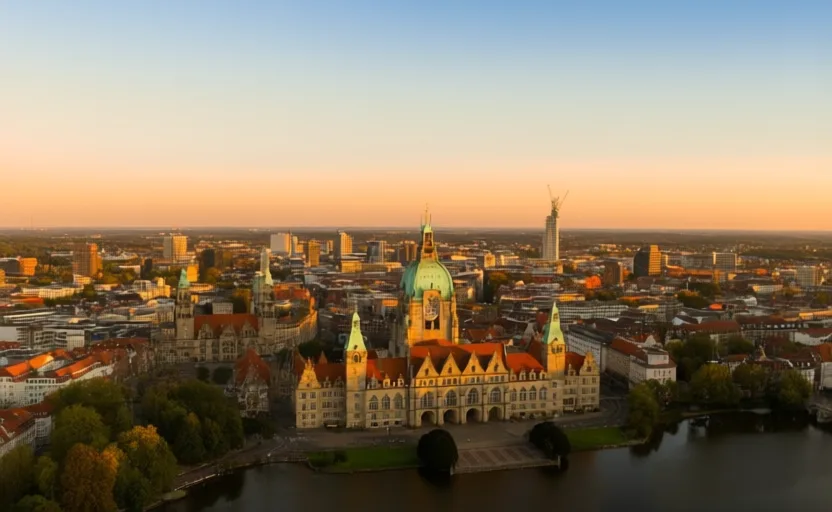 AI city illustration · Artistic impression
What people learn after moving
≈548,000 in the city; around 1.15 million across the surrounding Region Hannover
German — with a local reputation for the least-accented standard German in the country; Turkish, Polish and Arabic widely spoken; English common at the university, TUI and Continental
Euro (EUR)
CET (GMT+1); CEST (GMT+2) from late March to late October
AI city illustration · Artistic impressionCost of living in Hannover
Check your eligibility
Pick your passport to see entry rules and the long-stay routes we have researched.
Pick your passport to see whether you can enter Germany — and what it takes to stay.
Germany's sequence is rigid and identical everywhere: register your address within two weeks of moving in, which produces the confirmation needed for a tax ID, bank account, health insurance and residence permit. The Hannover-specific point is jurisdictional — this is Lower Saxony, and immigration matters for the city are handled by the Region Hannover rather than the city alone, which is one more office than newcomers expect.
EU and EEA licences remain valid without action. Non-EU licences are valid for six months from taking up residence, after which you need a German licence — and whether tests are required depends on the issuing country and, for federal countries, the specific state or province. Hannover is flat, compact and has one of Germany's better tram networks, so the case for a car is weak unless you are commuting to a plant on the edge of the region.
You need a German account for salary, rent and the direct debits German life runs on. Traditional banks require an Anmeldung first, creating a sequencing problem; digital banks generally do not. The Schufa problem is federal and identical everywhere, and in Hannover it lands in a market that is tight enough for the state to have capped it but nothing like Munich's — a complete folder and an employer letter generally get you through.
Germany requires everyone to hold health insurance. Employees below an annually-set income threshold must join the statutory system, where contributions are a percentage of income shared with the employer and dependants are covered free. Above the threshold, and for the self-employed, private cover becomes available — cheaper when young and healthy, considerably more expensive later, and very difficult to leave. Locally, the Medizinische Hochschule Hannover is one of Germany's leading transplant and specialist centres, which is a genuine and under-appreciated reason to be here if you have a complex condition.
Germany requires identity verification for every SIM including prepaid — passport or ID, verified in a shop, by video call or at a post office. Prepaid needs no Anmeldung or Schufa. Postpaid contracts run a Schufa check a newcomer will fail or pass marginally, so start prepaid and switch once you have a record. The local wrinkle is the exhibition grounds: during a major fair the cells around Laatzen and the Messe are the busiest in Germany.
German income tax is progressive and deducted at source, with your tax class determining monthly withholding. Church tax adds 9% of your income tax liability in Lower Saxony if you declared a religious affiliation at Anmeldung. A solidarity surcharge applies to higher incomes. Filing is optional for many employees but frequently produces a refund, particularly in the relocation year.
Each guide has verified costs, timelines, required documents, and the non-obvious gotchas — sourced from official government pages. Last verified August 2026.
Reading a list isn’t learning it. Globe Quest turns these into a trainer — hear each phrase spoken, drill them with spaced repetition, and get scored as you say them out loud.
The Anmeldung must be done at a Bürgeramt within two weeks of moving in, and it produces the Meldebescheinigung required for your tax ID, bank account, health insurance and residence permit. Hannover runs Bürgerämter across the districts. The wider point matters more than it sounds: almost every English-language guide to 'moving to Germany' is written from Berlin, Munich or the Rhineland, and the state-level rules — tenant protection, the poison centre number, the transport network, the school system — are all different here. Check whether advice you find is federal or state before acting on it.
Declaring membership of a recognised church at your Anmeldung triggers automatic deduction of church tax at 9% of your income tax liability — the standard rate across Germany except Bavaria and Baden-Württemberg, which charge 8%. Declaring no affiliation means no church tax. It is decided in a five-minute appointment most newcomers do not realise carries an annual cost, and leaving later needs a formal declaration and a fee.
Everyone in Germany must hold health insurance. Employees below an annually-set income threshold join the statutory system; above it, and for the self-employed, private becomes available. Private is often cheaper when young and healthy, considerably more expensive later, prices each family member separately where statutory covers dependants free, and is very difficult to leave. Decide on the thirty-year view, not the first year's quote.
The Niedersächsische Mieterschutzverordnung took effect on 1 January 2025 and names Hannover along with Laatzen, Langenhagen, Garbsen, Hemmingen, Seelze, Wunstorf, Isernhagen and Wedemark as tight housing markets. Inside them a new letting may not exceed the local comparative rent by more than 10%, with flats first let after 1 October 2014 and comprehensively modernised flats exempt. The state has since extended the designation to 31 December 2029. Check whether the suburb you are considering is on the list — several of the commuter towns in the Region Hannover are not.
Hannover's exhibition grounds are among the largest in the world and the events on them are correspondingly big: Hannover Messe every spring, plus Agritechnica, EMO and IAA Transportation in their rotations. During a major fair, hotel prices multiply, short-term flats vanish across the whole region, and locals routinely let their own flats out and leave. If you are arriving on a temporary let, look up the Deutsche Messe calendar before you fix dates — it will save you several hundred euros or several days of searching.
Six hundred and forty hectares of forest run right into the middle of the city — one of Europe's largest and oldest contiguous urban woodlands, with 80 km of walking paths, 38 km of cycle paths and 11 km of bridleways inside it. It is not a park on the edge of town; the Stadtbahn crosses it and several central districts back onto it. Combined with the Maschsee and the Herrenhäuser Gärten, it means Hannover offers more usable green space per resident than almost any German city of its size, and it is the single strongest argument for living here rather than in a bigger place.
Volkswagen Nutzfahrzeuge, Continental, ZF regional units
VW's commercial vehicle plant in Stöcken employs over 15,000 people and is the city's largest single employer; Continental runs its group headquarters here with around 9,000 more.
Talanx, HDI, Hannover Rück, VHV Gruppe, Concordia
The Talanx group — including HDI and Hannover Re, one of the world's largest reinsurers — employs around 4,800 people in the city, making Hannover a genuine insurance centre rather than a satellite of one.
TUI Group, TUIfly, Hannover Airport
TUI is headquartered here with roughly 4,600 staff — an unusual anchor for a city this size, and the reason there is a real commercial and digital job market in travel.
Deutsche Messe AG, Hannover Congress Centrum
The exhibition grounds host Hannover Messe, Agritechnica, EMO and IAA Transportation, and the events economy around them supports logistics, hospitality, stand-building and interpreting work on a scale the city's size would not otherwise justify.
Laser Zentrum Hannover, Max Planck Institute for Gravitational Physics, Sennheiser (Wedemark)
Hannover runs GEO600, the gravitational-wave detector that developed much of the technology LIGO later used, alongside a laser and photonics cluster that is one of Germany's strongest.
Medizinische Hochschule Hannover, Leibniz Universität Hannover, Niedersachsen state government, NDR, Deutsche Bahn
MHH is one of Germany's leading transplant centres, and as the state capital Hannover carries the Land ministries, the state broadcaster's regional operation and roughly 7,600 Deutsche Bahn jobs across the region.
Nature · Running from the Zoo to the northern districts
640 hectares of forest inside the city — one of Europe's largest and oldest contiguous urban woodlands, with 80 km of paths.
Local tip: Enter at Emmichplatz or the Lister Turm and walk in for ten minutes; the traffic disappears entirely. The Lister Turm beer garden inside the woods is where locals actually go on a summer evening, and almost no visitor finds it.
Landmark · Herrenhausen, north-west
A baroque garden laid out from 1666 under Sophia of Hanover, with the Great Fountain, a grotto finished by Niki de Saint Phalle, and the reconstructed palace.
Local tip: The Großer Garten is ticketed; the Berggarten alongside it holds the orchid and tropical houses and is a separate, quieter experience. Go for the Fountain's timed displays or for the Kleines Fest in summer, when the garden fills with small performances across a single evening.
Neighborhood · West of the Leine
The city's most alive district — a former working-class quarter now full of bars, kiosks, small kitchens and the verb 'limmern'.
Local tip: The Limmerstraße is the whole thing. Buy a beer at a kiosk and drink it outside like everybody else; that is the local custom rather than a violation of one. Come on a Friday evening in summer and the street is effectively one long party.
Food · City centre, off the Karmarschstraße
A covered market hall from 1892, known locally as the belly of Hannover — fishmongers, cheesemongers, Portuguese and Turkish stalls, and long shared tables.
Local tip: Come at lunchtime on a weekday and eat standing up at a counter rather than sitting down in the centre's restaurants. It is where the city eats, it is cheap, and the fish counters at the north end are the best in Lower Saxony outside the coast.
Culture · On the Maschsee
One of Germany's most important 20th-century collections — Kurt Schwitters, whose Merz work was made in this city, plus Picasso, Klee and a major photography holding.
Local tip: The Schwitters rooms are the reason to come: he built the original Merzbau here and it was destroyed in the war, so the reconstruction and the surviving work are as close as the city gets to its own lost avant-garde. Then walk out onto the Maschsee, which starts at the door.
Landmark · Trammplatz, city centre
A 1913 town hall with a lift that travels up the inside of the dome on a curve rather than a straight line — believed to be the only one of its kind in Europe.
Local tip: It costs a few euros, the queue moves, and the view from the top takes in the Maschsee, the Eilenriede and the whole layout of the city in one go. Downstairs, four city models in the entrance hall show Hannover in 1689, 1939, 1945 and today — the 1945 one explains almost everything about how this city looks now.
Side-by-side cost of living, language, climate and careers — to help you choose.