
Population
≈121,000 in the city itself; ≈1.2 million across the Hartford metro, which is spread across dozens of separate towns
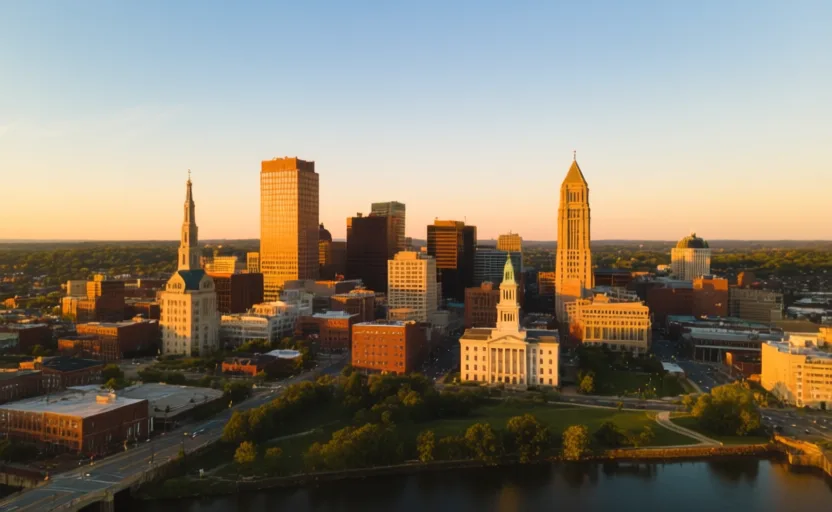 AI city illustration · Artistic impression
What people learn after moving
≈121,000 in the city itself; ≈1.2 million across the Hartford metro, which is spread across dozens of separate towns
English and Spanish — Hartford has one of the largest Puerto Rican communities per head in the mainland US; Portuguese, Polish, Vietnamese, Bosnian and West African languages are also common
United States dollar (USD)
Eastern Time — GMT-5 in winter, GMT-4 on daylight saving from mid-March to early November
AI city illustration · Artistic impressionCost of living in Hartford
Check your eligibility
Pick your passport to see entry rules and the long-stay routes we have researched.
Pick your passport to see whether you can enter United States — and what it takes to stay.
There is no post-arrival registration step in the US: your I-94 record is your status, and the 'admit until' date on it governs your stay rather than the expiry printed in the visa. The first weeks are a Social Security number if you are work-authorised or an ITIN if not, then Connecticut's 90-day clock for the licence and the vehicle registration. What is structurally different here is local government: Connecticut has none above the town, so every civic interaction you have will be with one of 169 towns rather than with a county.
Connecticut gives 90 days for both the licence and the registration, and transfers a current licence on a vision test rather than a road test. Emissions testing is statewide rather than metro-only, costs USD 20, and exempts vehicles fewer than four model years old, model year 2001 and older, fully electric vehicles and motorcycles. The financial part is the annual town property tax on the vehicle: from the October 2024 grand list it is computed from the original list price against a statutory depreciation schedule, assessed at 70% and taxed at a mill rate capped statewide at 32.46.
Federal rules let a bank identify a non-US person by passport number and country of issuance, so you do not have to wait for a Social Security number to open an account. The credit problem is the standard American one — no file scores worse than a bad file. Two Connecticut specifics belong in your first month's budgeting: your landlord must pay you interest on your security deposit at a rate the Department of Banking sets each year, and your payslip carries a Connecticut Paid Leave deduction that no other New England state's does in the same way.
Coverage comes from an employer, from HUSKY Health if your income qualifies, or from a plan bought through Access Health CT — Connecticut's own exchange, not HealthCare.gov. The distinctive addition is the Covered Connecticut Program: for residents aged 19–64 with household income up to and including 175% of the federal poverty level who are not income-eligible for HUSKY, the state uses the available premium tax credits and cost-sharing reductions in full on a Silver plan, so there is no premium and no cost sharing, and adds dental and non-emergency medical transport.
The US requires nothing at all to activate a prepaid SIM: no passport, no registration, no biometrics. The only friction is postpaid contracts, which run a credit check you cannot pass on arrival. Coverage across greater Hartford is good. What matters locally is what happens when a nor'easter or an ice storm drops trees across the lines — Connecticut is one of the most heavily wooded states in the country, and multi-day outages that take home broadband with them are a normal part of a winter here.
Connecticut's income tax runs across seven brackets from 2% to 6.99%, with the two lowest rates cut from 3% and 5% to 2% and 4.5% with effect from 1 January 2024 — the first meaningful cut in decades. No town adds an income tax on top, unlike Ohio, Michigan, New York City or Kansas City. Instead, towns levy property tax, and the mill rate is the number that varies. Hartford's real property rate is far above the 32.46-mill cap the state applies to motor vehicles, which is the shortest way to describe how heavy it is.
Each guide has verified costs, timelines, required documents, and the non-obvious gotchas — sourced from official government pages. Last verified August 2026.
Reading a list isn’t learning it. Globe Quest turns these into a trainer — hear each phrase spoken, drill them with spaced repetition, and get scored as you say them out loud.
The state abolished county government in 1960, and in 2022 the Census Bureau approved replacing the eight historical counties with nine planning regions as county equivalents for statistical purposes only. So there is no county sheriff, no county school district and no county tax. All 169 towns run their own schools, police, assessment and mill rate, and the town line is invisible from the street. Practically: when you compare two addresses, you are comparing two governments. Nothing you learned about counties anywhere else in America applies here.
Every town bills an annual property tax on vehicles. From the 1 October 2024 grand list, assessors statewide stopped using trade-in guides and instead apply a statutory depreciation schedule to the vehicle's original manufacturer's suggested retail price, assess it at 70% of that depreciated value, and apply the mill rate — which the state caps at 32.46 mills for motor vehicles. Two consequences: an expensive car is expensive to keep here regardless of what you paid for it second-hand, and because Hartford's real property mill rate is far above the cap, the car tax is one of the few Hartford bills that is not higher than the suburbs'.
The city's rate on real property sits far above the 32.46-mill vehicle cap, which is a good shorthand for how heavy it is. That is the single biggest reason so many people who work in Hartford live in West Hartford, Wethersfield, Glastonbury, Bloomfield or Manchester and drive in. If you are buying rather than renting, get the mill rate AND the assessment ratio for the exact town before you compare two houses — the Office of Policy and Management publishes every town's rate, and the difference across a town line is larger than most price negotiations.
Connecticut runs its own marketplace, Access Health CT, rather than using HealthCare.gov. On top of it sits the Covered Connecticut Program: for residents aged 19–64 with household income up to and including 175% of the federal poverty level who are not eligible for HUSKY on income, the state pays the premium and the cost sharing on a Silver plan — so there is no monthly premium and no out-of-pocket cost — and adds dental and non-emergency medical transport. For 2026 a single person can earn up to USD 27,387.50 and qualify. Check it before you buy anything.
Connecticut gives a new resident 90 days to transfer an out-of-state licence and 90 days to transfer the vehicle registration — a more generous and simpler pair of deadlines than most states. A current licence, or one expired less than two years, transfers with a vision test rather than a road test. Then emissions: Connecticut tests statewide, not just in one metro, at USD 20, with exemptions for vehicles fewer than four model years old, model year 2001 and older, fully electric vehicles and motorcycles.
New York is roughly two hours away by rail via New Haven and Metro-North; Boston is about two hours by road. Hartford's own commuter spine is the Hartford Line to New Haven and Springfield and the CTfastrak busway west to New Britain, and along those two corridors a car-light life is workable. Away from them it is not. Whether Hartford works for you usually comes down to whether your life fits those corridors or whether you will be driving to a suburb anyway.
The Hartford, Travelers, Aetna (CVS Health), Cigna, Voya Financial, Lincoln Financial, Nassau Financial Group
The industry was founded here — Hartford insurers wrote fire policies for a young republic and never left — and it is still the reason the downtown skyline exists. Actuarial, underwriting, claims, risk and the technology behind them are the region's defining professional job market.
Pratt & Whitney (RTX) in East Hartford, Collins Aerospace in Windsor Locks, a dense supply chain of precision machine shops across the Connecticut River valley
Jet engines are made across the river in East Hartford, and the state's precision manufacturing base — machining, castings, tooling — feeds them and the submarine yards down the coast. It is a skilled trades economy that pays well and is chronically short of people.
Hartford HealthCare, Trinity Health Of New England, Connecticut Children's, UConn Health in Farmington, The Jackson Laboratory for Genomic Medicine
Two large hospital systems run most of the beds in the region, with the state's academic medical centre and a genomics institute ten miles west in Farmington. Health care is the largest employment sector in the metro.
Connecticut General Assembly, Office of the Governor, state agencies, Connecticut Supreme Court, UConn School of Law
This is the state capital, and the legislative session — which runs from January and is longer in even-numbered budget years — sets the rhythm for a whole ecosystem of agency staff, lobbyists and public-affairs firms.
Trinity College, UConn Hartford, University of Saint Joseph, Capital Community College, UConn School of Law
Trinity's campus sits in the south of the city and UConn moved its Hartford campus downtown in 2017, which put several thousand students back into the centre and changed the evening economy around Front Street.
Bradley International Airport in Windsor Locks, distribution and fulfilment operations along I-91 and I-84, freight rail
Hartford sits at the crossing of I-91 and I-84 between New York and Boston, with New England's second-busiest airport fifteen miles north — a genuinely useful position for distribution, and the reason so much warehousing has gone up along the valley.
Culture · Downtown, Main Street
The oldest continuously operating public art museum in the United States, opened in 1844 — a castellated Gothic pile holding Hudson River School landscapes, European Old Masters, Surrealism and one of the country's better collections of American decorative arts.
Local tip: Its scale surprises everyone; this is a serious collection in a city of 121,000, and that mismatch is the most Hartford thing about it. Go for the Hudson River School room first. Admission is free to Hartford residents, and the museum runs regular free days for everyone else.
Nature · Beneath the State Capitol, downtown
The oldest publicly funded park in the United States, laid out in the 1850s below the gold dome of the State Capitol, with a 1914 carousel and the Soldiers and Sailors Memorial Arch spanning the road.
Local tip: The carousel still runs and still costs almost nothing. In summer the park carries a free concert series that is genuinely the centre of Hartford's warm months. Walk up through it to the Capitol and take the free tour — the building is far stranger and more ornate inside than the exterior prepares you for.
Landmark · Nook Farm, Farmington Avenue
Two writers' houses next door to each other — the extraordinary 1874 Tiffany-decorated house where Twain wrote Tom Sawyer and Huckleberry Finn, and the cottage where the author of Uncle Tom's Cabin spent her last decades.
Local tip: Do both in one visit; they are on the same block and the pairing is the point — this was a literary neighbourhood, not two isolated monuments. Twain's billiard room, where he actually wrote, is the highlight. The Stowe Center's tour is more argumentative and more interesting than most historic house tours.
Landmark · Capitol Avenue, above Bushnell Park
An 1878 marble and granite confection with a gold-leafed dome, sitting on the hill above Bushnell Park — a building that has been called both magnificent and the ugliest capitol in America, sometimes by the same person.
Local tip: Free guided tours run on weekdays and are worth it for the Hall of Flags and the strangeness of the architecture. If the General Assembly is in session between January and May you can sit in the gallery, which is a quick education in why your town's mill rate is what it is.
Neighborhood · West of downtown, along Park Street and Bartholomew Avenue
A former factory district turned into Hartford's most interesting eating and drinking corner — the Parkville Market food hall, breweries in old industrial buildings, and Puerto Rican, Peruvian and Southeast Asian restaurants along Park Street.
Local tip: Park Street is the spine of Hartford's Puerto Rican community and the food along it is the real argument for the neighbourhood. The market is the easy entry point and the restaurants either side of it are the better one. CTfastrak has a station here, which makes it one of the few genuinely transit-served neighbourhoods.
Nature · On the Hartford–West Hartford line, Prospect Avenue
The oldest municipal rose garden in the United States, with more than 15,000 bushes over an arched trellis system that peaks in the second half of June, plus greenhouses and a pond.
Local tip: Go in the third week of June at about seven in the evening, when the light is low and the scent is at its strongest — it is free, and it is the single loveliest hour available in Hartford. The rest of the year it is a good running and walking park, and the pond freezes for skating in a cold winter.
Side-by-side cost of living, language, climate and careers — to help you choose.