
Population
≈1.18 million in the city — the largest in the Chūgoku region and its commercial capital
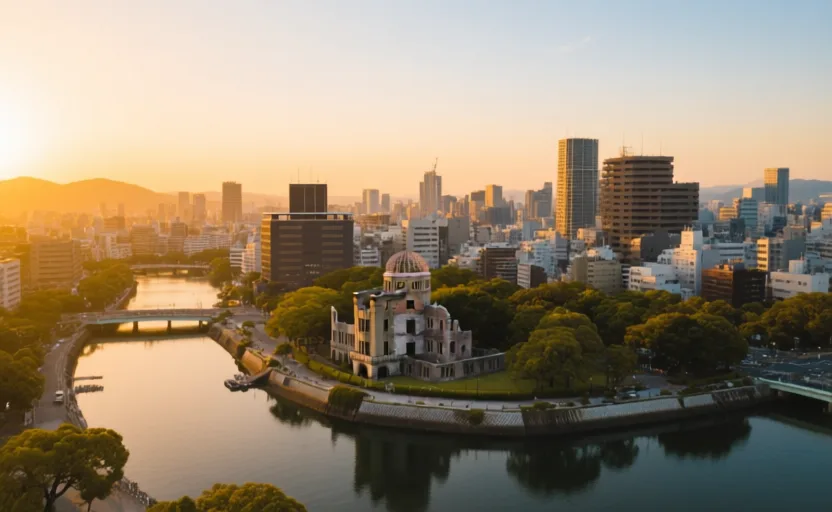 AI city illustration · Artistic impression
What people learn after moving
≈1.18 million in the city — the largest in the Chūgoku region and its commercial capital
Japanese, in the Hiroshima dialect. English signage is good around the Peace Park and thins quickly outside it
Japanese yen (JPY)
JST (GMT+9) — Japan does not observe daylight saving
AI city illustration · Artistic impressionCost of living in Hiroshima
Check your eligibility
Pick your passport to see entry rules and the long-stay routes we have researched.
Pick your passport to see whether you can enter Japan — and what it takes to stay.
Japan issues your residence card at the airport, but the card alone is not enough — you must register your address at your ward office within fourteen days, and that registration is what unlocks health insurance, banking and a phone contract. What Hiroshima adds is convenience rather than a different rulebook: the city hosts one of only eight regional immigration bureaux in Japan, serving the whole Chūgoku region, so extensions and status changes are handled locally instead of at a branch office that has to refer work elsewhere.
Converting a foreign licence — gaimen kirikae — requires a knowledge check and, for most countries, a practical test on a closed course that is notoriously exacting. A defined list of countries is exempt. The rules tightened nationally on 1 October 2025: a jūminhyō is now compulsory for every applicant, so short-stay visitors are shut out of the route, and the knowledge check went from ten questions at 70% to fifty questions at 90%. An International Driving Permit is valid for one year only. In central Hiroshima the tram network makes a car close to unnecessary; in the northern wards it stops being optional.
Japanese banks vary enormously in how they treat new foreign residents, and several major banks effectively require six months of residence before opening a full account. Japan Post Bank and the online banks are the usual first stop because they do not. You need ward registration first. Hiroshima Bank is the dominant regional institution and local employers and landlords are used to it.
Enrolment is a legal obligation, not a choice. Once enrolled you pay 30% of the cost of most treatment at the point of care and the scheme pays the rest, with a monthly ceiling that caps catastrophic costs. Pension enrolment is equally compulsory — and if you leave Japan you can claim a lump-sum withdrawal of part of what you paid, which a great many departing residents never do. Hiroshima additionally administers the Atomic Bomb Survivor's Health Handbook and carries a concentration of radiation-medicine expertise that exists almost nowhere else.
Japanese mobile has historically been expensive, dominated by three carriers with long contracts and heavy handset subsidies. Government pressure changed that, and the low-cost sub-brands and MVNOs now offer genuinely cheap plans on the same networks. You need a residence card and usually a Japanese bank account or credit card. Home fibre is fast and cheap, but what reaches your actual flat depends on the building — and in Hiroshima's older delta stock that is worth asking about before you sign.
Most employees never file a return — the employer's year-end adjustment handles it. The two things that catch foreign residents are residence tax, calculated on last year's income and billed from the following June, and the distinction between non-permanent and permanent tax residence, which decides whether Japan taxes your foreign income at all. The local detail worth knowing is the exact shape of the Hiroshima residence-tax bill: a flat per-capita floor of ¥5,500 a year, of which ¥500 is a prefectural forest levy that most of Japan does not charge, plus 10% of last year's income split 8% to the city and 2% to the prefecture because Hiroshima is a designated city.
Each guide has verified costs, timelines, required documents, and the non-obvious gotchas — sourced from official government pages. Last verified August 2026.
Reading a list isn’t learning it. Globe Quest turns these into a trainer — hear each phrase spoken, drill them with spaced repetition, and get scored as you say them out loud.
Hiroshima Prefecture carries an exceptional quantity of designated sediment-disaster warning area, and the reason is fresh: on 20 August 2014, debris flows and slope failures at 166 locations in Asaminami and Asakita wards killed 77 people. That disaster produced a national amendment to the Sediment Disaster Prevention Act, promulgated on 19 November 2014 and in force from 18 January 2015, obliging prefectures to publish the basic-survey results behind a designation rather than sit on them. The practical consequence for you is that the mapping now exists at street level on 土砂災害ポータルひろしま and Hiroshima City's own hazard map. A yellow warning area is a caution; a red special warning area carries actual building restrictions. Look the address up before the second viewing.
Japanese law requires you to register your address at the ward office covering it within fourteen days of moving in. Hiroshima's wards are Naka, Higashi, Minami, Nishi, Asaminami, Asakita, Aki and Saeki, and they are not interchangeable — Asakita alone runs deep into the mountains north of the delta. Registration produces the jūminhyō certificate and triggers your My Number, and without it you cannot enrol in health insurance, open most bank accounts, or complete a phone contract.
Hiroshima hosts one of Japan's eight regional immigration bureaux, not a branch office of somebody else's. The Hiroshima Regional Immigration Services Bureau handles residence procedures for Hiroshima, Yamaguchi, Okayama, Tottori and Shimane prefectures from here. That is a real quality-of-life difference against a city like Nagasaki, where the local office is a branch of Fukuoka's and the harder cases go two hours up the line. Extensions and status changes still take weeks to a couple of months, so start well before expiry.
Deposit, key money, agency fee, guarantor company fee, fire insurance and the first month. Key money is a gift to the landlord you never see again. Hiroshima is cheaper than any of Japan's three largest cities on the monthly rent and the up-front package is proportionally smaller, but budget for the full stack rather than the best case, and have it liquid in a Japanese account before you start looking.
Hiroden runs the largest surviving streetcar network in Japan — the delta's braided rivers made a subway expensive and the trams stayed. On 3 August 2025 the new Ekimae-Ōhashi route opened and trams now run up onto the second floor of the rebuilt Hiroshima Station, which had opened as the minamoa complex on 24 March 2025. It is the first arrangement of its kind in Japan and it removed the long-standing walk between the JR concourse and the tram stop. Central Hiroshima is genuinely workable without a car.
Itsukushima Shrine and its sea torii sit on an island reachable by tram-and-ferry or JR-and-ferry from the city in well under an hour, which means residents treat it as a Sunday morning rather than a trip. Since October 2023 there has been a small per-visit island tax collected from visitors alongside the ferry fare. Check the current terms and exemptions before assuming a regular walk up Mount Misen is free.
Mazda, Delta Kogyo, Hiroshima Aluminum, Molten, Toyo Seat
Mazda anchors the regional economy, but its Hiroshima head office and main plant are in Fuchū town, Aki District — a separate municipality wedged inside the city's boundary. Working there does not make your paperwork or your residence tax Fuchū's; where you sleep does.
Mitsubishi Heavy Industries, Japan Marine United, Hitachi Zosen, Chugoku Electric Power
The Inland Sea coast from Hiroshima through Kure is one of Japan's oldest industrial corridors, and Kure's shipyards and naval history remain a significant regional employer half an hour east.
Micron Memory Japan, Sharp, Kyocera, Elpida legacy operations
Micron's memory fab at Higashi-Hiroshima is the largest single high-tech investment in the prefecture and pulls a supply chain along the Sanyō corridor toward the university town of Saijō.
Otafuku Sauce, Aohata, Calbee Hiroshima, Kamotsuru, Chugoku Jozo
Okonomiyaki sauce, marmalade and sake are real industries here rather than souvenirs — Saijō in Higashi-Hiroshima is one of Japan's three major sake-brewing towns.
Edion, Hiroshima Bank, Fukuya, Izumi (Youme Town), Chugoku Shimbun
Hiroshima functions as the commercial capital of the whole Chūgoku region, so regional headquarters and back-office functions here serve five prefectures rather than one city.
Hiroshima University, Hiroshima City University, RERF, Hiroshima Prefectural Hospital
The Radiation Effects Research Foundation on Hijiyama has run the long-term health study of atomic-bomb survivors since 1975 as a joint Japan–US institution, and the city's radiation-medicine expertise is internationally unusual.
Landmark · Naka ward, on the Motoyasu river
The park laid out across the hypocentre district, with the skeletal Hall for Industrial Promotion left standing as it was and inscribed on the UNESCO World Heritage list in 1996.
Local tip: Go to the Peace Memorial Museum before the park, not after — the park reads differently once you have been through it. The museum is deliberately unsparing and takes two hours. On 6 August the ceremony begins at 8:15 and the park is full from dawn; if you would rather not be part of a crowd, the days either side are quiet and the lanterns on the river the evening of the 6th are the part residents actually attend.
Nature · Hatsukaichi, ~40 minutes by tram or JR plus ferry
An island of wooded peaks and a shrine built out over the water, its torii standing in the sea at high tide. Inscribed as World Heritage in 1996.
Local tip: Everyone photographs the torii and leaves. The island is better up: the Mount Misen ropeway plus a half-hour climb gets you the whole Inland Sea, and the last hour before the final ferry is when the day-trippers have gone and the deer have the streets. A small visitor tax is collected with the ferry fare.
Food · Naka ward, Shintenchi
A building of stacked floors, each lined with okonomiyaki counters, every one of them cooking the layered Hiroshima version on a shared steel plate.
Local tip: It is touristy and still worth it, but the better move is any single-counter shop in Nagarekawa or near Yokogawa station. Sit at the teppan, not a table — the cook slides it straight onto the plate in front of you and you eat off the hot metal with a small spatula rather than chopsticks.
Nature · Naka ward, beside the Kyōbashi river
A compressed-landscape garden laid out in 1620 for the Asano lords, with a pond, tea houses and a rainbow bridge, rebuilt after 1945.
Local tip: Small enough for forty minutes and central enough to be a lunch break. It is also a memorial site — many people sheltered here after the bombing and the ginkgo trees that survived are marked. The combined ticket with the Prefectural Art Museum next door is the sensible buy.
Nature · Minami ward, above the city
A wooded hill in the middle of the city carrying the Museum of Contemporary Art, a cherry-blossom slope and the Radiation Effects Research Foundation's distinctive buildings.
Local tip: The best free view of the delta and, in April, one of the least crowded hanami spots in the city because most people go to the castle. Walk up from Danbara; the bus route is slower than the climb.
Nature · ~90 minutes east by JR
A hillside port town of temple stairs and cats, and the start of a 70 km cycle route that crosses six islands of the Inland Sea on dedicated bridge lanes.
Local tip: The full crossing to Imabari is a long day; the honest local version is renting in Onomichi, riding to Ikuchijima for lemon gelato and coming back on the ferry. Bikes can be dropped at terminals along the route rather than returned, which is what makes a one-way ride practical.
Side-by-side cost of living, language, climate and careers — to help you choose.