
Population
≈3.0 million and rising by roughly 30,000 a year — projected to overtake Busan around 2031, having already passed it on regional GDP
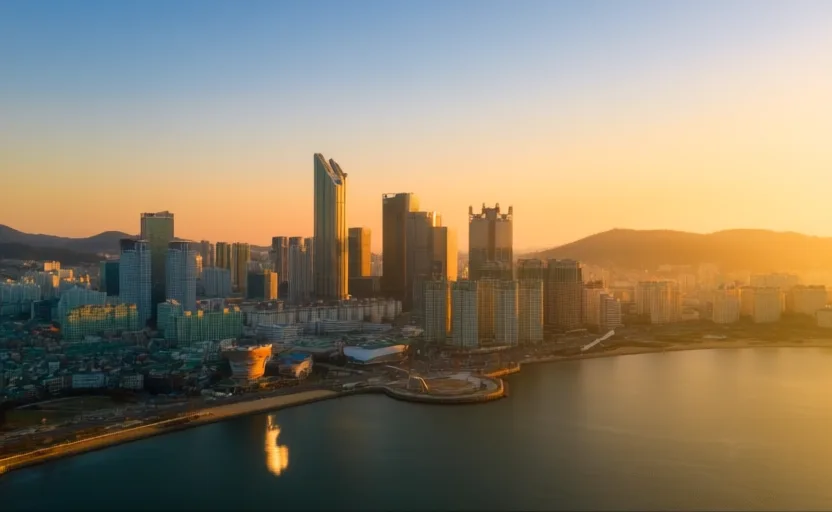 AI city illustration · Artistic impression
What people learn after moving
≈3.0 million and rising by roughly 30,000 a year — projected to overtake Busan around 2031, having already passed it on regional GDP
Korean, standard Seoul-area speech. English is more common in Songdo than almost anywhere in Korea outside central Seoul
South Korean won (KRW, ₩)
KST (GMT+9) — Korea does not observe daylight saving
AI city illustration · Artistic impressionCost of living in Incheon
Check your eligibility
Pick your passport to see entry rules and the long-stay routes we have researched.
Pick your passport to see whether you can enter South Korea — and what it takes to stay.
Korea keeps entry and residence entirely separate. Visa-free entry or a K-ETA lets you visit and nothing more. The long-stay category — E-7 skilled work, E-2 teaching, D-8 startup, D-10 job search, D-2 study, F-6 spouse, F-1-D remote work — is normally issued by a Korean consulate before departure and several cannot be switched into from inside Korea. Once here you have ninety days to register and obtain the Alien Registration Card, whose thirteen-digit number every Korean system authenticates against. Incheon's quirk is that its two islands, Ganghwa and Ongjin, are designated population-decline areas with their own regional residence route.
You may drive on your home licence plus a Geneva Convention International Driving Permit for one year from entry, and the permit must be issued at home before you travel — there is no way to obtain a recognised one here. Once you hold an ARC, KoROAD will exchange your foreign licence, and for reciprocity countries that means an eyesight and aptitude check rather than a test. Incheon is the one Korean metropolitan city where a car genuinely earns its keep: the built-up area is split between the mainland, Yeongjong Island and the reclaimed FEZ districts, and the links between them are tolled bridges rather than metro lines.
A Korean account belongs to a verified identity, and for a foreigner that identity is the ARC. Before it arrives some banks open a deposit-and-withdraw-only account on a passport — no transfers, no app banking, no outward remittance. A full account needs the ARC plus a Korean mobile number registered in exactly the same name. Even then, anti-fraud rules open every new account as a limited-transaction account capped around ₩1 million a day until you document what it is for. Incheon's advantage is branch density around Songdo and the Global Campus, where staff handle foreign customers constantly rather than occasionally.
National Health Insurance enrolment is compulsory once you pass six months of residence and cannot be declined because you hold private cover. With an employer the premium is split and payroll-deducted. Without one you become a local subscriber and are billed a premium benchmarked to the national average rather than to your Korean income, which catches students and early-stage freelancers hard. Arrears can block a visa extension. Pension contributions are equally compulsory and whether you can reclaim them on departure depends on your nationality, not your contributions.
The point of a Korean phone number is identity, not calls. Korean real-name verification binds your name, birth date, registration number and phone line together, and only a line registered to you personally passes it — which gates banking apps, delivery, government services and most of the useful internet. Incheon's specific hazard is that everyone arrives at the airport, where the carrier counters sell prepaid SIMs on a passport that feel like the job done. They are not. The sequence is eSIM or airport prepaid as a bridge, then the ARC, then a postpaid or MVNO line in your own name.
You become a Korean tax resident by having a settled life here or by 183 days of presence in a tax year. Residents are taxed on worldwide income at progressive rates plus a 10% local surtax. Two reliefs matter: resident five years or fewer of the last ten and your foreign-source income is taxed only when a Korean payer pays it or you remit it; and foreign employees may elect a flat 19% on Korean employment income, forfeiting all deductions. The Incheon-specific point is negative — the national tax reductions for foreign-invested companies in the Free Economic Zone were abolished from 1 January 2019, though a great deal of published material has never been updated.
Each guide has verified costs, timelines, required documents, and the non-obvious gotchas — sourced from official government pages. Last verified August 2026.
Reading a list isn’t learning it. Globe Quest turns these into a trainer — hear each phrase spoken, drill them with spaced repetition, and get scored as you say them out loud.
Relocation guides, brokers and even some recruitment material still promise up to seven years of corporate or income tax reduction for foreign-invested companies in the Incheon Free Economic Zone. Korea abolished those national tax reductions with effect from 1 January 2019, to equalise treatment between domestic and foreign capital under the OECD base-erosion work. Investments made before the end of 2018 were grandfathered. What survives is real but different: local acquisition and property tax reductions granted on application, customs duty exemption on imported capital goods, land and rent support, and one-stop regulatory services.
Your deposit is protected only once you have actually moved in and registered your residence, and that opposing power takes effect from 00:00 the following day. A landlord who registers a mortgage on the same day you pay therefore outranks you. This one-day gap is the mechanism behind a large share of Korea's deposit-fraud cases. File the move-in report and get the fixed-date stamp immediately, and pull the property register again the next morning.
The small-tenant priority repayment scheme ring-fences part of your deposit ahead of every other creditor, on regional ceilings. Most of Incheon sits inside the Seoul-area overcrowding-restriction zone, which carries the higher ₩145 million ceiling and ₩48 million protected slice — but Schedule 1 to the Enforcement Decree of the Metropolitan Area Readjustment Planning Act carves the Free Economic Zone out of that zone, so Songdo, Cheongna and Yeongjong fall into the ordinary metropolitan-city band instead, at ₩85 million and ₩28 million. The same schedule also excludes Ganghwa-gun, Ongjin-gun, the Namdong national industrial complex and eight dong of Seo-gu around Geomdan. The figures are set by decree and revised. Confirm which band your exact address falls in at the district office before deciding how much deposit to put down.
Incheon International is on Yeongjong Island, across a tolled bridge from the mainland city. From Songdo it is around forty minutes by road; from Bupyeong or Gyeyang you are often quicker taking the airport railway from a Seoul station than driving across your own city. Both bridges to Yeongjong charge tolls, with a city-funded discount arrangement for island residents that has been repeatedly renegotiated — check the current terms before assuming a cheap commute.
Incheon has Korea's densest concentration of international education, but foreign schools operate under a national rule: Korean nationals may enrol only if they have lived abroad for three years or more in total, and only up to 30% of places (up to 50% where the provincial education office so provides). Mixed-nationality and returning families regularly plan a Songdo move around a school their child turns out not to qualify for. Confirm eligibility with the school in writing before you commit to a lease.
The reclaimed-land districts were master-planned, and they read that way — wide blocks, underground waste collection, big parks and very little street life. Families and anyone who wanted space out of Seoul tend to stay for years. People who came for Korea itself often find the old port districts of Jung-gu and Dong-gu, or Bupyeong's markets, are where the city actually is. Spend an evening in both before choosing, because the two halves of Incheon feel like different countries.
Incheon International Airport Corporation, Korean Air and Asiana cargo, global express carriers
Incheon International is one of the world's busiest airports for international cargo and the region's dominant transfer hub. Air logistics, freight forwarding, MRO and airline ground operations employ tens of thousands across Yeongjong.
Samsung Biologics, Celltrion, Samsung Bioepis, Lonza
Songdo holds one of the largest concentrations of biologics manufacturing capacity anywhere in the world, built almost entirely since 2011. Contract manufacturing and biosimilars dominate, and the hiring is heavily process engineering and quality.
GM Korea (Bupyeong), tier-one suppliers across Bupyeong and Seo-gu
The Bupyeong complex is Incheon's largest single manufacturing employer and one of General Motors' major export plants outside North America, with a supplier belt built around it since the 1960s.
Hyundai Steel Incheon works, HD Hyundai Infracore, Doosan group operations
The Dong-gu and Seo-gu waterfront carries Korea's oldest heavy-industry cluster outside Pohang and Ulsan, including electric-arc steelmaking and construction equipment.
Incheon Port Authority, Incheon New Port operators, China ferry lines
Incheon is Korea's closest major port to China and the only one with scheduled passenger ferries to Chinese cities, alongside a growing container terminal at the New Port in Songdo.
Green Climate Fund, Incheon Global Campus, Chadwick International
The Green Climate Fund's global headquarters is in Songdo, and the Incheon Global Campus hosts Korean campuses of SUNY Stony Brook, George Mason, Ghent, the University of Utah and FIT — the largest cluster of foreign university campuses in the country.
Nature · Yeonsu-gu
A seawater canal park down the spine of the new city, with kayaks, a deer meadow and towers on all four sides.
Local tip: The canal is seawater pumped from the bay, which is why it does not freeze the way an inland pond would. Walk the eastern bank at dusk when the towers light up — the western side is where every photo is taken and it faces the wrong way.
Culture · Jung-gu
Korea's only official Chinatown, on the hill above the 1883 treaty port, where jjajangmyeon was invented.
Local tip: The Jjajangmyeon Museum occupies the original Gonghwachun restaurant building and is better than it sounds. Walk over the ridge into the Japanese-era banking street on the other side — same ten minutes, a completely different colonial architecture.
Food · Jung-gu
A covered market by the old port, famous nationally for sweet-and-spicy fried chicken and for dakgangjeong queues.
Local tip: Go on a weekday. The chicken stalls at the market's northern end run forty-minute weekend queues that are entirely avoidable, and the dumpling and mandu stalls in the middle are the actual local habit.
Neighborhood · Jung-gu
A slightly faded seafront amusement strip on the island where the 1950 landings came ashore, next to the reopened inner harbour grain silos.
Local tip: The raw fish market at the end of the promenade is where locals eat rather than the amusement strip. The Sangsang Platform in the converted grain silos nearby is the more interesting half of the area and almost nobody walks between the two.
Landmark · Ganghwa-gun, 90 minutes north-west
A large island of UNESCO-listed dolmens, Goryeo-era fortresses and the closest civilian viewpoint to North Korea.
Local tip: The dolmen sites are free and usually empty. The northern shoreline observatories look directly across the estuary at North Korean farmland — bring your passport, because some of the coastal roads pass military checkpoints.
Nature · Namdong-gu, on the edge of Songdo
Abandoned salt pans turned into a tidal reserve, with wooden windmills, salt-harvesting flats and enormous flocks of migratory birds.
Local tip: This was the salt farm that supplied much of the capital until the 1990s, and the pans are still flooded and drained. Come in late afternoon in autumn for the birds and the pink salt-tolerant plants. It is twenty minutes from Songdo's towers and hardly anyone who lives in them has been.
Side-by-side cost of living, language, climate and careers — to help you choose.