
Population
~1 million city; ~2.5 million across the Iskandar Malaysia conurbation
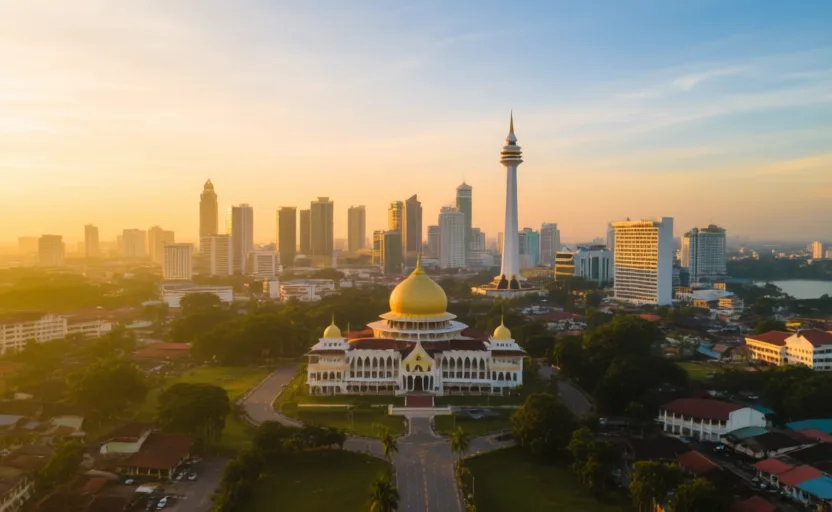 AI city illustration · Artistic impression
What people learn after moving
~1 million city; ~2.5 million across the Iskandar Malaysia conurbation
Malay (official), English (widely used in business), Mandarin, Tamil
Malaysian Ringgit (MYR); Singapore dollars are earned by many residents but not accepted as local tender
MYT (GMT+8), identical to Singapore — no time change at the border
AI city illustration · Artistic impressionCost of living in Johor Bahru
Check your eligibility
Pick your passport to see entry rules and the long-stay routes we have researched.
Pick your passport to see whether you can enter Malaysia — and what it takes to stay.
Living in JB and working in Singapore means holding a valid pass in each country independently. Malaysia will let you live here on an Employment Pass, a DE Rantau nomad pass or MM2H; Singapore will let you work there only on a Singapore work pass issued to you by a Singapore employer. Neither country's document does anything in the other. The Johor-specific overlay is the JS-SEZ, which offers a special individual income tax rate for qualifying knowledge workers employed by approved companies inside the zone.
Two things to get right: how you cross, and what you drive. The Causeway at Woodlands is closest to JB city centre and is heavily congested; the Second Link at Tuas is longer but frequently faster. Buses, motorcycles and the coming RTS Link each have different queueing characteristics. Whichever plate you drive, there is a vehicle entry permit regime in that direction, and Singapore additionally requires its own cars to leave with a nearly full tank.
Open a Malaysian account the standard way: passport, valid long-term pass and proof of a JB address, which in practice means an LHDN-stamped tenancy agreement. The distinctive JB question is the monthly conversion. If you earn Singapore dollars, the spread you accept on that transfer is a recurring cost roughly the size of a utility bill, and the default option — your Singapore bank's outward wire — is usually the worst one available.
JB has a solid private hospital sector — the reverse medical-tourism flow from Singapore is real, because Malaysian private care costs a fraction of Singaporean private care for comparable procedures. Government hospitals are the cheap fallback with long queues. The trap for cross-border commuters is assuming a Singapore employer's medical benefits cover them at home in Johor; usually they do not, and the gap is discovered at the worst moment.
Buy and register a Malaysian prepaid SIM on arrival — the coverage is good and the price is low. The commuter's problem is different from a normal newcomer's: your phone will cross an international boundary twice a day, and handling that badly means either roaming charges or being unreachable at work. Dual-SIM or eSIM plus a Singapore number is the standard answer.
Two countries assess you independently. Singapore taxes employment income arising from work physically performed in Singapore, and how much depends on how many days you spend there. Malaysia tests your residency under s.7 of the Income Tax Act 1967 and, for a resident, exempts foreign-sourced income received here under P.U.(A) 234/2022 — but only where that income was already subjected to tax in the territory where it arose. That condition is where a cross-border commuter's position is actually decided, and it is the part almost nobody checks.
Each guide has verified costs, timelines, required documents, and the non-obvious gotchas — sourced from official government pages. Last verified August 2026.
Reading a list isn’t learning it. Globe Quest turns these into a trainer — hear each phrase spoken, drill them with spaced repetition, and get scored as you say them out loud.
From 2014 Johor ran a Friday–Saturday weekend with a Sunday-to-Thursday working week. On 1 January 2025 the state reverted to Saturday–Sunday, aligning with Singapore and the rest of Malaysia. Almost everything written about Johor before 2025 still says Friday–Saturday, and it matters: state government offices, some state-linked employers and school calendars follow the state's rest days, while Singapore has always been Monday to Friday. Confirm your own employer's days rather than assuming either version.
If you work in Singapore, the crossing dominates everything. The Causeway at Woodlands is closest to JB city centre and is the most congested land crossing you are likely to encounter; the Second Link at Tuas is longer but often faster and serves the western side. Peak-direction queues of an hour or more are routine and can be far worse before a public holiday. Test your actual crossing at your actual departure time before you sign a lease, in both directions.
The Rapid Transit System Link will run between Bukit Chagar in JB and Woodlands North in Singapore — a roughly five-minute crossing with immigration for both countries cleared once, at the station you depart from. Construction passed ninety per cent in 2026 and passenger service is targeted for January 2027. It will reshape which JB neighbourhoods are commutable. It has also already priced itself into property around Bukit Chagar, so you are paying for it whether or not you will use it.
A very large share of JB's working population commutes to Singapore, and the exchange rate is effectively a second salary negotiation that happens without you. It makes JB feel extremely cheap to a Singapore earner and expensive to someone paid in ringgit — two people living on the same street can experience completely different cities. If you are paid in ringgit by a Malaysian employer, benchmark your costs against other Malaysian cities, not against what your Singapore-earning neighbours spend.
A Singapore-registered vehicle entering Malaysia needs a Malaysian Vehicle Entry Permit with an RFID tag, enforced since 2024 with summonses following. A Malaysian-registered vehicle entering Singapore needs Singapore's own vehicle entry permit and an Autopass card, and Singapore-registered cars leaving must depart with at least three-quarters of a tank of fuel. Sort the paperwork for whichever plate you will actually drive before you need it — being turned back at a checkpoint at 7am is a wasted day.
It is a sprawling, car-dependent border city organised around industrial estates, malls and gated townships rather than a walkable centre. There is no urban rail inside JB itself. The city centre around Jalan Wong Ah Fook has been substantially redeveloped, but most residents live in townships — Bukit Indah, Mount Austin, Iskandar Puteri — and drive everywhere. Expect to own a car unless you live and work in the same township.
Singapore employers across finance, logistics, engineering and healthcare
The largest single economic fact about JB is that a substantial part of its workforce is employed in Singapore. That is not an industry in the usual sense, but it is what determines household incomes, property prices and traffic patterns here.
Multinationals across the Pasir Gudang, Tebrau and Senai industrial corridors
Johor has a deep manufacturing base and the JS-SEZ incentive package is explicitly aimed at pulling higher-value operations across the strait from Singapore.
Regional and global operators clustered around Sedenak and the Kulai corridor
Johor became one of Southeast Asia's fastest-growing data-centre markets, driven by land, power and proximity to Singapore. Power and water availability, not demand, are the binding constraints.
Port of Tanjung Pelepas, Johor Port Pasir Gudang, Senai Airport freight
Tanjung Pelepas is one of the world's larger transhipment ports and sits directly opposite Singapore's. Logistics, customs and supply-chain skills are in real demand across the state.
Entities licensed into the Forest City Special Financial Zone
The Special Financial Zone offers a concessionary corporate rate for qualifying financial services and a 0% rate for approved single-family-office vehicles. It is early-stage and the qualifying conditions are detailed — this is a professionally advised route, not a retail one.
Iskandar Puteri, Medini, Forest City and the Tebrau corridor developers
Iskandar Malaysia has been a construction economy for two decades, with the boom-and-overhang cycle that implies. It is a large employer and a large source of the unsold inventory that keeps JB rents soft.
Landmark · City centre
The commercial heart beside the Causeway CIQ — malls, the riverfront promenade and the redeveloped spine of the old town.
Local tip: Come on a weekday. On Singapore public holidays this area is completely overrun by day-trippers and the queues at everything double.
Culture · Jalan Skudai
A Victorian-Moorish mosque completed in the 1890s, sitting on a rise above the strait with Singapore visible across the water.
Local tip: Visit late afternoon for the light and the view. Modest dress required, and robes are usually available at the entrance.
Culture · Jalan Ibrahim, old town
A small, well-made museum on the five Chinese dialect groups who built JB, in a restored shophouse in the old quarter.
Local tip: Pair it with a walk through the surrounding old streets — the heritage quarter around Jalan Tan Hiok Nee is where JB is most itself.
Food · Pontian district, southwest Johor
A stilt fishing village out over the mangroves, famous across Malaysia and Singapore for seafood eaten above the water.
Local tip: Go for a late lunch on a weekday and drive back before dark. Weekends bring Singaporean coach parties and the prices follow them.
Nature · North and east of the city
Forested hills and waterfall parks within an hour of the city — the closest thing JB has to a weekend escape that is not a shopping mall.
Local tip: Start early. These are humid lowland trails and by ten in the morning the heat is genuinely punishing.
Nature · Pontian district
The southernmost tip of continental Asia — a boardwalk through mangroves out to a point where the shipping lanes pass close inshore.
Local tip: Almost no visitors come from JB, which is why it is worth the drive. Time it for low tide and bring insect repellent that actually works.
Side-by-side cost of living, language, climate and careers — to help you choose.