
Population
≈17–20 million in the metropolitan area — Pakistan's largest city by a wide margin and one of the largest in the world
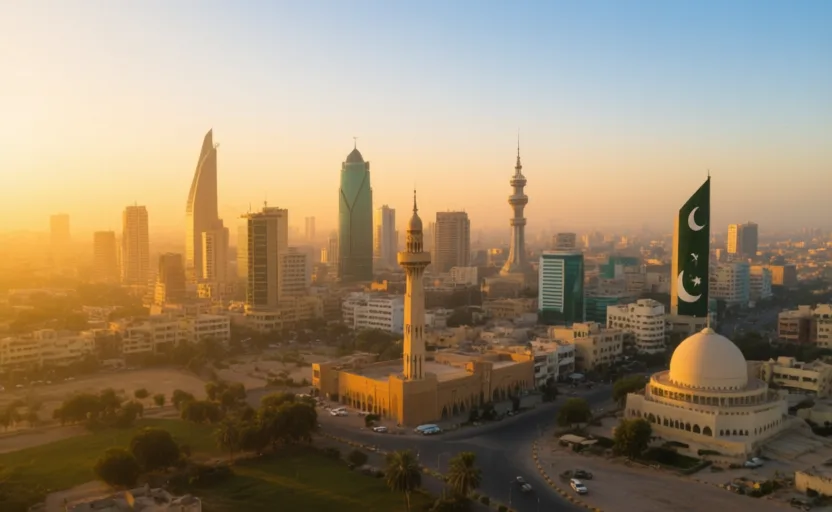 AI city illustration · Artistic impression
What people learn after moving
≈17–20 million in the metropolitan area — Pakistan's largest city by a wide margin and one of the largest in the world
Urdu is the lingua franca; Sindhi is the provincial language; English is the language of business, law and higher education. Karachi is also heavily Pashto-, Punjabi- and Balochi-speaking
Pakistani rupee (PKR)
PKT (GMT+5) — no daylight saving
AI city illustration · Artistic impressionCost of living in Karachi
Check your eligibility
Pick your passport to see entry rules and the long-stay routes we have researched.
Pick your passport to see whether you can enter Pakistan — and what it takes to stay.
Pakistan issues a short entry visa and then extends it in-country, with security clearance attached to the extension rather than only to the first grant. There is no settlement ladder — no points system and no accumulation toward permanent residence. The single most important question to answer first is whether you have Pakistani ancestry, because NADRA's Pakistan Origin Card gives indefinite stay and the right to work without any visa at all, and it is repeatedly overlooked.
Licensing is provincial, and the Sindh, Punjab and Islamabad systems are separate: a Sindh licence is issued by Sindh Police and the online portals are built around a CNIC rather than a foreign passport. Most foreign professionals in Karachi do not drive themselves. Ride-hailing is cheap and ubiquitous, and a driver on a monthly salary is a normal middle-class arrangement rather than a luxury. If you do drive, an International Driving Permit covers a visit but is not a substitute for a licence once you are resident.
The question that determines everything is whether you are opening a resident or a non-resident account, because the two have different documentation and, crucially, different repatriation rights. Pakistan operates real exchange controls, and getting money out later depends on how it was brought in and which account it sat in. Foreign nationals need a passport and valid visa; anyone with Pakistani origin should look at the Roshan Digital Account route, which is remote-openable and fully repatriable.
Pakistan has no universal health scheme that covers foreign residents. The government's Sehat Sahulat card programme is a provincial rollout for Pakistani citizens and has never been uniform across the country; it is not a route for expatriates. Karachi's advantage is that it has the best private hospital in the country — Aga Khan University Hospital — and a serious private sector around it. Private insurance, ideally international, is the practical answer, and arranging it before arrival is materially easier than after.
Every SIM in Pakistan is biometrically verified — you give a fingerprint at the point of sale and it is matched in real time before the SIM activates. Foreign nationals register against their passport through NADRA's foreigner verification route rather than a CNIC, and are held to a much lower SIM limit than citizens. Mobile data is genuinely cheap. Fixed-line broadband is the weak point, and in Karachi the answer to 'what internet does this building have?' is a lease-signing question.
Pakistan's tax year runs 1 July to 30 June, not the calendar year, and you are a resident individual if you are present for 183 days or more in that year. Residents are taxed on worldwide income; non-residents only on Pakistan-source income. The peculiarly Pakistani feature is the filer/non-filer distinction: appearing on the FBR's Active Taxpayers List materially reduces withholding on ordinary transactions, and you get on it by filing on time, not merely by registering.
Each guide has verified costs, timelines, required documents, and the non-obvious gotchas — sourced from official government pages. Last verified August 2026.
Reading a list isn’t learning it. Globe Quest turns these into a trainer — hear each phrase spoken, drill them with spaced repetition, and get scored as you say them out loud.
NADRA issues two documents that most people relocating to Pakistan have never separated properly. NICOP is for Pakistani citizens living abroad and supports a Pakistani passport and voter registration. POC — the Pakistan Origin Card — is for foreign nationals of Pakistani descent, including foreign spouses, and NADRA's own statement of its effect is generous: multiple visa-free entry, indefinite stay, exemption from reporting to police or foreigners' registration offices, the right to buy and hold property anywhere in Pakistan, the right to open bank accounts, and eligibility for employment. A POC holder does not need a work visa. People spend years renewing employment visas without ever checking whether they qualify.
Pakistan's work visa is issued for a short entry period and then extended in-country, and DGI&P applies a security clearance requirement to the extension. The initial grant can be quick and lull you into treating the extension as a formality. It is not: the clearance runs on its own timetable outside your employer's control, and starting the extension in the final fortnight before expiry is how people end up out of status. Begin it two to three months out.
The FBR's Active Taxpayers List is the practical dividing line in Pakistani financial life. Non-filers face materially higher withholding rates on property purchases, vehicle registration, dividends and various banking transactions. Registering for a National Tax Number is not enough; you appear on the ATL only after actually filing a return by the due date, and the list is refreshed weekly. For anyone buying a car or property here, the difference is large enough to change the transaction.
Karachi is not one municipality. DHA is run by the Defence Housing Authority, the cantonment areas by their own cantonment boards, and the rest by the city district and Sindh government. They differ on building approvals, property transfer procedure, utility connections and how quickly anything gets fixed. An agent will describe a flat as 'DHA Phase VIII' as though it were a postcode. It is a jurisdiction, and it determines who you deal with for the next few years.
Piped supply is unreliable across much of the city and a large share of households buy tankered water. Before renting, ask specifically: is there a bore, is there an underground tank and a roof tank, how often does the tanker come, and who pays for it. A flat with a good rent and no water storage is a flat with a recurring cost and a recurring argument. This is the single most common practical shock for people arriving from the Gulf or from Europe.
Karachi's expatriate life is largely ordinary: people work, eat out late, and drive themselves around. What differs is that employers commonly run their own security guidance, buildings have guards as standard, and it is normal to tell someone where you are going. Separately, and factually: a No Objection Certificate from the Ministry of Interior remains required for designated restricted and prohibited areas of Pakistan, mainly frontier districts and high-altitude zones. That is a trip-planning fact rather than a comment on daily life in the city.
Habib Bank, United Bank, MCB, Meezan Bank, State Bank of Pakistan
The State Bank of Pakistan and the Pakistan Stock Exchange are both headquartered here, and Karachi is where essentially every major bank runs its head office. Meezan is the country's largest Islamic bank and the sector is genuinely a specialism rather than a niche.
Karachi Port Trust, Port Qasim Authority, DP World, Maersk Pakistan
Karachi Port and Port Qasim together handle the overwhelming majority of Pakistan's seaborne trade. A landlocked country of 240 million funnels through two ports in one city, which is why logistics roles here carry national weight.
Gul Ahmed, Artistic Milliners, Soorty, Interloop (Faisalabad-based, Karachi export desks)
Textiles are Pakistan's largest export sector and the denim mills around Karachi supply major global brands. Buying-house and sourcing roles are the most common entry point for foreign professionals.
Pakistan State Oil, Engro, K-Electric, Byco, Pakistan Refinery
K-Electric is unusual in South Asia — a vertically integrated, privately held utility supplying a city of over twenty million, which is why Karachi's power situation differs from the rest of the country's.
Unilever Pakistan, Nestlé Pakistan, GSK, Searle, Getz Pharma
Most multinational FMCG and pharmaceutical operations in Pakistan run their country head office from Karachi, which makes it the natural base for regional marketing and supply-chain roles.
Systems Ltd, NETSOL, 10Pearls, Careem, Bazaar
Smaller than Lahore's software cluster but closer to the customers — fintech, logistics tech and e-commerce cluster here because the banks and the ports are here. Pakistan's IT export earnings are taxed under a concessional regime rather than ordinary rates.
Nature · Clifton, south Karachi
A long stretch of Arabian Sea beach with a promenade, camel rides and the city's evening escape valve.
Local tip: Go at sunset on a weekday. The water is not for swimming — currents are genuinely dangerous and drownings happen every year — but the walk is the most reliably pleasant hour in Karachi, and the corn and chai sellers along the front are the point.
Culture · Clifton
A 1927 pink Jodhpur-stone palace, later Fatima Jinnah's residence, now the city's best-curated museum.
Local tip: The building alone justifies the trip, but check what's on before going — it runs a small number of serious temporary exhibitions rather than a permanent collection, and between shows there is much less to see.
Food · Saddar, central Karachi
The city's oldest food street, run by families who came from Delhi in 1947 and never changed the recipes.
Local tip: Go for nihari at Waheed's or Sabri's and go late — this street is at its best between ten at night and two in the morning. Order the nalli. Cash only in most places, and the crowd is entirely local.
Landmark · Saddar
An 1889 Gothic-revival market hall with a clock tower, at the centre of the colonial-era commercial district.
Local tip: The market itself sells spices, birds and produce; the reason to come is the surrounding grid of Saddar, which has Karachi's densest concentration of pre-partition architecture — much of it derelict, most of it unmarked, and all of it walkable in a morning.
Nightlife · DHA Phase VIII, on the creek
A strip of seafront restaurants on the water where Karachi does its late-night eating.
Local tip: This is what nightlife means in a city with no bars, and it is genuinely good. Tables fill after eleven and stay full past two. Go on a weeknight if you want to hear anyone; weekends are chaos and the road in backs up badly.
Nature · Across the harbour from Keamari
A spit of land with a lighthouse, an old Hindu temple, a colonial church and a beach nobody photographs.
Local tip: Take the launch from Keamari rather than driving round — it costs almost nothing, takes twenty minutes, and the harbour crossing is the best view of the city there is. The 1889 Varun Dev Mandir and St Paul's Church stand within a few hundred metres of each other, both largely forgotten.
Side-by-side cost of living, language, climate and careers — to help you choose.