
Population
≈1.5 million in the city; roughly 3 million across the Kathmandu Valley including Lalitpur and Bhaktapur
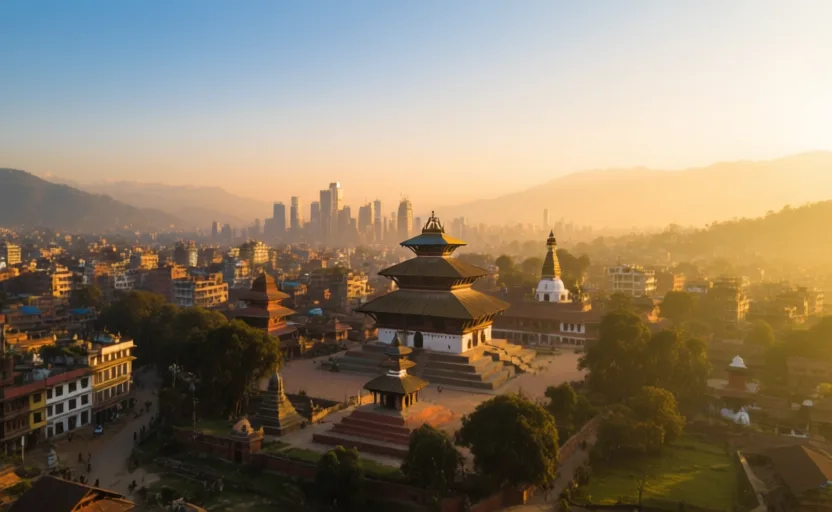 AI city illustration · Artistic impression
What people learn after moving
≈1.5 million in the city; roughly 3 million across the Kathmandu Valley including Lalitpur and Bhaktapur
Nepali is the national language; Nepal Bhasa (Newari) is the valley's own and still spoken in the old towns; English is widely used in the international sector and business
Nepalese rupee (NPR), pegged to the Indian rupee
NPT (GMT+5:45) — the only country in the world on a 45-minute offset
AI city illustration · Artistic impressionCost of living in Kathmandu
Check your eligibility
Pick your passport to see entry rules and the long-stay routes we have researched.
Pick your passport to see whether you can enter Nepal — and what it takes to stay.
Nepal separates the right to be here from the right to work, and they are issued by different ministries in a fixed order: labour permit first, line-ministry recommendation, then the non-tourist visa. Tourist days are capped at 150 per calendar year, which is a trap for anyone whose stay straddles a new year. Nothing here accumulates toward permanent residence — the Residential Visa is a money-based category, not a reward for years served.
An International Driving Permit is widely stated to be valid in Nepal for only about fifteen days, after which a resident needs a Nepali licence — a much shorter window than most countries allow and the detail that catches new arrivals. The Department of Transport Management runs an online application and smart-card system with in-person written and practical trials. In practice a large share of foreign residents in Kathmandu never drive a car at all: the valley's roads are narrow and congested, a motorcycle or scooter is the local answer, and taxis and ride-hailing are cheap.
Nepal operates exchange controls, and moving money out is a documented, permission-based process rather than an automatic right. The good news, and it is a genuine recent improvement, is that Nepal Rastra Bank has removed the previous ceiling on how much of their net after-tax income foreign employees may remit abroad. What makes that work is documentation: a valid employment contract, an appointment letter and evidence of tax compliance. Get those right at the start and the exit is straightforward; get them wrong and it is not.
Kathmandu punches above its weight medically for one specific reason: CIWEC, a travel-medicine hospital with genuine international standing in altitude illness and tropical disease, alongside Norvic and Grande for general private care. For complex treatment the established pattern is evacuation to Delhi or Bangkok. If you trek at all, check that your policy covers helicopter evacuation to a stated altitude — this is the one insurance clause in Nepal that people find out about the hard way.
SIM registration in Nepal is straightforward by regional standards: a passport, a copy of the visa page or entry stamp, and a passport photograph, done at an operator's store or at the airport, with activation usually within fifteen minutes. Foreign nationals may hold up to two SIMs in total across the operators. Fixed broadband in the Kathmandu Valley is genuinely good and inexpensive — a pleasant surprise for people arriving with low expectations — and load shedding, which used to make any of this unreliable, ended in 2018.
Nepal's residency test is not a fiscal-year one: you are resident if your normal place of abode is in Nepal, or if you are present for 183 days or more in any 365-day period ending in the income year. That rolling window is different from the calendar or fiscal-year tests used almost everywhere else in the region and it produces different answers. Residents are taxed on worldwide income; non-residents on Nepal-source income only. Everyone starting employment, business or a profession must obtain a PAN before receiving taxable income.
Each guide has verified costs, timelines, required documents, and the non-obvious gotchas — sourced from official government pages. Last verified August 2026.
Reading a list isn’t learning it. Globe Quest turns these into a trainer — hear each phrase spoken, drill them with spaced repetition, and get scored as you say them out loud.
Nepal permits a maximum of 150 days on a tourist visa in a calendar year — 1 January to 31 December — not in a rolling twelve-month period and not per entry. Someone who arrives in October, stays through to March and assumes they have a year's worth of allowance has in fact used part of two separate annual budgets, and can find themselves out of days in a way a rolling-year mental model does not predict. Extensions are done at the Department of Immigration in person, before expiry, even if applied for online, and late extensions attract a daily fine on top of the extension fee.
A working visa in Nepal is issued by the Department of Immigration only on the strength of a labour permit from the Department of Labour and Occupational Safety and a recommendation from the line ministry that regulates your employer's sector, plus the work agreement route the Department specifies. Three bodies, in that order. Going to immigration first is the classic wasted trip, and an employer who has never sponsored a foreigner will not know the sequence either. Ask, in writing, who is obtaining what.
The constitutional and Land Act position is that foreign nationals may not own land or immovable property in their personal capacity. No visa category alters it — not the working visa, not the business visa, and not the residential visa. What is available is leasing, which is common and can run for long terms, and corporate holding through a properly structured Nepali company for genuine business purposes. Non-Resident Nepali card holders are the partial exception: they may acquire residential and commercial property, excluding agricultural and forest land, on application to the Ministry of Foreign Affairs. Anyone told they can buy a house here should ask exactly which of those routes is being described.
Scheduled power cuts defined life in Kathmandu for years, and a great deal of published advice still tells you to buy an inverter and plan your evening around the schedule. Nepal declared the country free of load shedding in May 2018 and national electricity consumption has roughly tripled since. Short unscheduled outages still happen, and a UPS on a router is sensible, but the elaborate battery-and-inverter arrangements of the 2010s are no longer part of ordinary life. This is the single most commonly repeated stale fact about the city.
The 2015 Gorkha earthquake killed around 9,000 people and destroyed a large amount of Kathmandu Valley housing. Nepal updated its national building code, publishing NBC 105:2020 with revised seismic hazard provisions drawing on post-earthquake research. The honest caveat is that studies of compliance in Nepali municipalities have found it to be low, so a code existing is not the same as a building following it. Ask when the building was constructed, whether it was engineer-designed, whether a structural engineer signed off, and whether it was retrofitted after 2015. A reinforced-concrete frame from the last decade with a named engineer is a materially different proposition from an unreinforced brick building of unknown age.
Kathmandu sits in a bowl, and from roughly December to March a temperature inversion traps vehicle emissions, brick kiln smoke, construction dust and open burning inside it. Readings regularly reach unhealthy levels and the city has appeared among the world's ten most polluted at points during the season. It clears dramatically with the pre-monsoon rains and the winter months are otherwise the best weather of the year, which makes the contrast disorienting. Buy a HEPA purifier for the bedroom before December.
UN agencies, World Bank, ADB, ICIMOD, Save the Children, Oxfam, and a very large domestic NGO sector
This is the dominant employer of foreign professionals in Kathmandu and it shapes the city — the rental market around Patan and Lazimpat, the international schools, and much of the restaurant scene exist because of it.
Expedition operators, Yeti Airlines and Buddha Air, the hotel sector, Nepal Tourism Board
Nepal's signature industry and one of its largest foreign-currency earners. The sector is intensely seasonal — the autumn and spring windows carry most of the year — and Thamel is its commercial centre.
CloudFactory, Leapfrog Technology, Fusemachines, Deerwalk, Verisk Nepal
A genuinely growing software services sector, helped by the government removing the minimum foreign investment threshold for the IT sector in 2023 — a change that made small foreign-backed software ventures viable here for the first time.
Nepal Electricity Authority, Butwal Power, Chilime, independent power producers
The end of load shedding in 2018 and the shift to exporting power to India have made hydropower Nepal's most significant infrastructure sector, with substantial engineering and project finance employment.
Nabil Bank, Nepal Investment Mega Bank, Standard Chartered Nepal, Prabhu Group, IME
Remittances from Nepalis working abroad are a very large share of national income, which makes payments, foreign exchange and microfinance unusually developed sectors relative to the size of the economy.
Boudha and Jawalakhel carpet workshops, pashmina exporters, Nepali fair-trade cooperatives
The Tibetan carpet industry around Boudha and Jawalakhel remains a real export sector with deep craft skills, and the fair-trade and social-enterprise scene attached to it draws a particular kind of foreign professional.
Culture · Boudha, north-east Kathmandu
One of the largest stupas in the world, at the centre of a circular plaza ringed by monasteries and Tibetan cafés.
Local tip: Go at dusk and walk the kora clockwise with everyone else — it is a functioning devotional site rather than a monument, and the hour after sunset is when it is fullest. The rooftop cafés on the western side have the view; the ones on the north are quieter.
Landmark · Lalitpur, south of the Bagmati
The best-preserved of the valley's three royal squares, with the Patan Museum in a restored palace wing.
Local tip: The Patan Museum is the finest museum in Nepal and one of the best in South Asia — genuinely worth two hours, and almost nobody who lives here has been. Go on a weekday morning and have lunch in the museum café courtyard afterwards.
Nightlife · Central Kathmandu
The trekking district — gear shops, bars, live music and the densest concentration of visitors in the country.
Local tip: It is where you buy gear and where you go out, and it is not where most long-term residents live. Rents are high for what you get, the noise runs late, and the shops are priced for people who are leaving in a week. Come for the evening, live elsewhere.
Food · Lalitpur, near Sanepa
Nicknamed 'Jhamel' — a compact strip of restaurants, cafés and bars that has become the international community's actual local.
Local tip: This is where the development sector eats. It is calmer than Thamel, better value, and closer to where most INGO offices are. A weekday evening here tells you more about foreign life in Kathmandu than a week in Thamel would.
Nature · The northern rim of the valley, above Budhanilkantha
Protected forest rising from the valley edge, with trails to Nagi Gumba monastery and views to the Himalaya on clear days.
Local tip: The entrance above Budhanilkantha is twenty minutes from Lazimpat and puts you in genuine forest immediately. Go early on an October or November morning — the post-monsoon air is the clearest of the year and Ganesh Himal and Langtang are visible from the ridge.
Neighborhood · On a hill south-west of the city, above Tribhuvan University
A hilltop Newar town, largely intact, with brick lanes, temples and a view back over the whole valley.
Local tip: Twenty minutes from Patan and effectively undiscovered — the old town at the top is a working Newar settlement rather than a preserved one. Come for the newari khaja set at one of the small places near Bagh Bhairab temple, and walk the ridge at sunset.
Side-by-side cost of living, language, climate and careers — to help you choose.