Population
Around 17–18 million in the agglomeration — but the DRC's only census was in 1984, so every figure is a projection and estimates range from 12 to 21 million
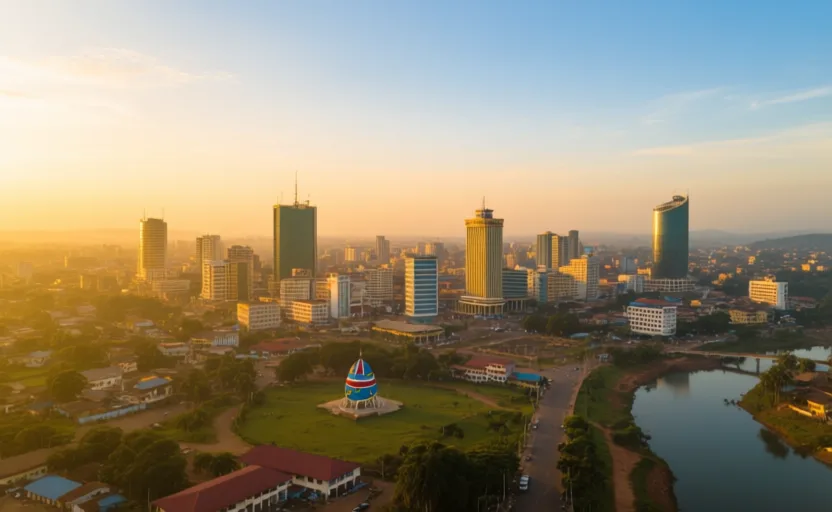 AI city illustration · Artistic impression
What people learn after moving
Around 17–18 million in the agglomeration — but the DRC's only census was in 1984, so every figure is a projection and estimates range from 12 to 21 million
French (sole official language); Lingala is what Kinshasa actually speaks day to day
Congolese franc (CDF, written FC) — but rent, salaries and anything large are quoted in US dollars
GMT+1, no daylight saving (the DRC spans two zones; the east is GMT+2)
AI city illustration · Artistic impressionCost of living in Kinshasa
Check your eligibility
Pick your passport to see entry rules and the long-stay routes we have researched.
Pick your passport to see whether you can enter Congo (DRC) — and what it takes to stay.
Two documents from two ministries, in a fixed order. The Commission Nationale de l'Emploi des Étrangers, under the Ministry of Employment, issues the biometric carte de travail — and under Ordonnance 87-281 art. 9 that work card is a PRECONDITION of the work establishment visa, not a consequence of it. The DGM then issues the establishment visa itself. Expect the sequence to be: enter on a travel visa, live lawfully for six months, then file. There is no route that lets you land on an establishment visa.
The DRC replaced its licence entirely. Since the relaunch in November 2024, only the biometric chip licence issued by CONADEP — the Commission Nationale de Délivrance du Permis de conduire — is recognised, and roadside enforcement of that rule began on 30 June 2025 and was confirmed as continuing through late 2025. The old paper and plastic licences are simply not the document any more. Applicants must be at least 18 and go through CONADEP.
Open a bank account and a mobile-money wallet early. From 9 April 2026 commercial banks may no longer physically import foreign banknotes — the BCC has that monopoly now — and from 9 April 2027 no person or company may settle any transaction in foreign-currency cash, at any amount. Dollars are not banned; dollar CASH is. Everything moves to transfer, card and mobile money. In a city that has run on physical hundred-dollar bills for thirty years, this is the largest practical change in a generation.
There is no national emergency medical number in the DRC: you call a clinic directly. The practical model most foreign residents use is a subscription to a private emergency centre — the Centre Privé d'Urgence inside the Centre Médical de Kinshasa in Gombe operates 24 hours a day but functions on a subscription basis — plus international insurance that explicitly covers medical evacuation, usually to South Africa. The state is building a universal health coverage scheme, and free maternity and newborn care launched in Kinshasa in 2024, but that is a scheme for Congolese citizens rather than a plan for you.
Four networks — Vodacom Congo, Airtel DRC, Orange RDC and Africell — and mobile money on all of them. Anonymous SIMs are over: the government adopted mandatory, systematic subscriber identification for every new mobile subscription, with the regulator ARPTC running the implementation alongside the four operators. Bring your passport. And ignore anything you read about the RAM levy: it was abolished on 1 March 2022.
Your employer withholds the impôt professionnel sur les rémunérations (IPR) on annual bands of 3%, 15%, 30% and 40%, capped so that IPR can never exceed 30% of your taxable salary. CNSS takes 5% of your pay for the pension branch. Separately — and invisibly to you — the employer pays the IERE at 25% of your gross remuneration simply because you are an expatriate. Foreign-source income is out of scope.
Each guide has verified costs, timelines, required documents, and the non-obvious gotchas — sourced from official government pages. Last verified August 2026.
Reading a list isn’t learning it. Globe Quest turns these into a trainer — hear each phrase spoken, drill them with spaced repetition, and get scored as you say them out loud.
The DRC's 2025 cholera epidemic was the worst in twenty-five years — more than 71,200 cases and 2,070 deaths in 2025 alone — and Kinshasa has been one of its epicentres, carrying around 30% of the country's cases and 32% of its deaths across nineteen health zones in early 2026. Drink treated or bottled water only, including for teeth. Any diarrhoea, with or without fever, is an urgent medical consultation and not a wait-and-see.
The Banque Centrale du Congo has already banned commercial banks from physically importing foreign banknotes, and from 9 April 2027 no person or company may settle a transaction in foreign-currency cash at all. Dollars are not being banned — dollar payments by transfer, card and mobile money stay legal. What ends is the envelope of hundred-dollar bills that has been how Kinshasa pays for everything since the 1990s. Open a bank account and a mobile-money wallet in your first month rather than your first year.
Ordonnance-loi 83-033 requires you to produce your stay documents on demand, and irregular stay is a criminal matter carrying servitude pénale, not a fine you settle later. Security forces run checkpoints, especially after dark; UK government advice is to stay inside the vehicle and show documents through a closed window. Photographing government or military buildings, the airport or bridges is illegal and gets people detained.
The armed-group conflict, the 2026 Ebola outbreak declared in Ituri and the mass displacement are real, and they are 1,500 to 2,600 km away in Ituri, North Kivu and South Kivu. France formally advises against all travel to Ituri and North Kivu and says nothing of the kind about Kinshasa. Expect to spend your first month correcting relatives — and expect your own insurance policy to have opinions about which provinces it covers.
SNEL's grid load-sheds by neighbourhood and the water network does not reach everywhere, which is why every serious building here has a generator, an inverter and a tank, and why 'is there a groupe électrogène?' is the second question to ask a landlord. The World Bank's $500 million Kin Elenda programme and a further $250 million approved in April 2026 for the city's waste and drainage are exactly the size of the problem they are addressing.
Walking into an office and starting with your request lands badly; ask after the person and the family first. On clothes, Kinshasa is one of the best-dressed cities in Africa and takes it seriously — the sapeur tradition is only the loud end of a general expectation that you turn up looking like you tried. Turning up to an administrative appointment in shorts is a category error.
MONUSCO, WFP, UNICEF, WHO, OCHA, MSF, ICRC, World Bank, USAID successors, ECHO
The largest single employer of foreigners in the country and the reason Gombe looks the way it does. It is also a market in transition: MONUSCO has been drawing down since 2024, and the humanitarian financing squeeze of 2025–26 has moved hiring toward Congolese national staff.
Rawbank, Equity BCDC, Trust Merchant Bank, Ecobank, Access, FBNBank, M-Pesa, Airtel Money, Orange Money, Afrimoney
Kinshasa is where the DRC's banking sector actually sits, and it is about to be very busy: the BCC's de-dollarisation package pushes an economy that settles in cash dollars onto scriptural rails by April 2027. Payments, compliance and AML skills are the scarce ones.
Vodacom Congo, Airtel DRC, Orange RDC, Africell, ARPTC, Texaf Digital, Kinshasa Digital
Four mobile networks in a country where mobile is the only network. The regulator ARPTC ran a licence-conversion deadline through September 2025 and, in 2026, a mandatory subscriber-identification drive that ended anonymous SIMs.
Bralima (Heineken), Bracongo (Castel), Marsavco, Grands Moulins de Matadi, Orgaman, Kin Marché
Primus and Skol are not just drinks here, they are two of the biggest industrial employers and two of the loudest marketing machines in the country. The rivalry funds a remarkable amount of Congolese music.
SNEL, Regideso, CREC, Sinohydro, Safricas, Kin Elenda / World Bank programmes
A city adding roughly a Brussels every few years builds constantly and unevenly. The Sino-Congolese infrastructure-for-minerals arrangement and the World Bank's urban programmes are the two biggest cheques, and both are hiring engineers and project managers.
Ministère des Mines, CAMI, Gécamines liaison, SAEMAPE, ANAPI, the trading and legal firms around them
The pits are in Haut-Katanga and Lualaba; the licences, the ministries, the Cadastre Minier and the lawyers are in Kinshasa. If your work is mining but your work is paperwork, this is where you live.
Landmark · Gombe
The city's eight-lane spine, running from the river through the banking district. It is also where Kinshasa's most-photographed invention works its shift: the solar-powered traffic robots, 2.5 metres tall and 250 kg, designed and built in Kinshasa by the engineer Thérèse Izay Kirongozi and her association, deployed since 2013.
Local tip: Walk it early on a Sunday, when it is briefly empty and you can see the architecture. On a weekday, treat crossing on foot as a genuine hazard and take the pedestrian bridges — this is the road where the robots exist precisely because drivers ignore people.
Culture · Mont Ngaliema
A purpose-built national museum on the hill above the river, opened to the public in 2019 with South Korean cooperation funding, holding a collection in the tens of thousands of objects — masks, Kongo nkisi figures, textiles and instruments, much of it seen publicly for the first time.
Local tip: Go for the permanent collection rather than an event, and go with time: the labelling is thin and the value is in the objects and, if you can get one, a guide. It is one of very few places in Kinshasa built for walking around slowly.
Nightlife · Kalamu
The quarter that gave its name to the Congolese district of Brussels, and the heartland of the ngandas, the live rumba bars and the sapeurs. Nothing here is early and nothing here is quiet; the seben — the fast guitar section everyone waits for — arrives when it arrives.
Local tip: Go with someone who knows the street, arrive after 22:00, carry small notes and leave the good watch at home. The music is genuinely world-class and the venues are genuinely unmarked, which is why a local guide is the difference between a great night and a wasted one.
Nature · Mont Ngafula, ~25 km south
The only sanctuary in the world for orphaned bonobos, founded by Claudine André, set in forest around the Petites Chutes de la Lukaya. Bonobos live nowhere on earth except the DRC, south of the Congo river, which makes this a genuinely singular thing to have on your weekend list.
Local tip: Weekend mornings, and check opening arrangements before setting out — the road is fine in the dry season and a different proposition in the rains. Combine it with the falls rather than treating it as a quick stop.
Landmark · Kalamu
Then called the Stade du 20 Mai, this is where Muhammad Ali knocked out George Foreman at four in the morning on 30 October 1974 in front of some sixty thousand people chanting 'Ali, boma ye'. The Rumble in the Jungle happened here, not in a metaphor.
Local tip: There is no museum and no plaque worth the name — the point is standing in it. Go on a match day if you can, when it is a working stadium rather than a pilgrimage site.
Nature · Gombe / Ngaliema
The Congo is the deepest river in the world, and Kinshasa and Brazzaville face each other across about four kilometres of it — the closest pair of capital cities anywhere except Rome and the Vatican. The Beach Ngobila ferry terminal is the crossing point, and the Pool Malebo widens out from it.
Local tip: For the view without the bureaucracy, take a Sunday lunch at a riverside nganda upstream in Ngaliema. The ferry itself is an international border crossing with all that implies — do not attempt it casually, and never swim.
Side-by-side cost of living, language, climate and careers — to help you choose.