
Population
≈15 million across the metropolitan area; India's third-largest urban agglomeration
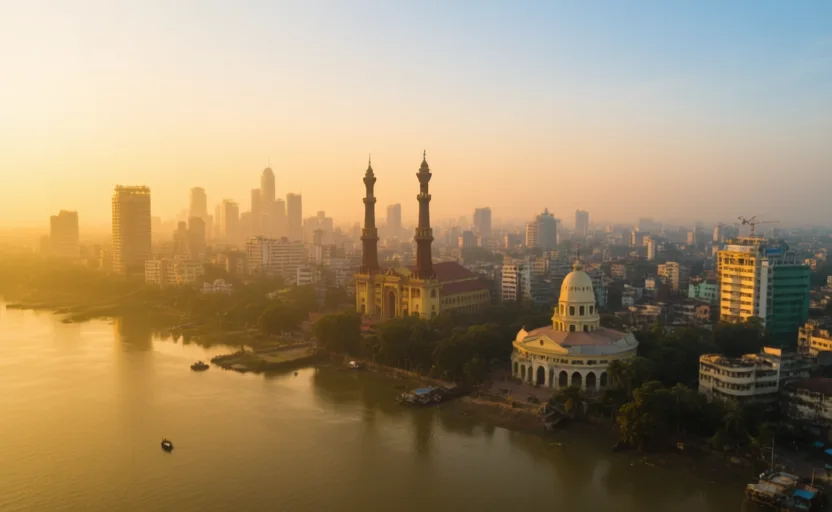 AI city illustration · Artistic impression
What people learn after moving
≈15 million across the metropolitan area; India's third-largest urban agglomeration
Bengali is the state language and the language of the street; English is widely used in professional and academic life; Hindi is common
Indian rupee (INR)
IST (GMT+5:30) — one national time zone, no daylight saving
AI city illustration · Artistic impressionCost of living in Kolkata
Check your eligibility
Pick your passport to see entry rules and the long-stay routes we have researched.
Pick your passport to see whether you can enter India — and what it takes to stay.
India has no nomad or freelance route. Salaried work requires an employer-sponsored employment visa with a minimum annual salary, obtained from your country of residence before travel. The fourteen-day registration clock runs from the arrival stamp. Kolkata's particular feature is that the same office also administers travel permits for the restricted parts of the north-east, which is the part of India most people living here eventually want to visit.
A valid foreign licence with an International Driving Permit covers you for up to a year from arrival or until your visa expires, whichever comes first, after which an Indian licence is required. The stronger advice is that Kolkata is the easiest large Indian city to live in without a car: the metro is India's oldest and now runs beneath the Hooghly, fares are the cheapest of any Indian metro, and the yellow Ambassador taxis and app cabs cover the rest.
PAN first, then the account, then UPI. Which account you may open turns on your residential status under the Foreign Exchange Management Act, a different test from your visa and different again from income tax residence. Someone employed in India is generally FEMA-resident and takes an ordinary resident savings account rather than NRE or NRO. Kolkata's advantage is straightforward: it is the cheapest of India's large metros to live in, so the same salary goes materially further here.
Employer group cover plus a top-up is the standard arrangement, and Kolkata's private hospitals are strong and inexpensive, with a medical tradition running back to the founding of the Calcutta Medical College in 1835. Two local factors deserve planning: the winter air quality, which is among the worst in India after Delhi, and the monsoon disease pattern — dengue in particular, which Kolkata sees at scale every year.
Every Indian SIM requires full identity verification: passport, visa, photographs and local address proof, followed by tele-verification before outgoing calls and data activate. Buy from a company-owned store rather than a kiosk. Kolkata's city coverage is good on all three networks, but eastern India's terrain — the Sundarbans, the hills, the north-east — falls away fast, and that is relevant here because those are the places you will travel to.
You are resident if present 182 days or more in the financial year, or 60 days plus 365 across the preceding four. Most new arrivals then fall into RNOR — Resident but Not Ordinarily Resident — for two or three years, during which foreign income is generally outside Indian scope. The new regime — section 115BAC under the old Income-tax Act 1961, and section 202 of the Income-tax Act 2025 that replaced it on 1 April 2026 — is the default. Kolkata's distinguishing feature is that it is one of the cities India treats as a metro for house rent allowance, which materially strengthens the case for electing the old regime.
Each guide has verified costs, timelines, required documents, and the non-obvious gotchas — sourced from official government pages. Last verified August 2026.
Reading a list isn’t learning it. Globe Quest turns these into a trainer — hear each phrase spoken, drill them with spaced repetition, and get scored as you say them out loud.
The West Bengal Premises Tenancy Act 1997 applies to Kolkata and Howrah and is among the most tenant-protective regimes in India. A landlord cannot evict at will; a suit lies only on specified statutory grounds, and a deceased tenant's dependent family members living with them can succeed to the tenancy for a period. Older tenancies under the 1956 regime are stronger still, with rents frozen decades ago and occupants who cannot practically be moved. This is why so much of north and central Kolkata is architecturally magnificent and physically decaying — the landlord has no rent worth reinvesting. As an incoming tenant on a modern eleven-month agreement you are outside the worst of it, but the law explains the market you are walking into.
If your visa runs beyond 180 days you must register within fourteen days of the arrival stamp. FRRO Kolkata, at 237 A.J.C. Bose Road, has one of the widest jurisdictions of any FRRO in India: West Bengal, Bihar, Jharkhand, Sikkim and six of the eight north-eastern states — Arunachal Pradesh, Manipur, Meghalaya, Mizoram, Nagaland and Tripura. Assam was carved out into a new FRRO at Guwahati in November 2025, so guidance written before then overstates the reach. That still matters, because much of the remaining territory is under Protected Area Permit rules and the office that registers you is also the one you deal with about travelling there.
The Permanent Account Number gates salary, banking and your tax return. Foreign nationals must use Form 49AA — the free instant e-PAN requires an Aadhaar you cannot obtain for six months. Without a PAN, tax is withheld at a substantially higher rate and recovered only by filing.
Under the old tax regime, salaried employees can exempt part of a house rent allowance, and the formula allows 50% of salary in a listed set of cities against 40% everywhere else. For two decades that list was four cities — Delhi, Mumbai, Kolkata and Chennai. The Income-tax Rules 2026, notified on 20 March 2026, widened it to eight from the 2026-27 year by adding Bengaluru, Hyderabad, Pune and Ahmedabad, so Kolkata's advantage is no longer exclusive — but it survives against Jaipur, Kochi, Goa and every other city outside the eight. Combined with the lowest metro rents in India, this makes the old-versus-new regime calculation genuinely different here, and worth modelling on your own numbers rather than accepting the default.
For five days in September or October the city effectively closes: offices shut, roads are blocked for pandals, hotels are full, movers are unavailable and government counters are dark. It is also the single best thing about living here, inscribed by UNESCO in 2021. Find out the dates for your year the moment you arrive and plan your lease, your registration appointments and any travel around them.
Kolkata's summers are hot and very humid, but the measurable problem is November to February, when air quality deteriorates sharply and the city ranks among India's worst after Delhi. If you have asthma, or young children, an air purifier is a reasonable investment and checking the daily index becomes a habit. The rest of the winter is otherwise the most pleasant weather of the year.
TCS, Cognizant, Wipro, Capgemini, IBM, PwC
Sector V at Salt Lake and New Town Rajarhat form eastern India's largest IT cluster, built substantially on cost advantage — Kolkata is materially cheaper to staff than Bengaluru or Pune.
Coal India, Balmer Lawrie, Exide, ITC, Berger Paints
Coal India, the world's largest coal producer, is headquartered here, alongside a nineteenth-century engineering legacy that still anchors a great deal of eastern Indian industry.
Kolkata Tea Auction Centre, Goodricke, Andrew Yule, jute mills along the Hooghly
Darjeeling and Assam tea is traded through Kolkata, and the auction centre is among the world's largest. The Hooghly jute belt remains the biggest jute cluster on earth.
Bandhan Bank, UCO Bank, Allahabad Bank legacy operations, ICRA
Bandhan grew from a Kolkata microfinance institution into a full commercial bank in 2015, one of only two such licences granted, and remains headquartered here.
IIM Calcutta, Indian Statistical Institute, Presidency, Jadavpur, Saha Institute
The Indian Statistical Institute is a globally significant research centre, and College Street holds what is generally described as the world's largest second-hand book market.
Calcutta Leather Complex at Bantala, Sreeleathers, garment clusters
The Bantala leather complex on the eastern fringe is one of the largest planned leather clusters in the world and a major export earner for the state.
Culture · North Kolkata, near Sovabazar
The idol-makers' quarter — narrow lanes of workshops where the Durga images are built from Hooghly clay and straw, generation after generation.
Local tip: Go between August and early October and you will see hundreds of unfinished goddesses in every stage from bamboo frame to painted eyes. The eye-painting is done last, on an auspicious day. Ask before photographing inside a workshop and buy something small if you spend time there.
Culture · Central, near Presidency University
A kilometre of second-hand bookstalls, generally called the largest such market in the world, with a first-floor coffee house that has been the city's arguing room since 1876.
Local tip: The stalls will find a specific title for you if you ask — the apparent chaos is an index only the sellers can read. The Coffee House upstairs is loud, slow and not really about the coffee. Order the infusion and stay two hours; that is the correct use.
Landmark · Central, south of Park Street
A vast white marble memorial from 1921 in a garden at the edge of the Maidan, the enormous open green that runs through the middle of the city.
Local tip: The gallery inside is a serious collection of colonial-era painting and documents that most visitors skip for the exterior. Walk the Maidan at dawn, when the football clubs, the horses and the tea sellers are all out — it is the best free thing in Kolkata.
Food · Under the bridge, west bank approach
A wholesale flower market that runs through the night under the Howrah Bridge cantilever, at its peak between four and eight in the morning.
Local tip: Go at five. Tonnes of marigold and tuberose move through in a few hours and the bridge above carries perhaps the heaviest pedestrian traffic of any bridge on earth. Photography of the bridge itself is officially restricted — photograph the market, not the structure.
Food · Central, near Poddar Court
India's only Chinatown, settled by Hakka migrants from the eighteenth century, now a handful of streets whose Sunday dawn breakfast market is the last of the old trade.
Local tip: It runs from about six to eight on Sunday mornings and then vanishes — momos, pork buns, fish ball soup, sold from baskets on the pavement. The community has shrunk enormously since the 1962 war; going early and buying from the older stallholders is the point.
Landmark · Howrah Maidan to Esplanade
India's first metro, opened in 1984, and since 2024 the first Indian railway to run in a tunnel beneath a river — thirty-two metres under the Hooghly.
Local tip: The Howrah Maidan to Esplanade run takes under a minute under the river and the tunnel section is marked with blue lighting. Howrah Maidan is among the deepest metro stations in India. It costs a few rupees and is a better introduction to the city than any tour.
Side-by-side cost of living, language, climate and careers — to help you choose.