
Population
~2 million city / ~8 million Klang Valley metro
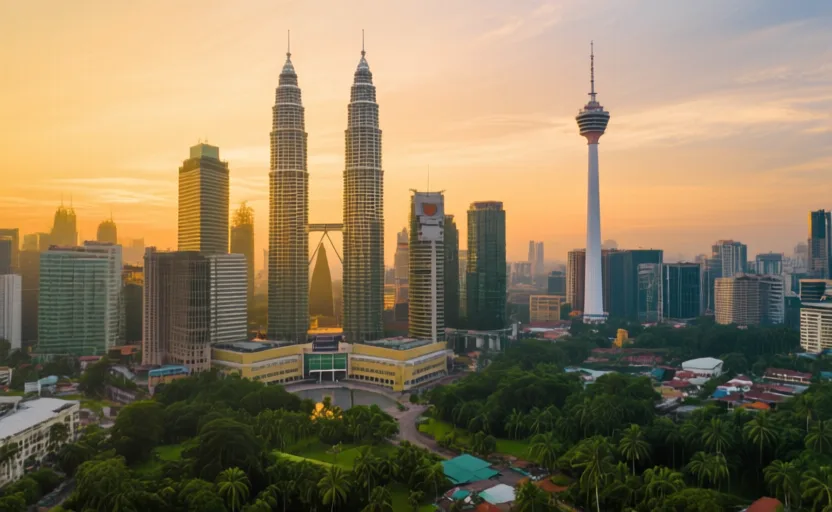 AI city illustration · Artistic impression
What people learn after moving
~2 million city / ~8 million Klang Valley metro
Malay (official), English (widely used), Mandarin, Tamil
Malaysian Ringgit (MYR); approx RM 4.35 = US$1 (2026)
MYT / Malaysia Standard Time (GMT+8), no daylight saving
AI city illustration · Artistic impressionCost of living in Kuala Lumpur
Check your eligibility
Pick your passport to see entry rules and the long-stay routes we have researched.
Pick your passport to see whether you can enter Malaysia — and what it takes to stay.
Malaysia offers the DE Rantau nomad pass (12 months, renewable once; income floor from US$24k/yr for digital and tech roles, higher for non-tech), the MM2H long-stay programme — restructured in 2024 into Silver/Gold/Platinum tiers built on a fixed deposit and a property purchase rather than an income test — the Premium Visa Programme (PVIP) for high-net-worth applicants, and employer-sponsored Employment Passes. A standard 90-day Social Visit Pass (SVP) is visa-free for most Western passports on arrival.
KL drives on the LEFT (like the UK). Grab is the dominant and recommended daily transport; the MRT/LRT rail network covers key corridors. Owning a car removes Grab dependency but adds parking costs and brutal traffic stress. Foreign licences are valid for up to 3 months; after that, an international driving permit (IDP) is recognised until you get a Malaysian licence (a full-test process).
CIMB and Maybank are the two largest Malaysian banks and the most foreigner-experienced. You can open an account in person with your passport and valid visa (DE Rantau approval letter counts). Some banks require a proof of Malaysian address; getting a utility bill or tenancy agreement stamped at LHDN first makes the process smoother. Wise and Revolut work in Malaysia but local MYR accounts unlock cheaper local transfers and avoid conversion fees.
Malaysia has a dual healthcare system. Public hospitals (government hospitals) are heavily subsidised for Malaysians and cheap for foreigners at foreigner rates, but are overburdened and can have long waits. Private hospitals (Pantai, Gleneagles, Prince Court, KPJ) are excellent — often JCI-accredited — and cost-comparable to Western prices. Private health insurance is essential; DE Rantau mandates it (US$50,000 minimum). KL's private healthcare quality is among the best in Southeast Asia.
Malaysia's mobile network is excellent and cheap. The four main operators are Maxis (best coverage overall), Celcom (now merged with Digi into CelcomDigi, strong 5G), U Mobile (aggressive pricing, growing 5G) and unifi Mobile (by TM, fibre-backed). All SIM cards require passport registration; prepaid SIMs are available at the airport for ~RM 30-60 and work immediately. eSIMs are supported by all operators and can be activated before you land.
Malaysia's main residency test is 182 days in a calendar year, though the Income Tax Act 1967 s.7 has three further limbs that can make you resident on fewer days. Tax residents pay graduated income tax on Malaysia-sourced income (0–30%, the 30% band applying above RM 2 million). Foreign-sourced income received in Malaysia became chargeable in principle from 1 January 2022 — but a standing exemption order keeps it tax-free for resident individuals provided it was already taxed in the country where it arose, and Budget 2026 extended that exemption to 31 December 2036. That order, not any nomad-visa carve-out, is what actually keeps most remote workers' foreign income untaxed here. No capital gains tax on financial assets and no inheritance tax; dividends are no longer wholly untaxed — a 2% tax applies to individual dividend income above RM 100,000 from 2025.
Each guide has verified costs, timelines, required documents, and the non-obvious gotchas — sourced from official government pages. Last verified 2026-06-29.
Reading a list isn’t learning it. Globe Quest turns these into a trainer — hear each phrase spoken, drill them with spaced repetition, and get scored as you say them out loud.
KL traffic is among Southeast Asia's worst; a 10 km journey can take 60+ minutes peak-time. The MRT/LRT network is expanding but remains patchy in expat areas like Mont Kiara and Bangsar South. Make sure your daily route — coworking, gym, wherever — is Grab-short or on a rail line, or budget serious time for commutes.
Malaysia's working language in business, signage and services is English; you can live here indefinitely without a word of Malay. But learning basic Manglish particles ('lah', 'mah', 'loh') and a few Malay words ('makan', 'jom', 'boleh') unlocks warmth, humour and much better service at the mamak.
Grab operates across KL for rides, food (GrabFood) and parcels; it's ubiquitous, cheap and cashless. Download it before you land, link a card and you're set. Uber exited Malaysia years ago; Grab is the dominant platform. Taxis exist but are metered and harder to hail; always use Grab.
A hawker meal runs RM 5-12 (US$1.10-2.75); a teh tarik at the mamak is RM 2-3. Mid-range restaurants run RM 30-80 for two. Monthly living costs outside rent (food, transport, activities) can be US$500-900. Electricity can spike if you run air-con 24/7 — typical bills RM 100-400/mo.
KL sits just 3° north of the equator: it's hot (~30-33°C) and humid every single day. Air-conditioning is universal indoors; outdoors you will sweat. Rain falls most afternoons (especially Oct-Jan monsoon); always carry a small umbrella or poncho. Your wardrobe needs to be heat-adapted.
Malaysia uses UK-style three-pin plugs (Type G) at 240V/50Hz. US and European devices need an adapter (and sometimes a converter for 110V gear). Adapters are available everywhere for RM 5-15; most modern electronics and laptop chargers are dual-voltage.
Petronas, Schlumberger, Baker Hughes, Halliburton
Petronas' Twin Towers are KL's skyline icon, and its vast supply-chain and contracting ecosystem employs thousands of international professionals.
Microsoft, IBM, DHL, Accenture, Grab, Axiata
The Multimedia Super Corridor (MSC Malaysia) status draws MNCs to KL; a fast-growing Southeast Asian startup scene is coalescing around Bangsar South and KLCC.
Maybank, CIMB, RHB, Hong Leong, AmBank, Standard Chartered
KL is Malaysia's financial capital and a regional hub; Islamic finance (sukuk) is a global speciality.
Bosch, HP, Shell SSC, Nestle SSC
Dozens of Fortune 500 companies anchor their Asia-Pacific shared-service centres in KL, creating a deep market for accountants, HR and supply-chain professionals.
Intel, Infineon, Renesas (Penang/PJ)
Malaysia is a top-5 global semiconductor exporter; while fabs are mostly in Penang, KL/PJ hosts corporate HQs and engineering divisions.
Shangri-La, Mandarin Oriental, YTL Hotels
KL is a major MICE (meetings, incentives, conferences, exhibitions) destination; hospitality and F&B offer strong entry-level and management roles.
Landmark · KLCC
The world's tallest twin towers until 2004 and still KL's defining icon — observation deck on Level 86 and Sky Bridge on Level 41.
Local tip: Book the observation deck online in advance; it sells out fast. The KLCC park fountains are free and gorgeous at night.
Culture · Batu Caves (30 min north)
A towering Hindu cave-shrine reached via 272 rainbow-painted steps, guarded by Southeast Asia's tallest golden Lord Murugan statue.
Local tip: Go early morning (before 9am) to beat heat and crowds; take the KTM Komuter Batu Caves line (RM 2.40 from KL Sentral). Cover shoulders and knees.
Food · Bukit Bintang
KL's most famous hawker strip — a nightly feast of grilled seafood, satay, dim sum and durian stalls stretching a full city block.
Local tip: Best after 7pm; wander before committing to a table, compare prices, and try the wong fu kee char kway teow.
Nature · Lake Gardens
130 hectares of green lung in the city centre, with a deer park, bird park, butterfly park and orchid garden.
Local tip: The KL Bird Park (one of the world's largest free-flight aviaries) is the must-see here — go first thing before the rain comes.
Culture · Chinatown
KL's historic Chinatown with covered market stalls, kopitiam coffee shops and the Sri Mahamariamman Temple next door.
Local tip: The covered market is touristy for goods but the surrounding alley kopitiams (coffee shops) are the real gem for breakfast dim sum at RM 3-8 per dish.
Nightlife · Chinatown
A renovated 1940s cinema now housing independent markets, galleries, street food, live music and KL's best record shops.
Local tip: Visit on a weekend when the markets are active; it's the creative-class heartbeat that makes KL genuinely interesting beyond malls.
Side-by-side cost of living, language, climate and careers — to help you choose.