
Population
~3 million — the wartime figure moves with displacement and return, so treat any precise number with suspicion
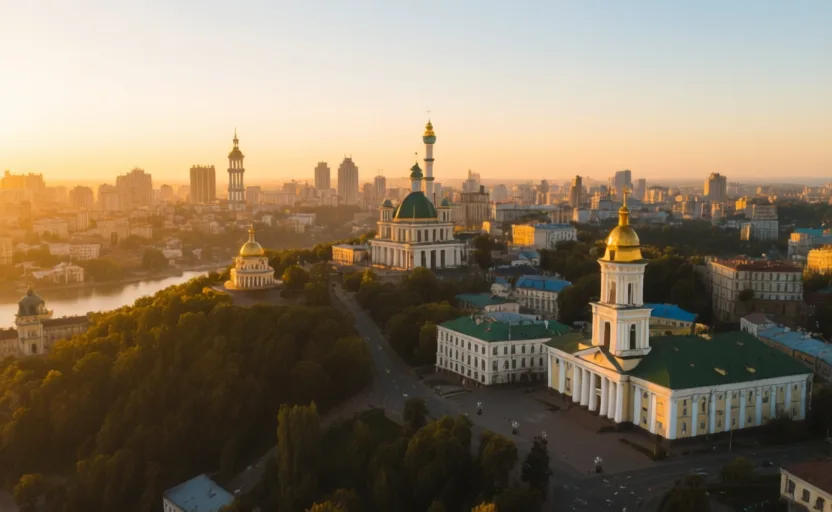 AI city illustration · Artistic impression
What people learn after moving
~3 million — the wartime figure moves with displacement and return, so treat any precise number with suspicion
Ukrainian is the sole state language; Russian is widely understood but has receded sharply from public life since 2022. Good English among under-40s in IT
Ukrainian hryvnia (UAH, ₴) — about ₴44.8 to the US dollar at the NBU official rate, August 2026
EET (GMT+2), EEST (GMT+3) from late March to late October
AI city illustration · Artistic impressionCost of living in Kyiv
Check your eligibility
Pick your passport to see entry rules and the long-stay routes we have researched.
Pick your passport to see whether you can enter Ukraine — and what it takes to stay.
Ukraine has two long-stay documents and they are not steps on one ladder. The TEMPORARY residence permit (посвідка на тимчасове проживання) is the ordinary one: it is issued by the State Migration Service on whichever ground in Article 4 of the Law on the Legal Status of Foreigners applies to you — employment with a work permit, an international technical assistance project, NGO or media work, study, family, or a foreign investment of at least EUR 100,000 — and the ground fixes the validity. PERMANENT residence (ten years) is a different instrument reached only through a prior immigration permit, which you qualify for by category, not by length of stay. Nothing about temporary residence accumulates into permanent residence, and that is the misunderstanding that costs people years. Everything runs under martial law: you arrive overland because the airspace is closed, wartime Cabinet resolutions rather than the ordinary timetable set exchange deadlines, and Russian citizens are excluded by name from the wartime accommodations.
Exchange happens in person at a сервісний центр МВС — an МВС service centre — and Kyiv has several. The head service centre is explicit that this service cannot be done online. You need your identity document, your РНОКПП tax number, the foreign licence with a certified translation, and a confirmation from the issuing country's competent authority or its diplomatic mission in Ukraine that the licence was genuinely issued and that you have not been disqualified. A medical examination is required in every case. Exams are NOT required where the licence was issued by a party to the 1968 Vienna Convention and the document conforms to the requirements; a theory and a practical exam ARE required where it was not, or where the document does not conform. You can go to any territorial service centre regardless of where you are registered.
Ukraine has one of the most advanced retail banking sectors in Europe — monobank is card-only and opened by phone, PrivatBank's Privat24 does in minutes what takes days elsewhere, and card-to-card transfers by phone number are how people split a dinner bill. For a foreign resident the practical path is a passport plus a residence permit plus a РНОКПП tax number; a non-resident individual with no РНОКПП is recorded with nine zeros in its place, which tells you how much easier life is with one. The National Bank has also permitted account opening using the digital passport in Diia. What you must understand before you move money is the wartime FX regime: purchases of foreign currency, cash withdrawals abroad and cross-border card transfers are all capped, and the caps change. The single most useful recent change for a foreign employee is the April 2026 easing that lets non-resident individuals buy and transfer abroad the foreign-currency equivalent of salary and civil-law-contract payments received into their Ukrainian hryvnia accounts on or after 1 May 2026.
Ukraine funds healthcare through the Programme of Medical Guarantees, administered by the National Health Service of Ukraine (НСЗУ), which pays contracted providers directly at national tariffs. Access to it is defined by the Law on State Financial Guarantees of Medical Services (No. 2168-VIII), and the insured population is citizens of Ukraine, foreigners and stateless persons PERMANENTLY RESIDING in Ukraine, and recognised refugees and persons needing complementary protection. A temporary residence permit is not permanent residence, which is why medical insurance is a listed condition of that permit in the first place. The practical shape for most newcomers is therefore: private or international insurance as the primary cover, a private clinic in Kyiv for anything routine, and 103 or 112 for anything acute — emergency care is provided to everyone. If you do hold permanent residence, sign a declaration with a family doctor: it is free, it is what opens the primary-care part of the programme, and it is done in person at the practice.
Three operators cover the country: Kyivstar, Vodafone Ukraine and lifecell. You can buy a prepaid SIM at a kiosk, a supermarket or an operator shop and use it immediately without producing a document, which surprises people arriving from Türkiye, the Gulf or most of the EU. What the operators offer instead is voluntary REGISTRATION or 'personification' — linking the number to your identity document through the shop, the app, Diia or BankID. Register, because an unregistered number cannot be recovered if the SIM is lost or the phone is stolen, cannot be ported, and is not accepted for the identity-linked services you will eventually want. Kyivstar caps registrations at ten numbers per document. Coverage in Kyiv is good, 4G is universal, and the constraint on connectivity is not the network but the power: base stations run on batteries and generators during outages and degrade as the outage lengthens, which is why Starlink terminals sit in so many Kyiv offices and cafés.
Two things to get right. First, the РНОКПП — the taxpayer registration number, still universally called the identification code — is the single most load-bearing number in Ukrainian life after your permit. Foreigners apply to the regional State Tax Service; a foreigner holding a temporary or permanent residence permit registers at the tax inspection covering the address on that permit. Second, the rates: employment income is taxed at 18% personal income tax plus a 5% military levy. The levy was 1.5% until Law No. 4015-IX of 10 October 2024 raised it to 5% with effect from 1 December 2024 — a change that is still routinely misreported, and it is the difference between a 19.5% and a 23% deduction from a Kyiv salary. Employers withhold both. Ukraine also runs a simplified single-tax regime for individual entrepreneurs (ФОП) that a great many IT contractors use, and the separate Diia City regime for registered IT companies and their specialists.
Each guide has verified costs, timelines, required documents, and the non-obvious gotchas — sourced from official government pages. Last verified August 2026.
Reading a list isn’t learning it. Globe Quest turns these into a trainer — hear each phrase spoken, drill them with spaced repetition, and get scored as you say them out loud.
Kyiv is under regular missile and drone attack and the alert is the organising fact of daily life. Install Повітряна тривога (Air Alert) and Kyiv Digital before arrival; both push a notification the moment the oblast goes under alert and again at the відбій. When an alert sounds the safest place is a metro station — Kyiv's are deep and open as shelters — or an underground car park. If you cannot get to one, the rule everyone here uses is two walls between you and the outside: an interior corridor or bathroom with no window. Learn where the shelter nearest your flat and your office is on day one, not during the first alert.
Under martial law Kyiv runs a curfew from 00:00 to 05:00. Bars and restaurants shut in time for staff and customers to get home, the metro closes early, and taxis surge in the last half hour. Moving during curfew without a pass gets you stopped and taken to a police station until morning. Carry your passport and residence permit at all times — document checks are routine and having nothing on you turns a two-minute stop into a long one.
Kyiv's fare had been ₴8 since 2018. On 15 July 2026 a single ride on the metro, bus, tram, trolleybus and funicular went to ₴30. Packages and monthly passes bought in the Kyiv Digital app bring the effective price back to roughly ₴23 a ride, so anyone commuting daily should never be paying the single fare. Kyiv Digital is also how you get alerts, shelter maps and utility payments — it is the one app to install first.
Strikes on the grid mean scheduled outages by queue, published a day ahead. Ask your landlord which черга the building is in and whether there is a generator or an inverter before you sign anything — it matters more than the view. Buy a large power bank and a charging station, keep a head torch by the door, and note that most Kyiv cafés advertise 'є світло' (there's power) and free wifi through outages, which is why so much of the city works from them. Lifts stopping is the practical risk of a high floor, not the dark.
Ukrainian is the sole state language and since 2022 the shift in Kyiv has been decisive: people who spoke Russian at home now conduct public life in Ukrainian, service staff answer in Ukrainian, and the law requires it in service provision. Russian is still widely understood and nobody will refuse to serve you, but opening in it as a foreigner reads as a choice rather than a convenience. Younger Kyivans speak good English. Fifty words of Ukrainian will buy you more goodwill here than fluent Russian.
Contactless is everywhere, monobank and Privat24 do in seconds what takes a week elsewhere, and card-to-card transfers by phone number are the normal way to split a bill. But a blackout takes down terminals and ATMs together, so keep two or three thousand hryvnia in small notes at home. Note also that the National Bank's wartime rules cap what you can move abroad from a hryvnia card — currently the equivalent of ₴30,000 a month in card-to-card transfers out of the country — so plan international money movement through your bank rather than your phone.
EPAM, SoftServe, GlobalLogic, Ciklum, Luxoft, Genesis, MacPaw, Grammarly's Kyiv office
Ukraine's biggest export sector after agriculture and the reason most foreign professionals are here. The Diia City regime (Law No. 1667-IX, 2021) gives registered IT companies a distinct tax and labour framework, and Kyiv holds the bulk of its residents.
The Brave1 cluster, a dense drone and electronic-warfare startup scene, Ukrainian Armor
The fastest-growing sector in the country and the one that did not exist at this scale in 2021. Brave1 is the state-backed defence-tech cluster; hundreds of small manufacturers now sit around it. Export controls and security clearance make hiring foreigners genuinely complicated here.
Kernel, MHP, Astarta, Nibulon (Kyiv head offices)
The grain, sunflower oil and poultry businesses that make Ukraine a top-five world exporter run their head offices, trading desks and agritech arms from Kyiv, even though the assets sit in the oblasts.
monobank, PrivatBank, Raiffeisen Bank Ukraine, Oschadbank, the National Bank of Ukraine
Ukraine's retail banking is unusually advanced — monobank is a card-only bank with millions of users — and the NBU's wartime capital controls make treasury and compliance work a live speciality rather than a back-office one.
EBRD, IFC, UN agencies, the Red Cross movement, large international NGOs
The largest concentration of internationally-hired staff in the country. Most are on international technical assistance or NGO employment residence grounds rather than ordinary work permits, and the NGO salary floor for a work permit is half the standard one.
Suspilne (public broadcaster), a large documentary and post-production scene, design studios
Accredited foreign correspondents get a residence treatment nobody else does — during martial law and for 30 days after, they are not subject to the ordinary limits on temporary stay.
Landmark · Sofiivska Square, Shevchenkivskyi
An eleventh-century cathedral whose baroque exterior hides the largest surviving ensemble of Byzantine mosaics and frescoes anywhere from that period, inscribed by UNESCO in 1990 and sandbagged since 2022.
Local tip: Pay the separate ticket for the bell tower. The view down Volodymyrska to St Michael's golden domes is the one photograph of Kyiv worth taking, and the interior mosaics are best in late-afternoon light.
Culture · Pecherskyi
The Monastery of the Caves — a walled hilltop complex of gold-domed churches above the Dnipro, founded in 1051, with kilometres of burial catacombs cut into the slope below. Also UNESCO-listed, and the subject of an ongoing dispute over which church administers it.
Local tip: Buy a beeswax candle at the entrance to the Near Caves; it is the only light down there and the queue moves in near silence. Women are expected to cover their heads. Give it three hours, not one.
Neighborhood · Podilskyi, on the river flats
The old river-trade quarter below the hills: low nineteenth-century streets, Kontraktova Square, the funicular up to St Andrew's, and the densest concentration of independent coffee, natural wine and small bars in the city.
Local tip: Go on a weekday evening around Frunze/Kyrylivska and Nyzhnyi Val. This is where Kyiv's creative and IT crowd actually drinks, and it empties for curfew rather than fading out — order the last round by 22:30.
Nature · Above the Dnipro, Shevchenkivskyi
A park on the escarpment with the 1853 monument to Volodymyr the Great, joined to Khreshchatyi Park by a glass-floored footbridge with a 100-metre drop below it and the whole left bank ahead.
Local tip: Come at sunset and walk down through the park to the river rather than back to the metro — the paths drop through the trees to the Dnipro embankment and it is the best half-hour walk in the city.
Food · Bessarabska Square, end of Khreshchatyi
A 1912 covered market hall at the top of the main street — pickle stalls, sour cream by weight, mountains of berries in July, black caviar in the corner and butchers who will tell you exactly what to do with what you are buying.
Local tip: It is not the cheapest market in Kyiv and locals know it. Come for the pickled vegetables, the honey and the sheer theatre, then buy your week's groceries at Silpo or a Novus. Taste before you buy — you are expected to.
Landmark · Pecherskyi, Sviatoshynsko-Brovarska line
The deepest metro station in the world at 105.5 metres, built into the escarpment in 1960 — two long escalators with an intermediate hall between them, and the better part of five minutes underground before you reach the platform.
Local tip: Ride it once for its own sake, then remember it: Kyiv's deep stations are the city's primary air-raid shelters, and the deepest ones are where people go when the alert is for ballistic missiles rather than drones.
Side-by-side cost of living, language, climate and careers — to help you choose.