
Population
≈1.4 million in the city — a working city, not a museum, despite the visitor numbers
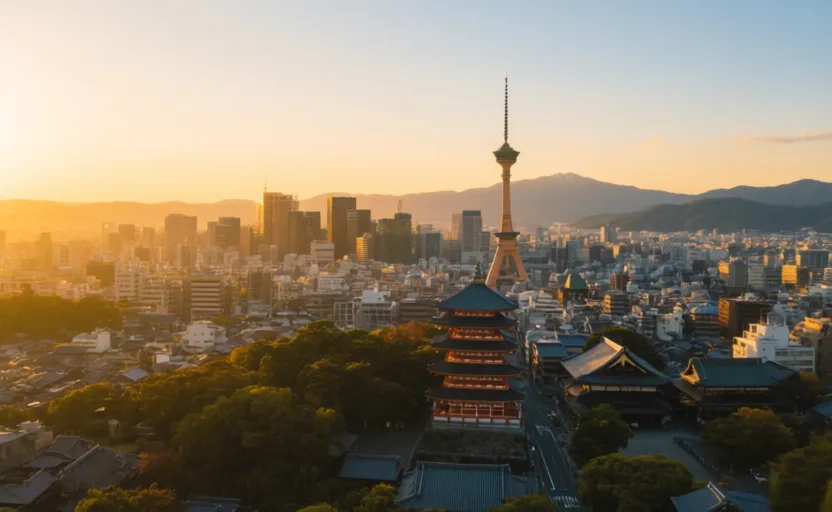 AI city illustration · Artistic impression
What people learn after moving
≈1.4 million in the city — a working city, not a museum, despite the visitor numbers
Japanese, in a Kyoto dialect noted for indirectness and softness. English is more available than in most Japanese cities because of tourism, less so in administration
Japanese yen (JPY)
JST (GMT+9) — Japan does not observe daylight saving
AI city illustration · Artistic impressionCost of living in Kyoto
Check your eligibility
Pick your passport to see entry rules and the long-stay routes we have researched.
Pick your passport to see whether you can enter Japan — and what it takes to stay.
Japan issues your residence card at the airport on arrival, but the card alone is not enough. You must register your address at your ward office within fourteen days, which produces the jūminhyō certificate, triggers your My Number, and unlocks health insurance, banking and phone contracts. Kyoto's large student and researcher population means the university offices are unusually good at guiding people through this — use them if you have access.
Converting a foreign licence — gaimen kirikae — requires a knowledge check and, for most countries, a practical test on a closed course. A defined list of countries is exempt from the practical test. The rules tightened nationally on 1 October 2025: a jūminhyō is now compulsory for every applicant, so short-stay visitors are shut out of the route entirely, and the knowledge check went from ten questions at 70% to fifty questions at 90%. Registering a car requires proving you have an off-street parking space. In practice Kyoto is a flat grid city of 1.4 million where the bicycle is the dominant private vehicle, and the rules around parking bicycles are stricter than newcomers expect.
Japanese banks vary enormously in how they treat new foreign residents, and several major banks effectively require six months of residence before opening a full account. Japan Post Bank and the online banks are the usual first stop because they do not. You need ward registration first. Kyoto Bank and the local shinkin credit unions are also worth knowing about, particularly if your employer or university banks with them.
Enrolment is a legal obligation, not a choice. Once enrolled you pay 30% of most treatment costs at the point of care, with a monthly ceiling that caps catastrophic expense. Pension enrolment is equally compulsory, and if you leave Japan you can claim a lump-sum withdrawal of part of what you paid. Kyoto's student and researcher population means a large share of residents are on the municipal scheme rather than an employer one.
Japanese mobile was historically expensive and dominated by three carriers. Government pressure changed that, and low-cost sub-brands and MVNOs now offer genuinely cheap plans on the same networks. You need a residence card and usually a Japanese bank account or credit card. Home fibre is fast and cheap, but in Kyoto's older housing and machiya stock, installation is genuinely constrained by the building.
Most employees never file a return — the employer's year-end adjustment handles it. The two things that catch foreign residents are residence tax, calculated on last year's income and billed from the following June, and the distinction between non-permanent and permanent tax residence, which determines whether Japan taxes your foreign income at all. Kyoto also levies its own accommodation tax, which was raised sharply from 2026 and is worth understanding if you ever let a room.
Each guide has verified costs, timelines, required documents, and the non-obvious gotchas — sourced from official government pages. Last verified August 2026.
Reading a list isn’t learning it. Globe Quest turns these into a trainer — hear each phrase spoken, drill them with spaced repetition, and get scored as you say them out loud.
Japanese law requires you to register your address at the local ward office within fourteen days of moving in. That registration produces the jūminhyō residence certificate and triggers your My Number, and without it you cannot enrol in health insurance, open most bank accounts, or complete a phone contract. Kyoto has eleven wards and you must go to the right one. It is a short in-person appointment with your residence card and passport.
The standard Japanese package is a deposit (shikikin), key money (reikin — a non-refundable gift to the landlord), an agency fee, a guarantor company fee, fire insurance and the first month's rent. Kyoto's large student population means plenty of small cheap stock, but key money remains common here and the total entry cost is the thing to budget for rather than the monthly rent.
Jūminzei is calculated on your previous calendar year's income and billed from the following June. Your first year feels cheap and your second is expensive, and if you leave Japan you can still owe a full year's residence tax on income you have already spent. Settle it or appoint a tax representative before departing — this is the most common financial shock among people finishing a stint in Japan.
Kyoto receives visitor numbers many multiples of its resident population, concentrated on a handful of sites and the bus routes serving them. Residents structure their days around it: avoiding certain buses entirely, shopping outside the central corridors, and treating Arashiyama and Fushimi Inari as early-morning-only propositions. The city has responded with express tourist bus routes, a sharply raised lodging tax from 2026, and photography bans on private alleys in Gion. As a resident you adapt quickly, but the first month is a genuine adjustment.
Nintendo, Kyocera, Murata, Omron, Shimadzu, Rohm and Horiba are all headquartered here, and Kyoto University is Japan's second most prestigious with the country's strongest record of Nobel laureates outside Tokyo. The local corporate culture is famously independent of Tokyo's. If you have a technical background, the real job market here is much larger than the tourism economy suggests.
Kyoto sits in a bowl ringed by mountains on three sides, which traps humid air in summer and cold air in winter. August is hotter and more oppressive than Tokyo or Osaka, and January is colder — in a housing stock with almost no insulation and no central heating. Choose a flat for its heating and its aspect, not for the view of the mountains that cause the problem.
Kyocera, Murata Manufacturing, Rohm, Nidec, Omron
An extraordinary concentration of globally dominant component makers for a city this size — Murata and Nidec in particular hold commanding shares of markets most people have never heard of.
Nintendo, Q Games, Vanillaware, Skeleton Crew Studio
Nintendo has been headquartered in Kyoto since 1889, when it made playing cards, and remains one of the city's largest and most famous employers.
Shimadzu, Horiba, Nihon Kohden
Shimadzu was founded here in 1875 and one of its engineers won a Nobel Prize in Chemistry in 2002 — a case of the city's research and industry overlapping directly.
Kyoto University, Doshisha, Ritsumeikan, iPS Cell Research Institute
Kyoto University's CiRA institute is the world centre for induced pluripotent stem cell research, led by the Nobel laureate whose work created the field.
Nishijin weaving workshops, Kyo-yuzen dyers, ceramics and lacquer ateliers
Nishijin has produced silk textiles for over a millennium, and the surviving craft workshops remain economically significant as well as culturally central.
Hotel groups, temple and shrine organisations, ryokan operators
Enormous in scale and increasingly contested locally, with the city raising its lodging tax sharply from 2026 to have visitors fund the infrastructure they use.
Landmark · South-east, on the Keihan and JR lines
Thousands of vermilion torii gates climbing a wooded mountain behind the shrine, open around the clock and free.
Local tip: The crowds thin dramatically after the Yotsutsuji junction about halfway up, and almost nobody completes the full mountain loop. Go at six in the morning or after nine at night — it is lit, it is open, and you will have the upper mountain to yourself.
Nature · Eastern hills
A canal-side walk under cherry trees linking Ginkaku-ji to Nanzen-ji, with temples and small shrines strung along the hillside above.
Local tip: The path itself is famous and busy. The temples immediately uphill from it — Honen-in, Anraku-ji — are minutes away, charge little or nothing, and are usually almost empty.
Food · Central, north of Shijo
A narrow covered market street that has supplied Kyoto's kitchens for centuries, running into the covered shopping arcades.
Local tip: Nishiki's western end still serves restaurants and households; the eastern end is now largely street food for visitors. The proper Kyoto grocery shopping happens at Nishiki's west end and in the depachika food halls under the department stores at Shijo-Karasuma.
Nature · Western edge of the city
A riverside district beneath wooded hills, with the bamboo grove, the Togetsukyo bridge and a chain of temples.
Local tip: The bamboo grove is genuinely impassable by mid-morning. Arrive before seven or skip it entirely and walk north to Gio-ji and Adashino Nenbutsu-ji instead — moss gardens and stone Buddhas at the quiet end of the same valley.
Nature · Running north–south through the city
Grassed embankments along the river that function as the city's living room — running, picnics, students, musicians and evening drinking.
Local tip: The stretch between Sanjo and Shijo is where everyone gathers, and the couples famously space themselves at even intervals along the bank. North of Demachiyanagi, where the two rivers meet at a delta with stepping stones, is where families go and where you should.
Nature · Northern mountains, an hour by bus or train
Two mountain villages in the hills north of the city, with terraced temples, a river gorge and a hot spring at the end of a walking trail.
Local tip: The walk from Kurama over the mountain to Kibune takes about ninety minutes through cedar forest, and there is an onsen at the Kurama end. Almost no visitors go this far north, and in autumn it is better than anything in the city centre.
Side-by-side cost of living, language, climate and careers — to help you choose.