
Population
≈105,000 in the municipality — and a university that registered over 64,000 students across all its campuses for 2025–26, a large share of them here
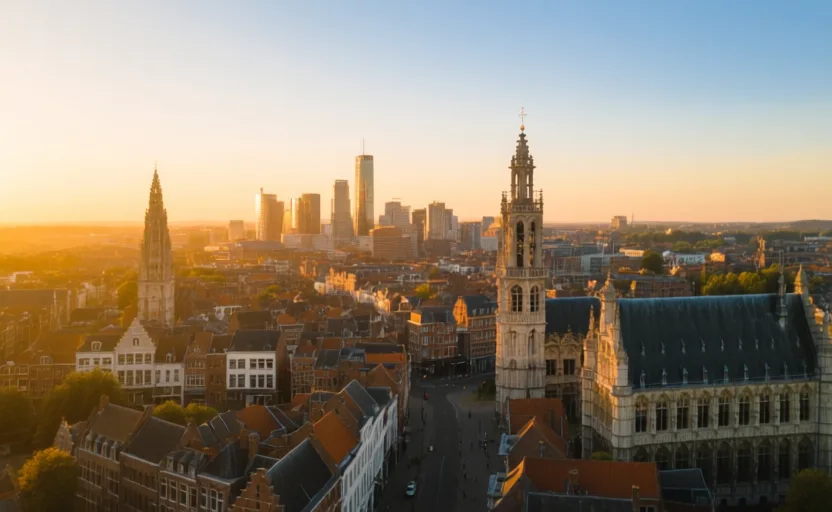 AI city illustration · Artistic impression
What people learn after moving
≈105,000 in the municipality — and a university that registered over 64,000 students across all its campuses for 2025–26, a large share of them here
Dutch. English is exceptionally widely spoken for a Flemish city of this size because of the university and imec, but it is not the administrative language
Euro (EUR)
CET (GMT+1), CEST (GMT+2) from late March to late October
AI city illustration · Artistic impressionCost of living in Leuven
Check your eligibility
Pick your passport to see entry rules and the long-stay routes we have researched.
Pick your passport to see whether you can enter Belgium — and what it takes to stay.
One permit, three levels of government. Your employer lodges a single permit with the Flemish government, which decides the work half against Flemish salary floors and a Flemish migration list, while the Immigration Office decides the residence half. On arrival you report to the city, receive a Bijlage 15, and wait for a neighbourhood police officer to verify you live at the address. Most non-EU newcomers then pick up a compulsory civic integration obligation, which since September 2023 the newcomer part-pays for. In a city this research-heavy the first question is often which route applies at all — an employment permit, or a hosting agreement with an approved research institution.
EU and EEA licences remain valid and can be exchanged at the city. A non-EU licence can only be exchanged if the issuing country is on the FPS Mobility recognition list, and you have roughly 185 days from registration to do it — after that, the Belgian theory and practical exams. Driving here is then shaped by a 2016 circulation plan that removed through traffic from the centre and by a rail position most Belgian cities would envy: Brussels in about twenty-five minutes and Brussels Airport in around a quarter of an hour. There is no emission zone, so an older vehicle is legal here and not in Brussels.
Belgian banks want your national register number and an eID, which puts the city registration first in the queue. Most Belgian current accounts carry an annual fee, which surprises arrivals from free-banking markets — though in a city this student-heavy the free packages are real and worth asking for. The thing that actually determines how painless your first months are is itsme, the national digital identity app that unlocks tax filing, government portals and bank logins.
Belgian healthcare is fast and good, and works by reimbursement rather than free-at-point-of-use: you pay the doctor and get most of it back, usually automatically within days. Cover is compulsory but enrolment is not automatic — you choose a ziekenfonds and join. Two decisions then set what you actually pay: registering a global medical file with one GP, and checking whether the doctors you see have signed the national fee agreement. Leuven's advantage is UZ Leuven, one of the largest hospitals in the country, with the teaching faculty behind it.
Every SIM in Belgium, prepaid included, must be registered to an identified person under the 2017 anti-terrorism rules. Mobile pricing is high by EU standards and the smaller operators reselling on the same networks are dramatically cheaper. For fixed internet, Leuven is largely served by the Flemish coax network alongside Proximus copper, with fibre arriving street by street — and in a city of shared student houses, whose name the connection is in matters as much as which technology it uses.
Belgium taxes employment income about as heavily as any country in the OECD: four brackets rising to 50%, employee social security of 13.07% off the top, and a communal surcharge on the tax you owe — 6.7% in Leuven for assessment year 2026. The single most valuable thing to know here is the inbound researcher regime, which carries the same tax-free expense allowance as the executive version with no minimum salary condition at all — and which, in a city built on a university, a teaching hospital and a research institute, a very large number of arrivals qualify for and never hear about.
Each guide has verified costs, timelines, required documents, and the non-obvious gotchas — sourced from official government pages. Last verified August 2026.
Reading a list isn’t learning it. Globe Quest turns these into a trainer — hear each phrase spoken, drill them with spaced repetition, and get scored as you say them out loud.
Flanders has two instruments and Leuven uses both heavily. A main-residence lease runs nine years, lets you leave on three months' notice with a diminishing indemnity, and carries a deposit of up to three months in a blocked account. A student lease is a separate title of the same decree: it runs a fixed term, has its own notice and sub-letting rules, and caps the deposit at two months. Handing over three months on a student lease is handing over a month you did not owe. And a student lease is not the route to a registered main residence, which is what you need for an eID and a national register number — so a working newcomer who takes a kot because it is what is available has a problem to solve, not a home.
Belgium's single permit is decided by the region where the job sits, so a Leuven job is judged by Flanders. The floors are annual: €48,912 gross for a highly skilled worker, €39,129.60 for under-30s on a local contract, €78,259 for management, and €63,586 for an EU Blue Card, set at 130% of the average gross annual salary. From 1 January 2026 level-2 low-skilled roles no longer qualify at all, the mid-skilled migration list lost functions, level 3–4 roles need a VDAB vacancy published for nine weeks first, and diploma authenticity can be demanded. Flanders also charges a non-refundable €180 regional retribution on applications lodged from 1 September 2026 and will not begin processing until it is paid. Note that a research post may instead run on a hosting agreement rather than a work permit — establish which route your institution is using before assuming the salary floor applies to you.
Third-country nationals on a long-stay visa must report to the city within eight working days of arriving. You receive a Bijlage 15, and a wijkagent then calls at the address to confirm you live there. Until that report is positive there is no national register number, and without the number there is no eID, no bank account, no ziekenfonds and no phone contract. Put your name on the letterbox and the doorbell the day you get the keys. In a house divided into kots, make sure your name is on the right bell — a wijkagent who cannot identify which room is yours is a failed check.
Non-EU newcomers aged eighteen or over with a permit of more than three months, registered in a Flemish municipality, must follow the inburgering path: social orientation, Dutch, individual guidance towards work and diploma evaluation, with 80% attendance across each part. Since September 2023 the newcomer pays €180 for the social orientation classes and first test and €180 for the Dutch classes and first test, with retakes and books extra. Twenty-five minutes down the line in Brussels, the identical programme is free. Unlike Antwerp and Ghent, which run their own agencies, Leuven is served by the regional Agentschap Integratie en Inburgering.
For assessment year 2026 Leuven charges 6.7% on top of the income tax you already owe, against 7.0% in Antwerp, 6.9% in Bruges, 6.5% in Ghent, 4.9% in the City of Brussels and 8.0% in Liège, with the national FPS Finance table running from 0% in Knokke-Heist to 9.0% in Mesen. Separately, and unlike Antwerp and Ghent, Leuven operates no low emission zone — so an older diesel that would need a paid pass in Ghent and is barred from Brussels can be kept here. The constraint in the centre is the 2016 circulation plan and paid parking, not emissions.
Ghent made a conformiteitsattest compulsory before any new lease on a home over thirty years old. Leuven has not: the certificate exists, it is valid for ten years, and the city publishes a fee schedule for it — €133 for a self-contained dwelling and €27 for a room in 2026, waived where a landlord requests it voluntarily — but no ordinance forces a landlord to hold one. What Leuven runs instead is the kotlabel for student housing, awarded after a city inspection covering safety, fire, occupancy limits, gas and electrical certificates and planning compliance, and displayed as a QR sticker. The previous green labels ceased to be valid on 1 January 2025, so check the sticker is current rather than assuming any sticker will do.
KU Leuven, UZ Leuven, LRD (Leuven Research & Development)
The university marked six hundred years in 2025 and registered over 64,000 students across its campuses for 2025–26, about a quarter of them from outside Belgium; the teaching hospital alongside it is one of the largest in the country, and between them they are far and away the region's biggest employer.
imec and the cluster of chip, sensor and photonics companies around it
imec is headquartered in Leuven and describes itself as the world's largest independent research and innovation centre for nanoelectronics and digital technology, with 6,500 scientists and engineers from over a hundred countries — an unusual thing for a city of this size to contain, and the reason the local English-language technical job market exists at all.
AB InBev, and the brewing supply chain around it
The world's largest brewer runs its global headquarters from Leuven, on the site of a brewing tradition the company traces to the Den Hoorn brewery of 1366 — which is why a city of 105,000 has a genuinely global corporate head office in it.
University spin-offs, the Leuven and Haasrode research parks, clinical research groups at UZ Leuven
The combination of a very large teaching hospital, a research university with an active technology transfer office and a science park within cycling distance produces a steady flow of spin-outs — most small, several that have grown very large.
University and imec spin-offs, venture funds attached to both, and the Vaartkom creative district
Leuven was named European Capital of Innovation in 2020, and what the label actually describes is a small city where the research institutions, the funds and the companies are all within a twenty-minute cycle of each other.
City of Leuven, Province of Flemish Brabant, the courts, and the regional services around them
Leuven is the provincial capital of Flemish Brabant, which puts the provincial administration and the judicial district here — a steady Dutch-language public-sector employment base beside the international research economy.
Landmark · Centre
A late-Gothic town hall built between 1448 and 1469 and encrusted with statues, standing across from a church that never got the towers it was designed for.
Local tip: The statues on the façade are nineteenth-century additions filling niches that stood empty for four centuries — which is why the building looks more medieval than it originally did. Sint-Pieterskerk opposite holds Dirk Bouts' Last Supper in the room it was painted for, and is quiet at almost any hour.
Nightlife · Centre, one street from the Grote Markt
A single rectangular square with bars along every side of it, universally advertised as the longest bar in Europe.
Local tip: It genuinely is one continuous run of terraces, and it fills from about ten rather than eight. Term time and holidays are two completely different squares — in August you can hear yourself think, and in November you cannot. If you are viewing a flat nearby, view it on a Thursday night.
Culture · South of the centre, on the Dijle
A walled village of brick houses, bridges and courtyards inside the city, inscribed by UNESCO as part of the Flemish Béguinages.
Local tip: The university bought it in the 1960s, restored it over decades and uses it as housing for students and visiting academics — so unlike most heritage sites it is fully inhabited, and you can walk through it at any hour because people live there. Getting a room in it is a genuine perk of an academic post here.
Landmark · Ladeuzeplein
A 1920s neo-Renaissance library rebuilt after being burned in 1914 and burned again in 1940, with a carillon tower you can climb.
Local tip: The building is a monument to two destructions: it was funded largely by American donors after the first fire and gutted again a quarter-century later. Climb the tower for the view over the roofs, and look at the balustrade inscriptions on the way up — the whole façade is an argument about the twentieth century. Jan Fabre's giant beetle pierced by a needle sits on the square below.
Food · The old canal dock, north of the centre
The industrial dock district around the original Stella Artois brewhouse, now a creative quarter of offices, bars and food halls.
Local tip: De Hoorn is the old brewery building itself, repurposed rather than demolished, and the surrounding Vaartkom is where the city has put its new housing and its evening economy that is not student-driven. It is a ten-minute walk from the Grote Markt and a completely different city — this is where locals in their thirties go.
Nature · Kapucijnenvoer, west of the centre
Belgium's oldest botanical garden, laid out in 1738 as a physic garden for the university's medical faculty.
Local tip: It is small, free, walled and almost always empty, which for a garden nearly three centuries old in the middle of a busy city is remarkable. The greenhouses are open in the afternoons. Students revising sit here in June and nobody else seems to know it exists.
Side-by-side cost of living, language, climate and careers — to help you choose.