
Population
≈197,000 in the commune of Liège — the largest city in Wallonia — set in an agglomeration of many separate communes including Seraing, Herstal and Ans
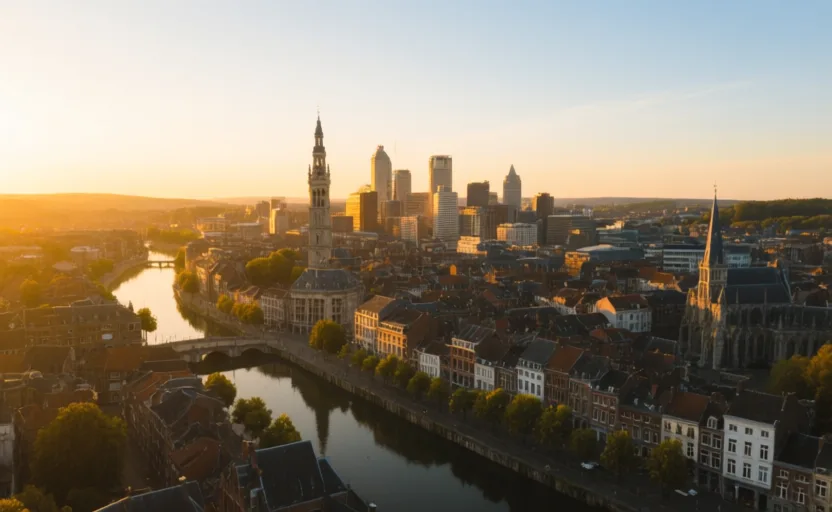 AI city illustration · Artistic impression
What people learn after moving
≈197,000 in the commune of Liège — the largest city in Wallonia — set in an agglomeration of many separate communes including Seraing, Herstal and Ans
French. Walloon survives in expressions, place names and the August festivities rather than as a daily language. English is markedly less widespread than in the Flemish cities
Euro (EUR)
CET (GMT+1), CEST (GMT+2) from late March to late October
AI city illustration · Artistic impressionCost of living in Liège
Check your eligibility
Pick your passport to see entry rules and the long-stay routes we have researched.
Pick your passport to see whether you can enter Belgium — and what it takes to stay.
One permit, three levels of government. Your employer lodges a single permit with the Walloon region, which decides the work half against Walloon salary floors, while the Immigration Office decides the residence half. On arrival you report to your commune, receive an Annexe 15, and wait for a neighbourhood officer to verify you live at the address. Most non-EU newcomers then pick up Wallonia's compulsory parcours d'intégration — four modules, at least 400 hours of French, at least 60 hours of citizenship training, eighteen months to complete, and free.
EU and EEA licences remain valid and can be exchanged at your commune. A non-EU licence can only be exchanged if the issuing country is on the FPS Mobility recognition list, and you have roughly 185 days from registration to do it — after that, the Belgian theory and practical exams. Driving here is then unusually unconstrained by Belgian standards: Wallonia repealed its regional low emission zone in April 2024 and no Walloon commune has introduced one. What has changed the city instead is public transport — a tram line opened in April 2025, the first in Liège since 1967.
Belgian banks want your national register number and an eID, which puts the commune registration first in the queue. Most Belgian current accounts carry an annual fee, which surprises arrivals from free-banking markets. The thing that actually determines how painless your first months are is itsme, the national digital identity app that unlocks tax filing, government portals and bank logins — and which normally needs a Belgian eID or a Belgian bank card to activate.
Belgian healthcare is fast and good, and works by reimbursement rather than free-at-point-of-use: you pay the doctor and get most of it back, usually automatically within days. Cover is compulsory but enrolment is not automatic — you choose a mutuelle and join. Two decisions then set what you actually pay: registering a global medical file with one GP, and checking whether the doctors you see have signed the national fee agreement. Liège is well provided for, with a large university hospital and a teaching faculty behind it.
Every SIM in Belgium, prepaid included, must be registered to an identified person under the 2017 anti-terrorism rules. Mobile pricing is high by EU standards and the smaller operators reselling on the same networks are dramatically cheaper. For fixed internet, Wallonia's cable network grew up separately from Flanders' and has since been taken over, so the brand on your neighbour's bill may not be the brand selling today — what matters is what is physically in the building.
Belgium taxes employment income about as heavily as any country in the OECD: four brackets rising to 50%, employee social security of 13.07% off the top, and a communal surcharge on the tax you owe — 8.0% in Liège for assessment year 2026, the highest of Belgium's major cities. Because the agglomeration is a patchwork of separate communes, the rate you actually pay is decided by which town hall holds your registration on 1 January, not by which city you say you live in.
Each guide has verified costs, timelines, required documents, and the non-obvious gotchas — sourced from official government pages. Last verified August 2026.
Reading a list isn’t learning it. Globe Quest turns these into a trainer — hear each phrase spoken, drill them with spaced repetition, and get scored as you say them out loud.
Belgium's single permit is decided by the region where the job sits, and everyone assumes the poorer region asks for less. It asks for more. For 2026 Wallonia requires €53,220 gross a year for a highly qualified worker against Flanders' €48,912; €42,576 for an under-30 against €39,129.60; €88,790 for a management post against €78,259; and €68,815 for an EU Blue Card against €63,586. There are separate figures for intra-corporate transferees — €68,815 for a manager, €55,053 for a specialist, €34,408 for a trainee — and €44,396 for an artist. All of them sit on top of the guaranteed minimum monthly wage, which is €2,189.81 gross from 1 April 2026. An employer that has only ever hired in Flanders will quote the wrong number, and a file that quotes the wrong region's test gets refused rather than corrected.
Third-country nationals on a long-stay visa must report to their commune within eight working days of arriving. You receive an Annexe 15, and a neighbourhood officer then calls at the address to confirm you live there. Until that report is positive there is no national register number, and without the number there is no eID, no bank account, no mutuelle and no phone contract. Put your name on the letterbox and the doorbell the day you get the keys. Note also that the Liège agglomeration is many separate communes — Liège itself, Seraing, Herstal, Ans, Saint-Nicolas, Chaudfontaine and more — and it is your commune, not 'Liège', that runs your file and sets your tax rate.
A primo-arrivant is any foreign national who has been in Belgium under three years and holds a permit of more than three months. EU, EEA and Swiss nationals and their family members are exempt. The pathway has four parts: a welcome module with a social assessment and a French-level test, French tuition of at least 400 hours where needed, citizenship training of at least 60 hours, and socio-professional orientation. You have 18 months from the residence-permit application to complete it, extendable, and administrative fines are provided for if you do not. The whole thing is free. In Flanders the same obligation now costs the newcomer €180 for social orientation and €180 for Dutch. Two regions, one country, opposite answers.
Belgium's additional communal tax is a percentage added to the income tax you already owe, voted by each commune and published annually by FPS Finance. For assessment year 2026 Liège charges 8.0%, against 7.0% in Antwerp, 6.9% in Bruges, 6.7% in Leuven, 6.5% in Ghent and 4.9% in the City of Brussels. Neighbouring Walloon communes vary — Charleroi charges 8.5% — and the national table runs from 0% in Knokke-Heist to 9.0% in Mesen. It is your registered address on 1 January that fixes the rate for that year, and in an agglomeration of many communes that is a decision you make when you sign a lease.
The Walloon Government adopted the current flood-hazard mapping on 4 March 2021, publishing it that month — four months before the July 2021 floods devastated the Vesdre valley and inundated parts of Liège itself. The map grades every parcel from très faible to élevée and is public on the regional geoportal, so you can check an address in five minutes without asking anyone. Two consequences follow. Notaries flag high-hazard zones to buyers by reference to insurance law. And that same law defines high-hazard areas as zones where insurers are permitted to refuse to cover buildings erected there. A cheap ground-floor flat near the water may be cheap for a reason that no listing will mention.
Wallonia adopted a decree in 2019 that would have progressively banned the most polluting vehicles across the whole region. The Walloon Parliament repealed that generalised ban in April 2024, after expert advice that a zone of this kind only works for an agglomeration of a certain size. Communes retain the power to create their own zones where pollution is highest, and Liège is one of the cities named as large enough for it to be worth doing — but none has been introduced. So an older diesel that is barred from Brussels and needs a paid pass in Ghent can currently be driven and kept here without restriction. That is worth money today and is not a permanent settlement.
Liège Airport, integrator and freighter operators, e-commerce fulfilment and customs operators
The airport handled 1,325,000 tonnes of cargo in 2025 and says more than 1.35 billion e-commerce parcels passed through it that year, supporting over 5,100 direct jobs — it is Belgium's freight airport in a way Brussels is not, and it is the single biggest reason the Liège region hires logistics people.
ULiège, CHU de Liège, GIGA research institute, Liège Science Park at Sart-Tilman
The university, its teaching hospital and the science park on the plateau at Sart-Tilman are the largest concentration of research employment in Wallonia, and together with the CHU they are among the region's biggest employers of any kind.
Centre Spatial de Liège, Safran Aero Boosters, Sonaca and the regional aerospace supply chain
The Centre Spatial de Liège has been testing and qualifying space instruments for ESA missions for decades, and the aero-engine plants on the northern edge of the agglomeration make aerospace one of the few high-value industries that survived the collapse of the steel economy intact.
John Cockerill, engineering contractors and the metals supply chain around Seraing
John Cockerill is what remains and what was rebuilt from Liège's industrial past — the name behind the nineteenth-century steel valley, now working in hydrogen electrolysers, energy and defence from Seraing upstream of the city.
Port autonome de Liège, terminal operators on the Meuse and the Albert Canal
Liège is Belgium's largest inland port and one of the largest in Europe, connected by the Albert Canal to Antwerp and by the Meuse to Rotterdam — which is why so much of the airport's freight economy has a barge and a warehouse behind it.
City of Liège and the surrounding communes, Province of Liège, CPAS, hospital groups and care providers
In a city that lost its industrial base and rebuilt around services, the public and health sectors are a very large share of stable employment — and effectively all of it works in French.
Landmark · Hors-Château, north of the centre
A single straight staircase of 374 steps climbing the hillside from the old town to the citadel, with no landings and no mercy.
Local tip: Go up it once for the view over the Meuse and the rooftops, then never again — the locals' route is the Impasse des Ursulines beside it, which zigzags gently through the Coteaux gardens and comes out at the same place. In October the whole staircase is lit with thousands of candles for one night.
Food · Quai de la Batte, along the Meuse
A Sunday market that runs for well over a kilometre along the river — food, plants, livestock, junk, and most of the province.
Local tip: It claims to be the oldest and largest market in Belgium and it is genuinely enormous. Come before ten if you want to buy anything; come at one if you want the atmosphere and the discounts. The stalls at the eastern end are the food ones, and the boulets and péket sellers are why half the crowd is there.
Landmark · Guillemins
Santiago Calatrava's white steel-and-glass station, opened in 2009 — a monumental building for a city that was not obviously going to get one.
Local tip: There is no façade: the architect refused one, so the vault simply opens onto the square at both ends. Walk up to the Esplanade des Guillemins across the road and look back through it — the view straight through the station to the hills on the far side of the Meuse is the shot, and almost every passenger walks out without turning round.
Neighborhood · The island between the Meuse and the Dérivation
The 'free republic' across the water — Tchantchès' own quarter, and the heart of the city's folklore.
Local tip: The 15 August festivities here are the biggest folk event in Wallonia and last several days, with a procession, a mock funeral and a great deal of péket. It is not a tourist production; it is the neighbourhood's own. Go, but do not plan anything for the 16th.
Nightlife · Between Place du Marché and the Meuse
A grid of pedestrian lanes packed with small bars, which is the reason a lot of people in Belgium know Liège's name at all.
Local tip: It is genuinely a grid, and it fills from about eleven rather than eight — the student population and the university's medical faculty are a large part of why. Place du Marché and the Place Saint-Étienne terraces are where you start; the Carré is where you end up, and it does not close early.
Nature · The hillside above Hors-Château
A hundred hectares of terraced gardens, orchards, staircases and hidden allotments climbing the slope behind the old town.
Local tip: This is the part of Liège nobody expects: a continuous green corridor of impasses and stairways running from the Palais des Princes-Évêques up to the citadel, restored and knitted together over the last two decades. There are half a dozen ways up and they are all better than the Montagne de Bueren. The viewpoint at the top is free, unfenced and almost never busy.
Side-by-side cost of living, language, climate and careers — to help you choose.